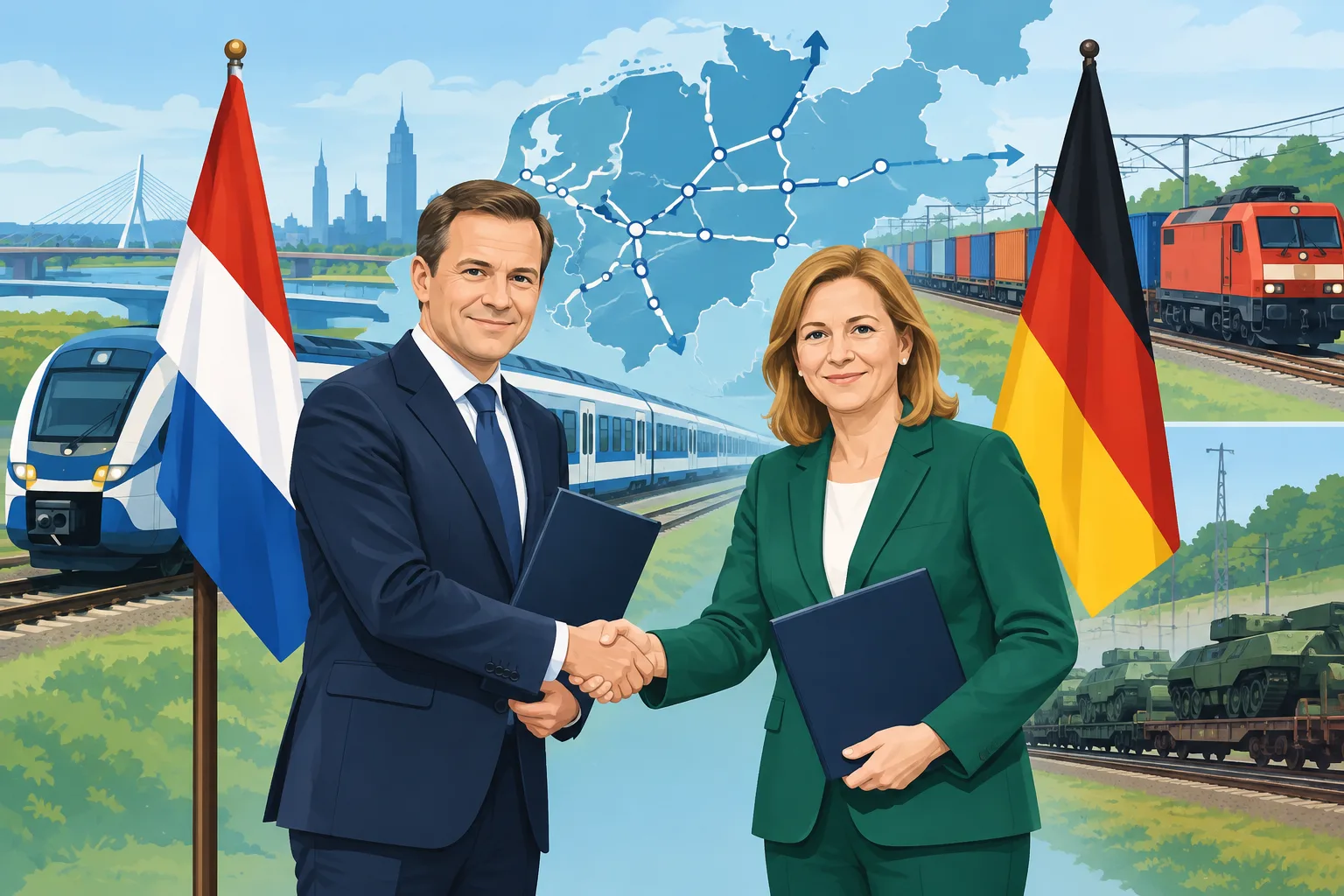
Netherlands and Germany agree to deepen cross-border rail cooperation
The Netherlands and Germany have agreed to deepen rail cooperation, targeting more cross-border trains, shorter journeys and improved freight links, including routes important for military transport.
Review information is loading.
The Netherlands and Germany have agreed to step up cooperation on rail, with plans to expand cross-border passenger and freight services, cut journey times and coordinate work on key routes. The countries also want to improve rail links used for military transport.
German transport minister Steffen Bilger and Dutch state secretary Annet Bertram signed a joint declaration in Berlin on 10 November. It sets out areas for closer cooperation; it does not itself specify when more trains will run or how much journey times will fall.
More services and faster journeys
The countries will focus on routes including Amsterdam–Hamburg, Amsterdam–Berlin and Amsterdam–Frankfurt, with onward connections to cities such as Copenhagen, Warsaw, Prague, Basel and Vienna. They also want to make it easier for new rail operators to enter the international market, which the Dutch government says could increase competition in passenger and freight services.
The declaration covers four cross-border rail projects. One is improving the German connection to the Betuweroute, the freight corridor linking the port of Rotterdam with Germany’s Ruhr region. The plan includes expanding capacity between Emmerich and Oberhausen.
The other routes under consideration are Venlo–Kaldenkirchen–Viersen, the Bad Bentheim–Oldenzaal border crossing, and Bremen–Oldenburg–Groningen–Amsterdam. The last could support the Wunderline and a possible extension of the proposed Lelylijn into Germany; that extension is an option, not a settled plan.
Freight and military mobility
The two governments also want closer technical cooperation, including on the European Rail Traffic Management System, and to make it easier for 740-metre trains to operate. Longer trains can help move military equipment, the Dutch government said. Both countries serve as transit routes for military materiel in Europe.
Around 45,000 freight trains cross the Dutch-German border each year, according to the government announcement. Officials will meet annually with infrastructure managers ProRail and DB InfraGo, while working groups develop the declaration’s proposals. The governments say the aim is to turn them into concrete results as soon as possible.
The agreement builds on rail-freight cooperation begun in 2019. Regional cross-border services have also recently advanced, including the reopening of the Wunderline between Groningen and Leer; services between Coevorden and Bad Bentheim are due to start in December, the announcement said.
Sign in to give this article a thumbs up or down.
About this discussion and AI questions
Private test discussion. Comments are readers’ views and are not yet automatically fact-checked. Editing is available for 60 seconds after posting.
Sign in with a confirmed reader account and choose a username to read comments and participate.
Sorting applies to top-level comments; replies remain oldest first. New comments and likes can change the order. Refresh for the current ranking.
Loading comments…