Nvidia and AI stock falls raise questions about US growth and recession risk
A sustained fall in AI shares could weaken US growth through household spending and credit. Economists say the scale of the effect is difficult to predict.
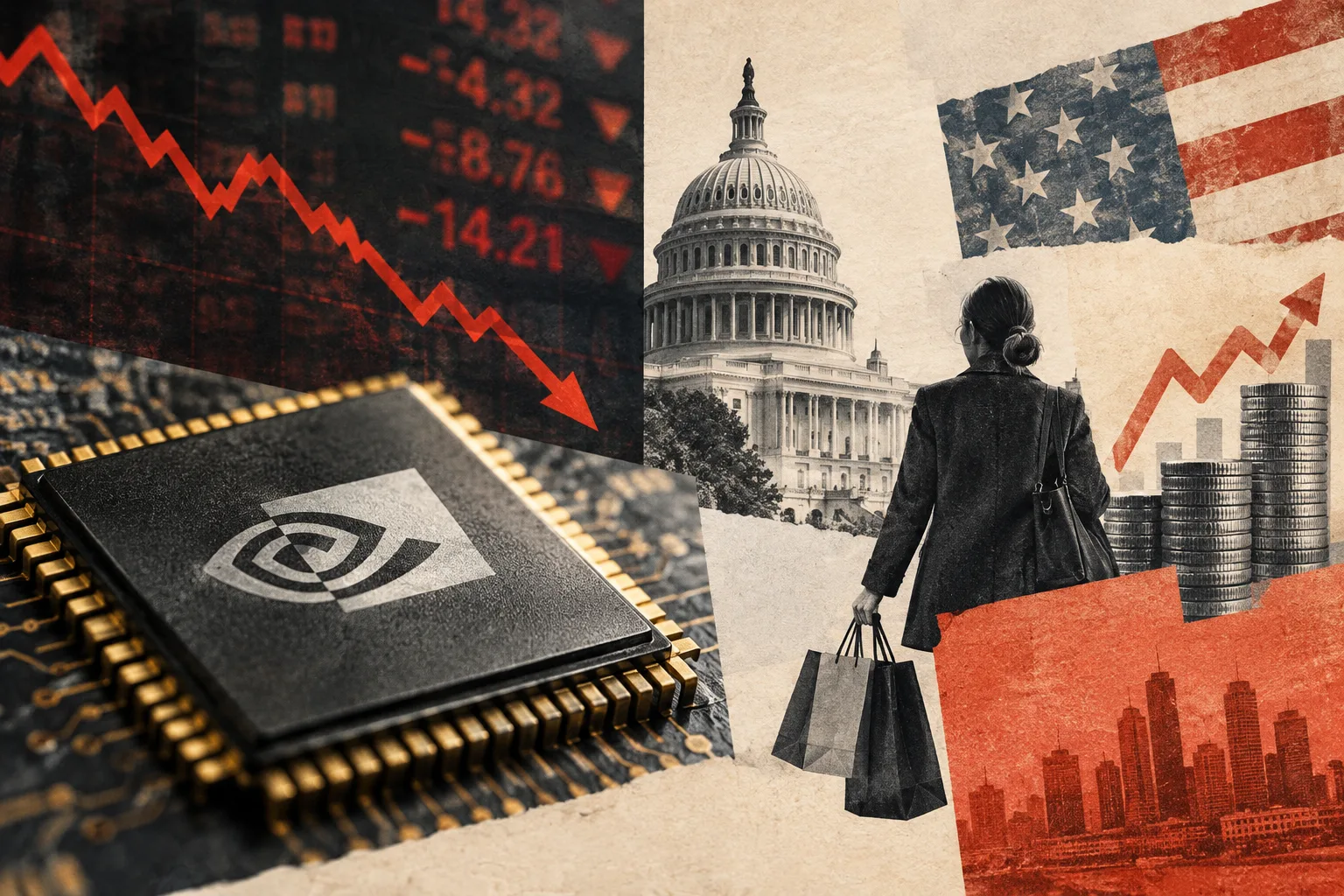
A sell-off in Nvidia and other AI-related shares has raised concerns about the US economy, but a slowdown in AI investment alone would not cause a recession, an economist at RSM US has told CNN.
Joe Brusuelas, chief economist at RSM US, told CNN that a slowdown in AI investment alone would not lead to a recession. Such a scenario would also require a financial market event, he said.
One concern is that sustained stock market losses could leave wealthier households feeling poorer and less willing to spend. But the effect on growth is hard to quantify, and the available spending and investment figures do not establish how large a market fall would need to be to trigger a recession.
CNN reported on 25 November that the Nasdaq was 14% below its record despite a 6% rise the preceding Monday, while the S&P 500 was more than 8% below its peak. Nvidia shares closed 4.3% lower on 12 November, having fallen as much as 14% during the session, U.S. Bank reported. The following day, the bank described its outlook for the wider economy and markets as constructive despite uncertainty at the chipmaker.
Spending and the wealth effect
US consumer spending grew at an annualised pace of 3.8% in the third quarter of 2026, CNN reported, citing the Bureau of Economic Analysis. Higher earners account for a substantial share of spending, although estimates of how much that share has changed require care.
CNN reported that RSM economists estimated the top 40% of earners accounted for $15.7 trillion in spending through September, compared with $6.7 trillion for middle- and lower-income Americans. Those figures imply a share of about 70% for the top group. CNN compared that with 61% in 2025, but the methods behind the figures, including whether the years use the same measure, are unclear.
A calculation from the US Bureau of Labor Statistics’ consumer expenditure survey puts the highest 40% of consumer units by pre-tax income at about 61.2% of measured expenditure in 2025. That measure includes items such as pensions and insurance and is not necessarily comparable with RSM’s; it cannot establish whether the share rose in 2026.
Economist Pablo Duarte of the Flossbach von Storch Research Institute has also warned that falling AI-related share prices could weaken consumption, though he said the size of the effect was difficult to forecast.
Measuring AI investment
Duarte argues that the direct contribution of AI investment to growth is difficult to isolate: national accounts classify investment by the type of asset, not by whether it is used for AI.
In an August analysis, he estimated that broad measures of AI-related investment contributed 0.45 to 0.94 percentage points to US real GDP growth of 2.1% over the year to the second quarter of 2026. Those gross figures are not adjusted for imports and include assets used for other purposes.
Duarte calculated that, if the entire negative contribution of net hardware imports were set against hardware investment, the combined contribution of hardware and software would fall from 0.70 to 0.14 percentage points. He said the true figure probably lay between the gross and fully adjusted estimates.
There are other ways an AI downturn could spread. Concerns about financing at data-centre operator CoreWeave drew market attention in October. In June, the Bank for International Settlements warned that disappointing returns could cause AI financing to retreat, while a sharp repricing of shares could also lead to tighter credit conditions more broadly.
Sign in to give this article a thumbs up or down.
From the discussion
Private test discussion. Comments are readers’ views and are not yet automatically fact-checked. Editing is available for 60 seconds after posting.
Sign in with a confirmed reader account and choose a username to read comments and participate.
Sorting applies to top-level comments; replies remain oldest first. New comments and likes can change the order. Refresh for the current ranking.
Loading comments…