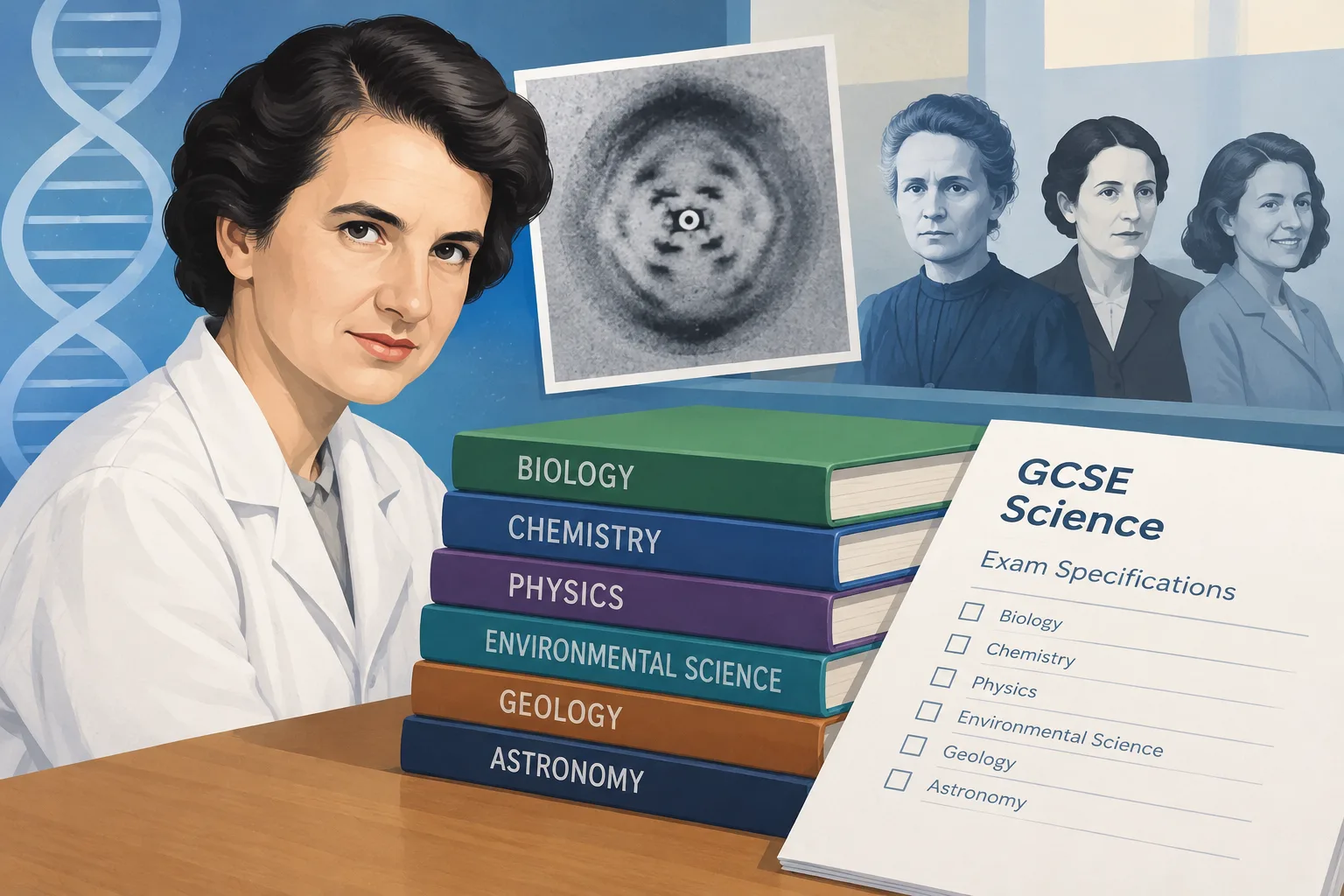
Rosalind Franklin is only woman named among 86 scientists in GCSE science specifications, study finds
A Cambridge study found that Rosalind Franklin is the only woman named among 86 scientists in UK GCSE and equivalent science exam specifications. Researchers say women’s contributions are often omitted, while exam bodies and governments point to upcoming opportunities to address representation.
Review information is loading.
Rosalind Franklin is the only woman among 86 scientists named in UK GCSE and equivalent science exam specifications, according to a University of Cambridge study. Researchers say the figures highlight how women’s contributions to science are often left unacknowledged in the qualifications students study.
The study examined specifications for biology, chemistry, physics, environmental science, geology and astronomy across six UK exam boards. At Key Stage 5 and equivalent, women accounted for three of the 181 named scientists: Franklin, American cartographer Marie Tharp and Danish seismologist Inge Lehmann.
Exam specifications set out what students are expected to learn and how their knowledge will be assessed. Franklin, a chemist and crystallographer, is named in Cambridge OCR GCSE Biology and Scottish Higher Biology. Her X-ray diffraction work helped reveal DNA’s structure, but she died in 1958, before the 1962 Nobel Prize for the discovery was awarded to Francis Crick, James Watson and Maurice Wilkins.
The researchers found that women had made contributions to several scientific breakthroughs included in the specifications without being explicitly named. Their paper, published in the British Educational Research Journal, says the curricula reflect a historical imbalance in whose work is recognised.
The academics recommend naming Franklin in all specifications that teach DNA structure. They also suggest including figures such as Marie Curie, who discovered radium and polonium, and nuclear physicist Lise Meitner, whose work contributed to the discovery of nuclear fission.
Study co-author Stephanie Buttigieg said relatable role models could help girls feel they belong in science and encourage positive attitudes towards scientific careers.
The Joint Council for Qualifications, which represents five of the exam boards, said there was “a clear need for greater representation in science qualifications” and that this would be considered as qualifications are reformed. Qualifications Scotland said its curriculum review offered an opportunity to consider gender representation.
The Department for Education in England said girls should see women’s contributions to science, while the Scottish Government said it would consider the study’s findings and was committed to closing the gender gap in STEM.
Sign in to give this article a thumbs up or down.
About this discussion and AI questions
Private test discussion. Comments are readers’ views and are not yet automatically fact-checked. Editing is available for 60 seconds after posting.
Sign in with a confirmed reader account and choose a username to read comments and participate.
Sorting applies to top-level comments; replies remain oldest first. New comments and likes can change the order. Refresh for the current ranking.
Loading comments…