Technology outages revive fears of William Gibson’s ‘jackpot’ collapse
A series of technology outages has revived discussion of William Gibson’s “jackpot”: a gradual collapse caused by intersecting crises. Researchers differ on whether the disruptions signal that kind of danger, while warning that interconnected infrastructure has vulnerabilities.
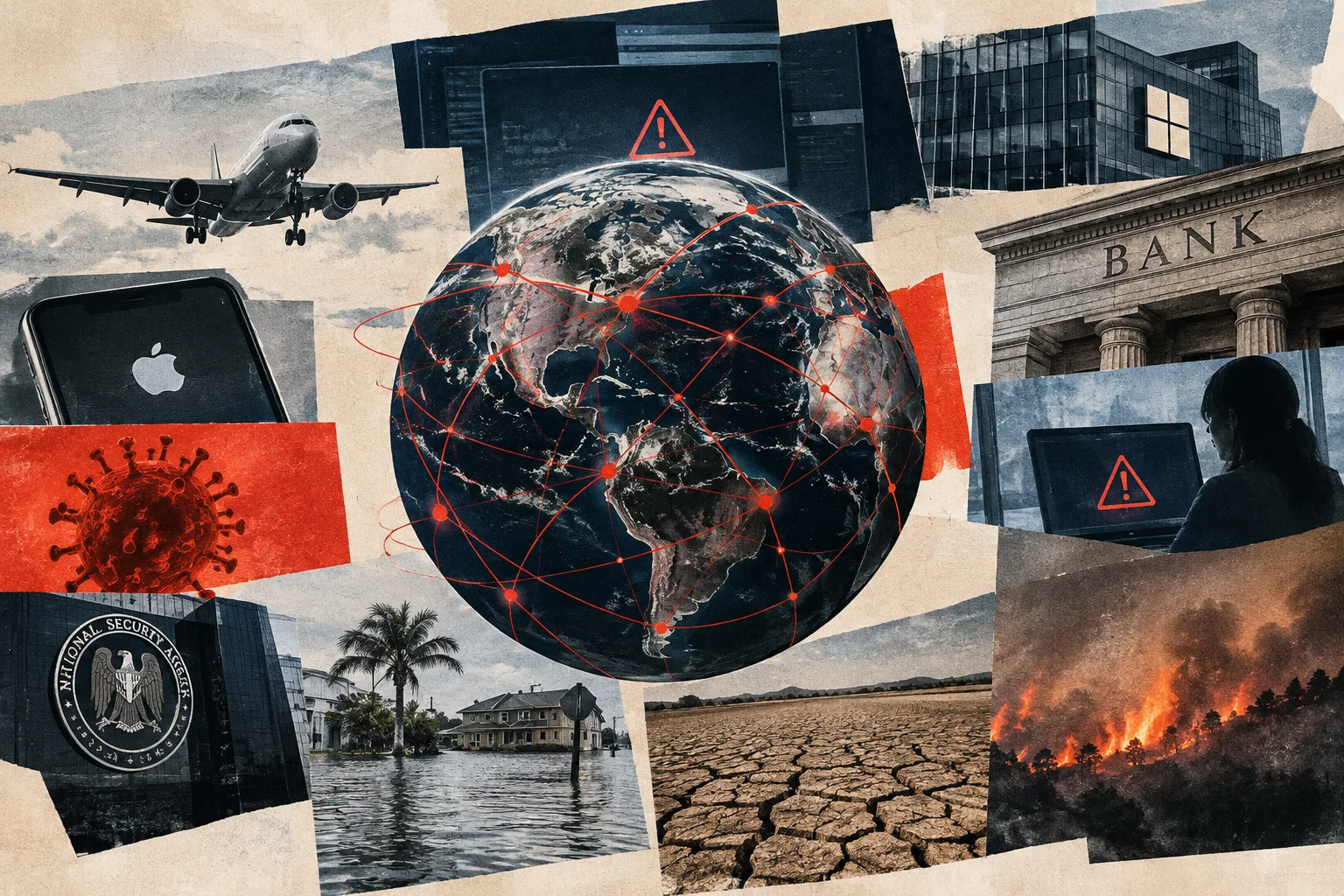
A week of technology outages and other disruptions has prompted renewed talk of “the jackpot” — science-fiction writer William Gibson’s term for a gradual collapse driven by multiple crises. Experts quoted by CNN disagree on whether the recent events point to such a danger, but say they expose vulnerabilities in interconnected systems.
CNN reports that failures affected Microsoft services, the US Federal Aviation Administration, Workday, Chase Bank, United Airlines, the National Security Agency’s internal communications system and Apple. The outages followed one another, but the article does not establish that they shared a cause. It also describes flooding in Florida, the loss of US measles-elimination status and environmental pressures including drought and wildfires.
Gibson introduced “the jackpot” in his 2014 novel *The Peripheral*. In the story, humanity is devastated not by one sudden catastrophe but by overlapping environmental, economic and political crises unfolding over time.
Luke Kemp, a researcher of existential risk, told CNN that society could be in an ongoing, gradual unravelling, but that it is difficult to recognise such a process while it is happening. He described collapse as the fragmentation or contraction of power structures, which can bring both costs and benefits.
Kemp said modern crises can compound one another, while the world’s interconnected infrastructure may allow a major shock to spread widely. He pointed to disruption from Microsoft’s Outlook outage as evidence of reliance on a small number of technology companies, raising questions, in his view, about national sovereignty.
Zachary Kallenborn, who studies global catastrophic risk, was more cautious: he said the outages reflected public anxieties more than existential danger. Digital infrastructure vulnerabilities deserve attention, he said, but whether they could bring about civilisational collapse depends on how collapse is defined. He also noted that the world’s different levels of connection and isolation may provide some resilience.
Daniel Holz, chair of the Bulletin of the Atomic Scientists’ Science and Security Board, said the outages were not necessarily evidence of anything nefarious, but showed that global infrastructure needs investment and attention. The board’s Doomsday Clock is set at 85 seconds to midnight, its closest position since it was created in 1947. Holz warned that the risks to humanity may include forms of catastrophe not yet anticipated.
Sign in to give this article a thumbs up or down.
From the discussion
Private test discussion. Comments are readers’ views and are not yet automatically fact-checked. Editing is available for 60 seconds after posting.
Sign in with a confirmed reader account and choose a username to read comments and participate.
Sorting applies to top-level comments; replies remain oldest first. New comments and likes can change the order. Refresh for the current ranking.
Loading comments…