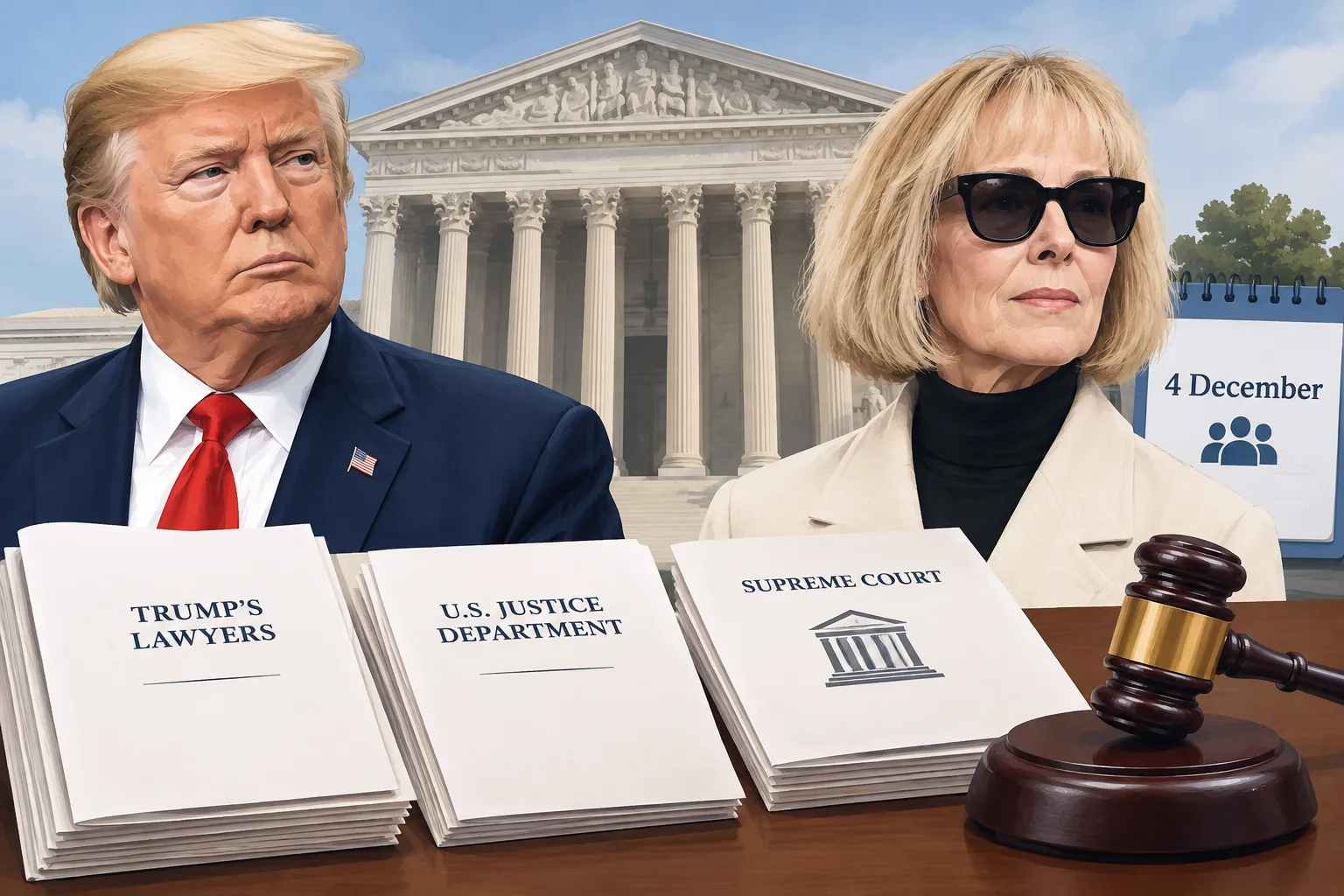
Trump and Justice Department seek Supreme Court review of $83.3m Carroll judgment
The court has scheduled the requests for a private conference on 4 December, but has not decided whether to hear them.
Review information is loading.
Donald Trump’s lawyers and the US Justice Department have submitted separate final briefs urging the Supreme Court to review an $83.3 million defamation judgment in favour of writer E. Jean Carroll.
The requests concern statements Trump made about Carroll in 2019, during his first term as president. His lawyers say presidential immunity should protect him from liability; the Justice Department wants the government to take his place as the defendant.
The justices have scheduled the requests for a private conference on 4 December. They have not decided whether to hear either case, and the conference is not a promised decision date.
Carroll sued after Trump denied sexually assaulting her and accused her of fabricating her account. A jury awarded her $83.3 million in January 2024: $18.3 million in compensatory damages and $65 million in punitive damages. A federal appeals court upheld the award in September 2025.
A separate civil case went to trial first, in 2023. In that case, a jury found Trump liable for sexually abusing Carroll in 1996 and defaming her in 2022, and awarded her $5 million. The Supreme Court has already declined to review that verdict.
In their new brief, Trump’s lawyers argue that his 2019 statements were protected by presidential immunity and that he never expressly gave up that protection. Carroll’s lawyers say he raised the immunity defence too late, and separately waited too long to advance his argument about the standard for giving it up.
The Justice Department argues that Trump was acting within the scope of his office and that the Westfall Act allows the government to replace him as defendant even after trial. Carroll disputes both points. The appeals court has said that successful substitution would end her defamation claim because federal law excludes such claims against the United States.
The department first supported substitution in 2020. In 2023, after a court clarified the legal test and new evidence emerged, it declined to certify again that Trump had acted within his official duties. Trump and the government renewed their substitution request in 2025, after the damages trial.
The appeals court rejected that request as too late and saw no reason to revisit its earlier ruling that Trump had waived his immunity defence. It declined to rehear the case in April 2026, although Judge Steven Menashi dissented and argued for another hearing.
Sign in to give this article a thumbs up or down.
About this discussion and AI questions
Private test discussion. Comments are readers’ views and are not yet automatically fact-checked. Editing is available for 60 seconds after posting.
Sign in with a confirmed reader account and choose a username to read comments and participate.
Sorting applies to top-level comments; replies remain oldest first. New comments and likes can change the order. Refresh for the current ranking.
Loading comments…