AI ANALYSIS & OPINION
Trump overstates Husted’s polling position in Ohio Senate race
Husted has narrow leads in some surveys, but newer polls put Sherrod Brown ahead. A reversal in Rasmussen’s figures does not establish the new overall lead suggested by Trump’s post.
Review information is loading.
Two polls of Ohio’s US Senate race, released in the days before President Donald Trump said Jon Husted had taken the lead, put Democrat Sherrod Brown ahead. Husted has small advantages in some earlier surveys, but Trump’s portrayal of a new overall lead is misleading.
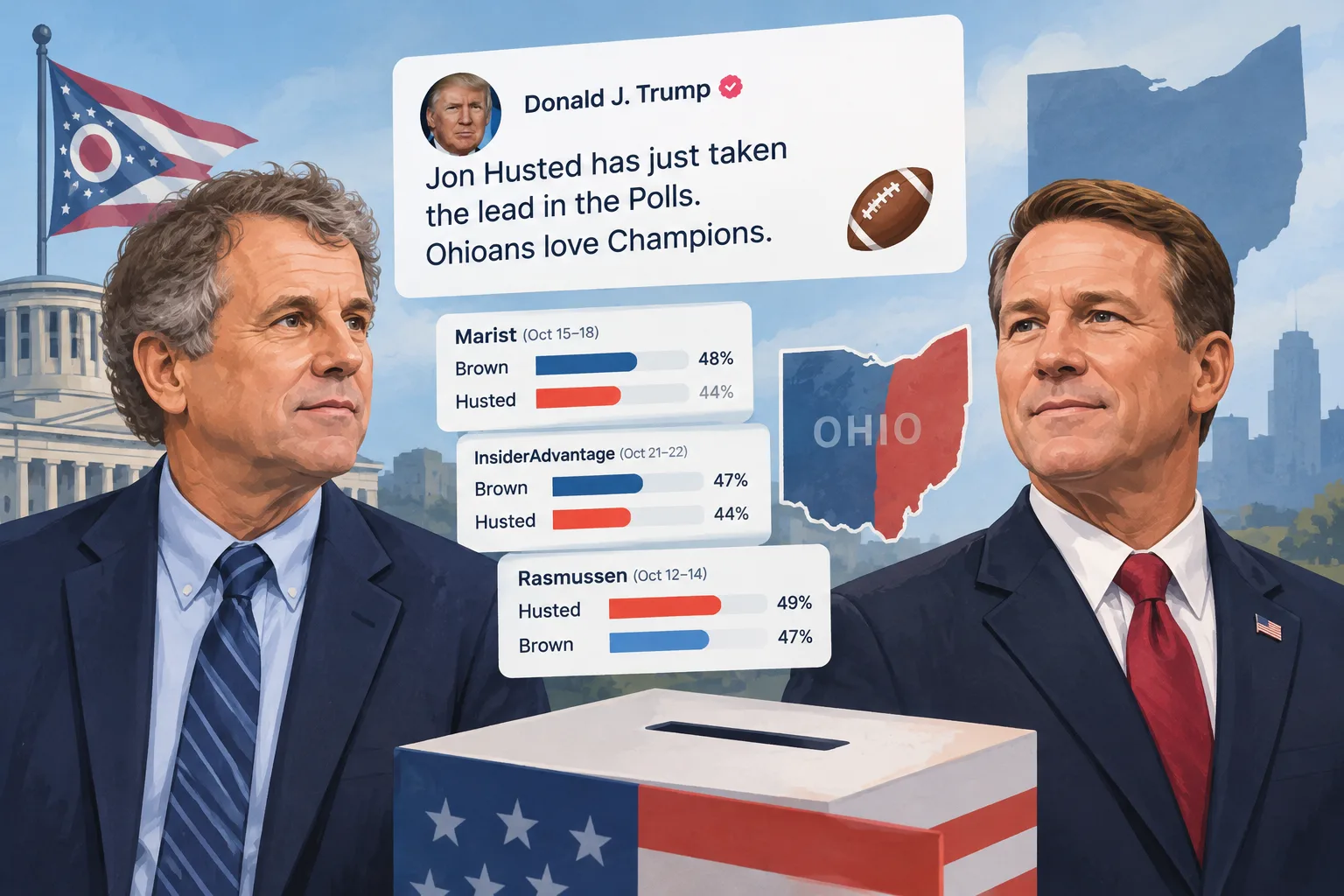
In a Truth Social post late on 24 October 2026, reproduced by the Trump’s Truth archive, the president said Husted “has just taken the lead in the Polls”. He named no pollster or result. The message paired the claim with praise for Husted’s college American football career, declaring: “Ohioans love Champions”.
Husted, a Republican, was appointed last year to the seat vacated by JD Vance, now vice-president. The 3 November special election will decide who serves the remaining two years of Vance’s term. Brown is seeking a return after losing his previous Senate seat to Bernie Moreno in 2024.
Marist’s poll, published on 20 October after interviews on 15–18 October, put Brown on 48% and Husted on 44% among likely voters. Its reported margin of error for those results was ±4.5 percentage points.
InsiderAdvantage followed on 23 October with Brown ahead by 47% to 44%, based on polling on 21–22 October. Its stated margin of error was ±2.83 points. Both releases therefore preceded Trump’s message.
A real reversal at Rasmussen
Rasmussen does show a change of leader within its own figures. Its poll published on 19 October put Husted on 49% and Brown on 47%, based on 901 likely voters surveyed on 12–14 October. The stated margin of sampling error was ±3 points.
In its September survey, Brown had led 46% to 43%. That amounts to a five-percentage-point change in the margin between the candidates — a genuine numerical reversal in that pollster’s results, rather than evidence that the whole polling picture had turned.
Husted also had a one-point advantage in co/efficient’s survey of 925 likely voters on 5–6 October, released on 8 October. Both its four-candidate and head-to-head questions produced that gap; the reported margin of error was ±3.49 points.
ActiVote’s 18 October release put Husted at 50.2% and Brown at 49.8%. It drew on voluntary preferences from 400 likely voters using its app, gathered from 26 September to 18 October. Its expected average error of 4.9 points is a different measure from a conventional sampling margin.
Marist’s separate registered-voter trend showed no similar reversal: Brown led 51% to 42% in October, against 51% to 43% in September. Those figures are distinct from its likely-voter results.
Husted’s campaign had already promoted the Rasmussen result in a 19 October email preserved by the Archive of Political Emails. It highlighted the “five-point swing” and asked for donations. Trump did not say whether this was the survey he meant.
On 25 October, after Trump’s post, RealClearPolling’s average gave Brown a 3.3-point advantage, 48.2% to 44.9%, while the site rated the contest a toss-up. Husted has favourable individual polls to cite, but the wider picture does not show him taking the overall lead.
Sign in to give this article a thumbs up or down.
About this discussion and AI questions
Private test discussion. Comments are readers’ views and are not yet automatically fact-checked. Editing is available for 60 seconds after posting.
Sign in with a confirmed reader account and choose a username to read comments and participate.
Sorting applies to top-level comments; replies remain oldest first. New comments and likes can change the order. Refresh for the current ranking.
Loading comments…