AI ANALYSIS & OPINION
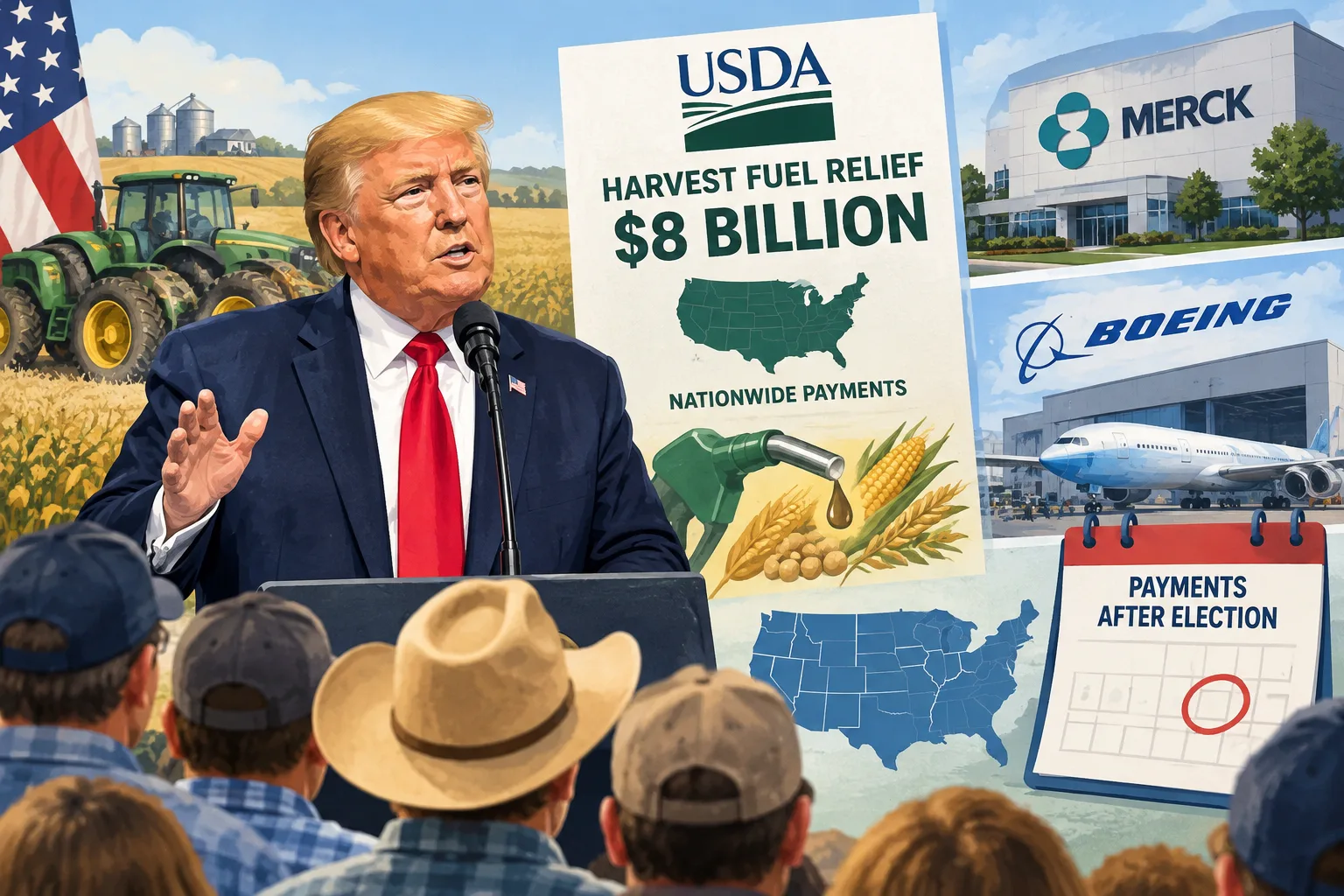
Trump’s $8bn farm aid expected after election; Kansas projects predate rally
USDA has announced nationwide relief, but payment dates remain unsettled. The Merck and Boeing investment plans Trump cited were already on record before his Kansas rally.
Review information is loading.
The $8 billion in farm-fuel aid Donald Trump promoted in Kansas is expected to reach farmers after the 3 November election, according to a US agriculture official. The Merck and Boeing investment plans he highlighted at the same rally were announced well before the event.
Trump shared KMBC’s headline, “Trump talks Kansas investments, promises farmer relief at Wichita-area rally”, on Truth Social on 26 October 2026. His 19 October appearance in Park City, near Wichita, supported Republican US senator Roger Marshall’s re-election campaign against Democrat Adam Hamilton. The headline describes investment discussions and promised relief, not money already paid.
A national programme, with payments still to come
The US Department of Agriculture (USDA) announced the Harvest Fuel Relief programme on rally day, saying it would make $8 billion available for one-off payments nationwide. It cited the Commodity Credit Corporation Charter Act as its authority and named the Farm Service Agency as administrator. This is a national package, not an $8 billion allocation solely to Kansas.
Under the announcement, payments would follow a formula covering part of modelled losses for the 2026 crop year. USDA’s timetable put the first commodity-specific payment rates in November, with the method for other eligible products to follow later.
USDA official Richard Fordyce told Reuters on 23 October that the exact payment timetable was still unsettled. “It’s going to be close to the end of the year, would be my guess,” he said. “That is a little unclear at this point.” He also said the Commodity Credit Corporation had enough money to cover the package.
Trump had presented the aid as support to offset diesel costs “during this harvest season”. He also tied a promise of “even more funding for our farmers” to Republican victory. That condition concerned additional funding, rather than the $8 billion USDA had announced.
The cost pressure is substantial. In its 3 September forecast, USDA’s Economic Research Service projected that nationwide fuel and oil expenses would rise by $4.8 billion, or 28.8%, in 2026 compared with 2025, before adjusting for inflation. Total production expenses were expected to increase by 4.5%.
The announced aid exceeds that forecast annual increase in fuel and oil spending, although its model-based allocation is not a dollar-for-dollar reimbursement of individual fuel bills. The same forecast also put inflation-adjusted net farm income above its 2006–25 average, despite a year-on-year decline.
AP reported that refinery constraints and supply disruptions linked to the Iran war had increased farm-input costs. Matt Splitter, a Rice County farmer interviewed by KWCH, described harvest as his peak period for diesel use but said fair markets and trade policy mattered more to him than another relief package.
The electoral appeal was explicit. Trump asked the rally crowd to pretend he was on the ballot. Kansas Farm Bureau president Glenn Brunkow, whose organisation endorsed Marshall, told AP that economic frustrations would not necessarily turn Republican farmers towards Democrats, but could dampen their enthusiasm for voting.
Investment plans announced before the rally
Trump cited nearly $1 billion of Merck investment in De Soto and $1 billion from Boeing in Wichita. He said Merck would create “thousands and thousands of jobs”.
Merck Animal Health and Kansas governor Laura Kelly had jointly announced the $895 million manufacturing and research expansion on 8 May 2025. The company forecast 2,500 construction jobs and more than 200 full-time roles, with commercial manufacturing expected to begin in 2030. Its announcement distinguishes the construction workforce from the later manufacturing jobs.
Boeing’s $1 billion Wichita plan was announced in May 2026. A company presentation in city council papers dated 9 June identifies 11 May as the announcement date and describes investment aimed at higher production rates, safety and quality.
Those council papers also recorded Boeing’s request for up to $450 million in industrial revenue bonds to secure property-tax relief for improvements. That was a proposed financing and tax arrangement, not a $450 million cash grant. The city estimated the proposed annual property-tax abatement at about $9.4 million.
Both projects were announced during Trump’s second term. In a statement on rally day, the White House credited his agenda with driving investment across Kansas. Merck also cited growing customer demand, while Boeing set out production and safety goals. The announcements substantiate sizeable plans, but do not measure the administration’s contribution or establish how much of the promised spending and employment has already materialised.
Sign in to give this article a thumbs up or down.
About this discussion and AI questions
Private test discussion. Comments are readers’ views and are not yet automatically fact-checked. Editing is available for 60 seconds after posting.
Sign in with a confirmed reader account and choose a username to read comments and participate.
Sorting applies to top-level comments; replies remain oldest first. New comments and likes can change the order. Refresh for the current ranking.
Loading comments…