AI ANALYSIS & OPINION
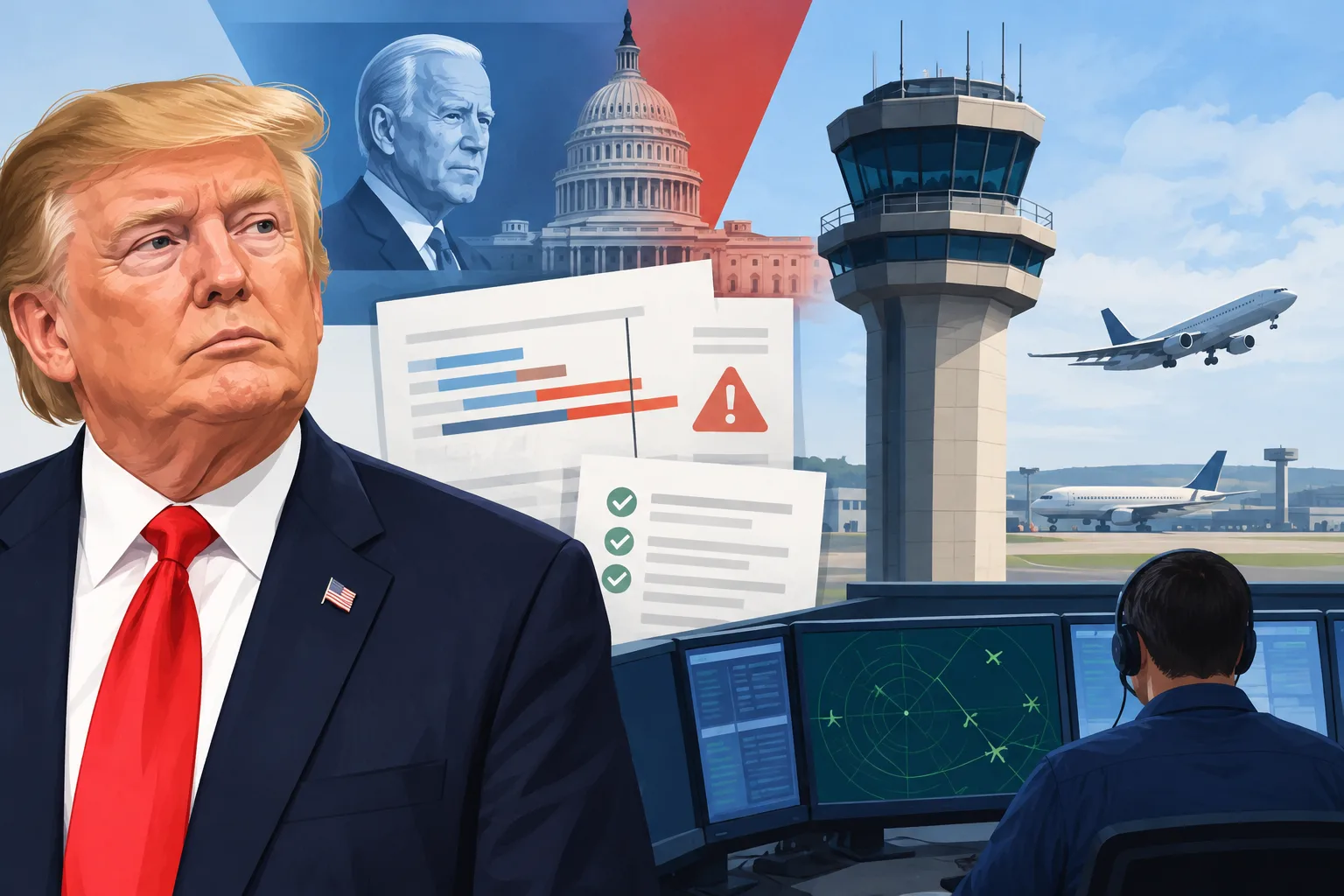
Trump’s claim that Biden set back US air traffic control overhaul lacks support
The president wants Congress to fund a rebuild after a nationwide ground stop. Records show missed targets under Biden, but also earlier delays and work during his term.
Review information is loading.
Donald Trump’s claim that Joe Biden’s administration set the US air traffic control overhaul back by years is not substantiated by government audits. They document missed targets during Biden’s term, but also delays before he took office and continued investment under his presidency.
Trump made the claim on Truth Social on Sunday 15 November, calling on Congress to approve funding and saying the system could then be built “quickly and efficiently”. His appeal followed a nationwide ground stop on Friday that lasted more than four hours and disrupted thousands of flights.
Transport Secretary Sean Duffy said contractor L3Harris had been switching communications lines from copper to fibre when the problem occurred. Investigators were examining whether a faulty router or an installation error was responsible. Bryan Bedford, head of the Federal Aviation Administration (FAA), said the work was routine maintenance on the old network, separate from the current $12.5 billion modernisation programme.
A backlog across administrations
The Government Accountability Office (GAO), Congress’s independent watchdog, reported that a satellite-navigation project covering Cleveland and Detroit was completed 26 months late in 2018. The FAA told auditors that the 2018–19 government shutdown, during Trump’s first term, had shifted some modernisation milestones by four to 18 months.
There were substantial delays under Biden too. A system replacing the paper flight strips controllers use to track flights went live at its first site in October 2022, two years late. By 2023, the FAA had cut the planned rollout from 89 airports to 49. Officials cited pandemic-related travel restrictions as a reason for the initial delay.
In 2022, the FAA said it had begun investing the first $1 billion of $5 billion set aside for air traffic facilities under Biden’s infrastructure law. But an independent safety review said in 2023 that the money was largely restricted to buildings and supporting infrastructure, not the modernisation of core radar and communications equipment. By May 2024, the GAO found, four of 17 critical systems it considered especially concerning had no associated modernisation investment under way.
Earlier on Sunday, Trump shared a Just the News article in a separate post, The Mirror reported via AOL. That article quoted the White House’s Rapid Response 47 account saying the Biden administration had done “absolutely nothing” to address air traffic control problems after a 2023 nationwide ground stop. That claim is false.
In March 2023, the FAA awarded Verizon a contract to replace its old telecommunications network. Congress also passed a law requiring a backup for the system that alerts pilots to hazards; the GAO says a backup was implemented in mid-2024.
The system’s age is nevertheless a real concern. Trump said much of it was 50 years old. In 2023, the safety review found that the buildings housing 21 control centres handling flights between airports were 56 to 64 years old, while 280 terminal radars were 25 to 50 years old. Those figures do not show what proportion of the overall system is roughly 50 years old.
Funding and the new plan
Congress appropriated around $12.5 billion for the current overhaul in 2025, including about $9 billion for system upgrades. Before Friday’s ground stop, Duffy and the White House had requested $30.1 billion for aviation infrastructure, including $10.1 billion for air traffic control, according to Reuters. After the outage, Duffy called for $50 billion in air traffic control funding. It is unclear how the requests overlap.
Duffy said on Saturday that 69 per cent of the FAA’s copper communications had been replaced with fibre and that 25 towers had electronic flight strips. The GAO found that at least 11 investments connected to the new plan were already under way before it was announced in May 2025. In the watchdog’s 2026 review, the programme’s first phase aimed to install electronic strips at 89 airports.
The FAA awarded Peraton a contract to coordinate the first phase in December 2025, with a $1.5 billion ceiling. FAA officials told the GAO the negotiated price was about $876 million.
In a September report, the GAO praised initial progress but said that, as of mid-2026, the FAA lacked a reliable full cost estimate and an integrated schedule for the programme’s thousands of projects. It said a waiver of standard acquisition requirements had contributed to the incomplete estimate. The transport department disputed the GAO’s reading of the waiver and said it had developed estimates and schedules for phase one; auditors said the estimates omitted substantial costs and the projects were not properly linked.
The GAO warned that without better planning, the overhaul could repeat the cost overruns and delays that have plagued modernisation across administrations, long before Biden took office.
Sign in to give this article a thumbs up or down.
About this discussion and AI questions
Private test discussion. Comments are readers’ views and are not yet automatically fact-checked. Editing is available for 60 seconds after posting.
Sign in with a confirmed reader account and choose a username to read comments and participate.
Sorting applies to top-level comments; replies remain oldest first. New comments and likes can change the order. Refresh for the current ranking.
Loading comments…