Tunnels and chambers uncovered beneath Istanbul’s Hagia Sophia
A network of tunnels, chambers and water channels is being cleared beneath Istanbul’s Hagia Sophia. Work has exposed 420 metres of tunnels so far, while the full extent of the underground complex remains unknown.
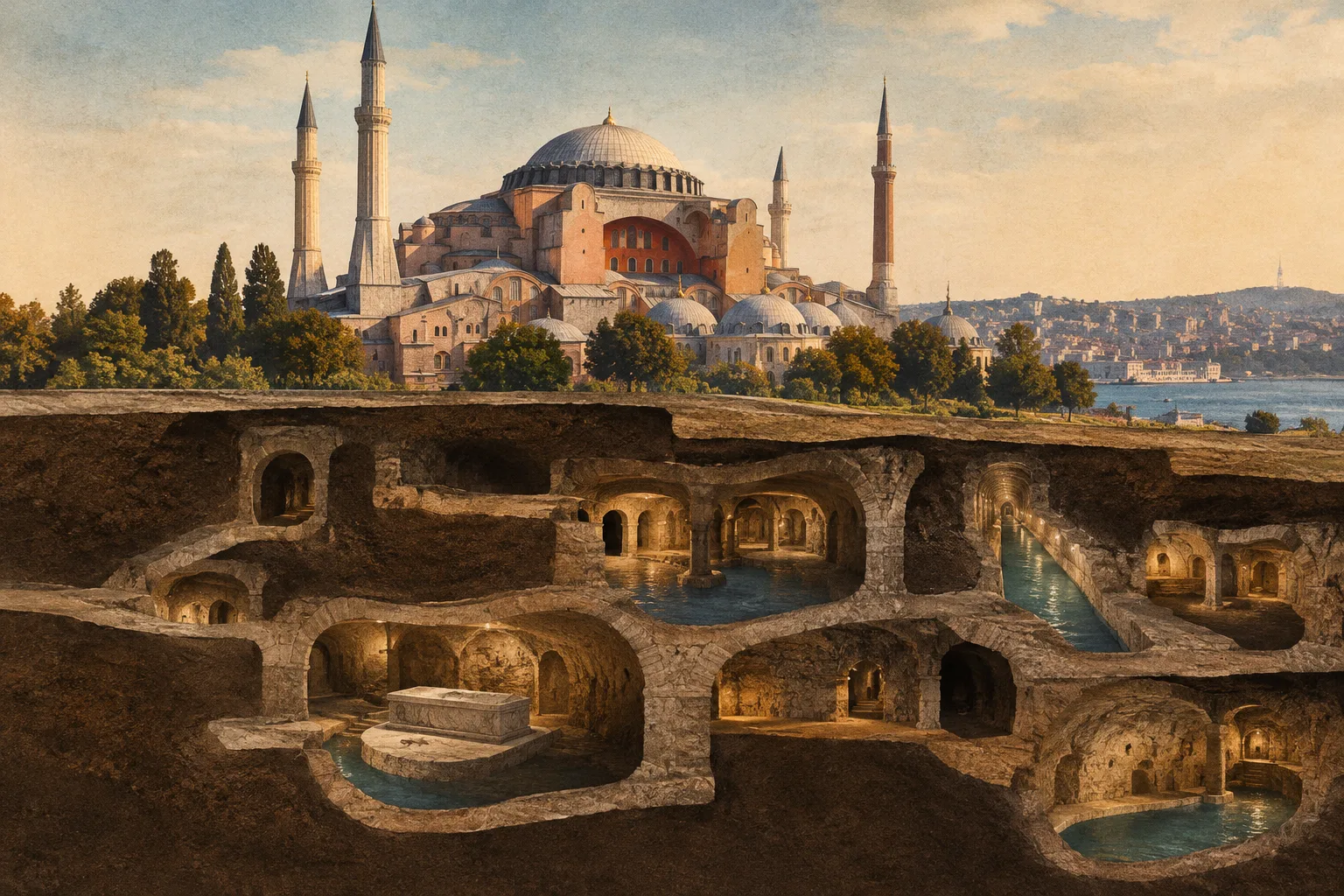
Workers have uncovered a network of tunnels, chambers and water channels beneath Istanbul’s Hagia Sophia, revealing more of the infrastructure below one of the city’s best-known landmarks.
Turkey’s Ministry of Culture and Tourism said sections of the underground network may be older than the present building, completed in 537. The discovery began during cleaning work in early 2025 in vaulted cellars beneath what was once the monument’s atrium courtyard.
Nearly 3,000 tonnes of debris have been removed so far, and 420 metres of tunnels cleared. The work has exposed six chambers connected by nine tunnels, alongside water channels, a burial structure and a passage believed to be linked to a fifth-century Roman street. The network may extend for several kilometres, but its full extent is not yet known.
The Hagia Sophia’s history stretches back beyond the current structure: the site was previously occupied by a Roman temple and two earlier churches. A Roman underground burial chamber was discovered there in the 1940s, while rumours of tunnels beneath the landmark have persisted for centuries.
Culture and Tourism Minister Mehmet Nuri Ersoy said the underground system had been used for water distribution and rainwater drainage. Researchers are documenting the spaces with laser scanning as conservation work continues. A restoration project that began in 2025 is also intended to strengthen the building against earthquakes.
The authorities hope to open suitable sections of the underground spaces to visitors, but have not announced a timetable. The active mosque’s ground-floor prayer hall is not open to sightseers; visitors can enter its upper gallery.
Sign in to give this article a thumbs up or down.
From the discussion
Private test discussion. Comments are readers’ views and are not yet automatically fact-checked. Editing is available for 60 seconds after posting.
Sign in with a confirmed reader account and choose a username to read comments and participate.
Sorting applies to top-level comments; replies remain oldest first. New comments and likes can change the order. Refresh for the current ranking.
Loading comments…