UK income tax thresholds to stay frozen until 2031
UK income tax thresholds will stay frozen until April 2031, meaning wage rises can push more income into tax or higher bands. They are then expected to rise with inflation.
Review information is loading.
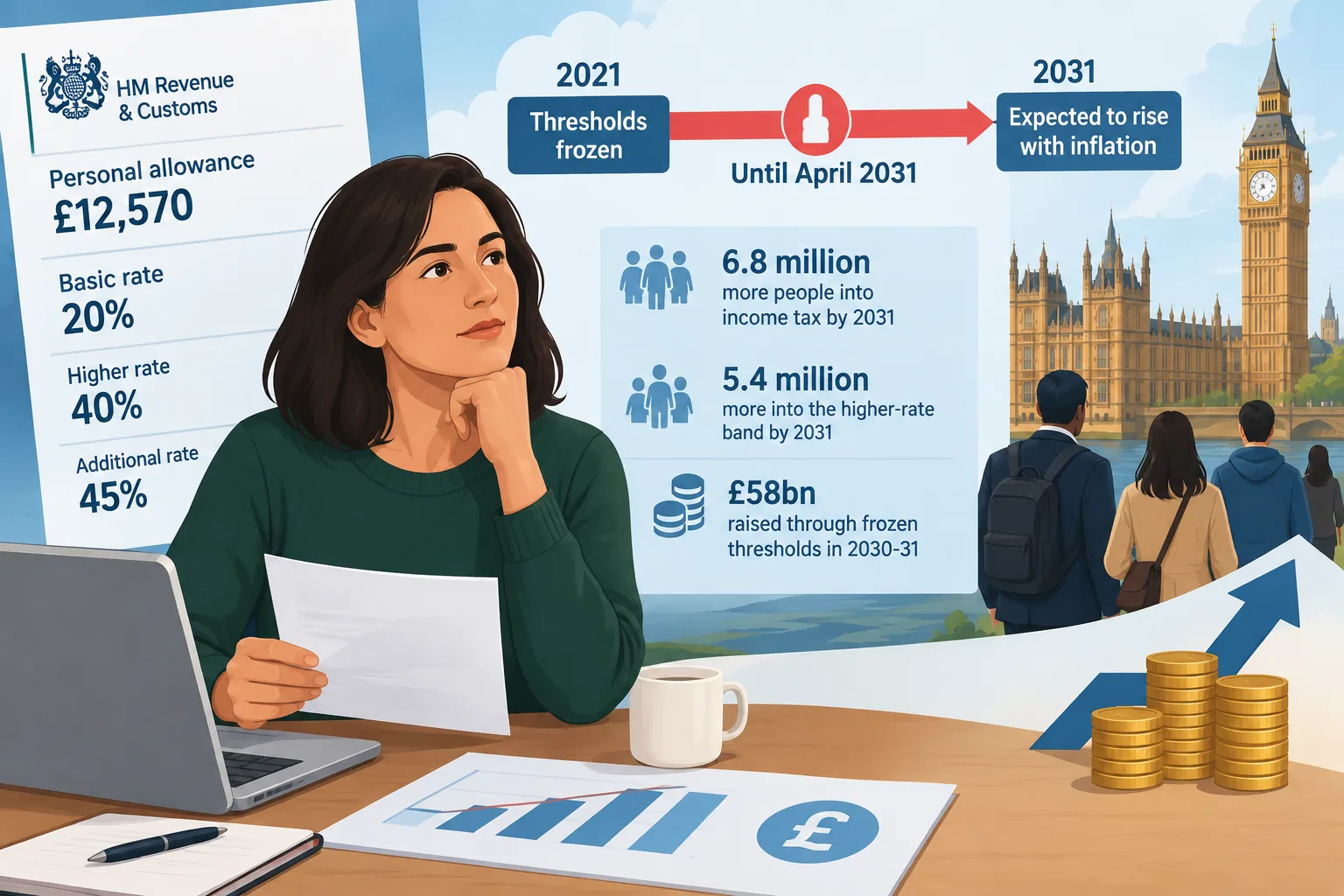
UK income tax thresholds will remain frozen until April 2031, after which they are expected to rise with inflation, according to documents from the Office for Budget Responsibility (OBR). The change means tax thresholds will stop pulling more people into higher tax bills as their wages rise — but not for another four years.
The freeze, introduced in 2021, keeps the personal allowance — the amount people can earn before paying income tax — at £12,570. As pay rises, more income is taxed and some people move into higher tax bands, even though the headline tax rates have not changed.
The OBR estimates that by 2031 the freeze will have brought 6.8 million more people into paying income tax and 5.4 million more into the higher-rate band. The BBC reports that the amount raised through frozen thresholds is expected to reach £58bn in 2030-31.
What it means for pay
If the personal allowance had risen with inflation over the past five years, it would now be about £16,070, the BBC reports. Instead, income above £12,570 is subject to the basic 20% rate. The higher-rate threshold is £50,271; the BBC says it would be £64,470 this year if it had risen with inflation.
The freeze affects people who receive pay rises and earn enough to pay tax, with the biggest impact on those near a threshold. The personal allowance applies across the UK, although Scotland has different income tax bands. National Insurance contributions are also levied using the same thresholds.
The OBR expects almost one in four taxpayers to pay some income tax at the higher rate by 2031. The additional 45% rate applies to income above £125,140.
The Institute for Fiscal Studies estimates that, if the personal allowance had been unfrozen this week, basic-rate taxpayers would have saved up to £198 a year and higher-rate taxpayers £395. For people in the middle of the earnings range, a National Insurance cut introduced in 2024 has offset some of the higher income tax bill, the BBC reports.
After April 2031, thresholds are expected to rise with inflation. The effect on individual tax bills will depend partly on how quickly wages rise by then.
Sign in to give this article a thumbs up or down.
From the discussion
Private test discussion. Comments are readers’ views and are not yet automatically fact-checked. Editing is available for 60 seconds after posting.
Sign in with a confirmed reader account and choose a username to read comments and participate.
Sorting applies to top-level comments; replies remain oldest first. New comments and likes can change the order. Refresh for the current ranking.
Loading comments…