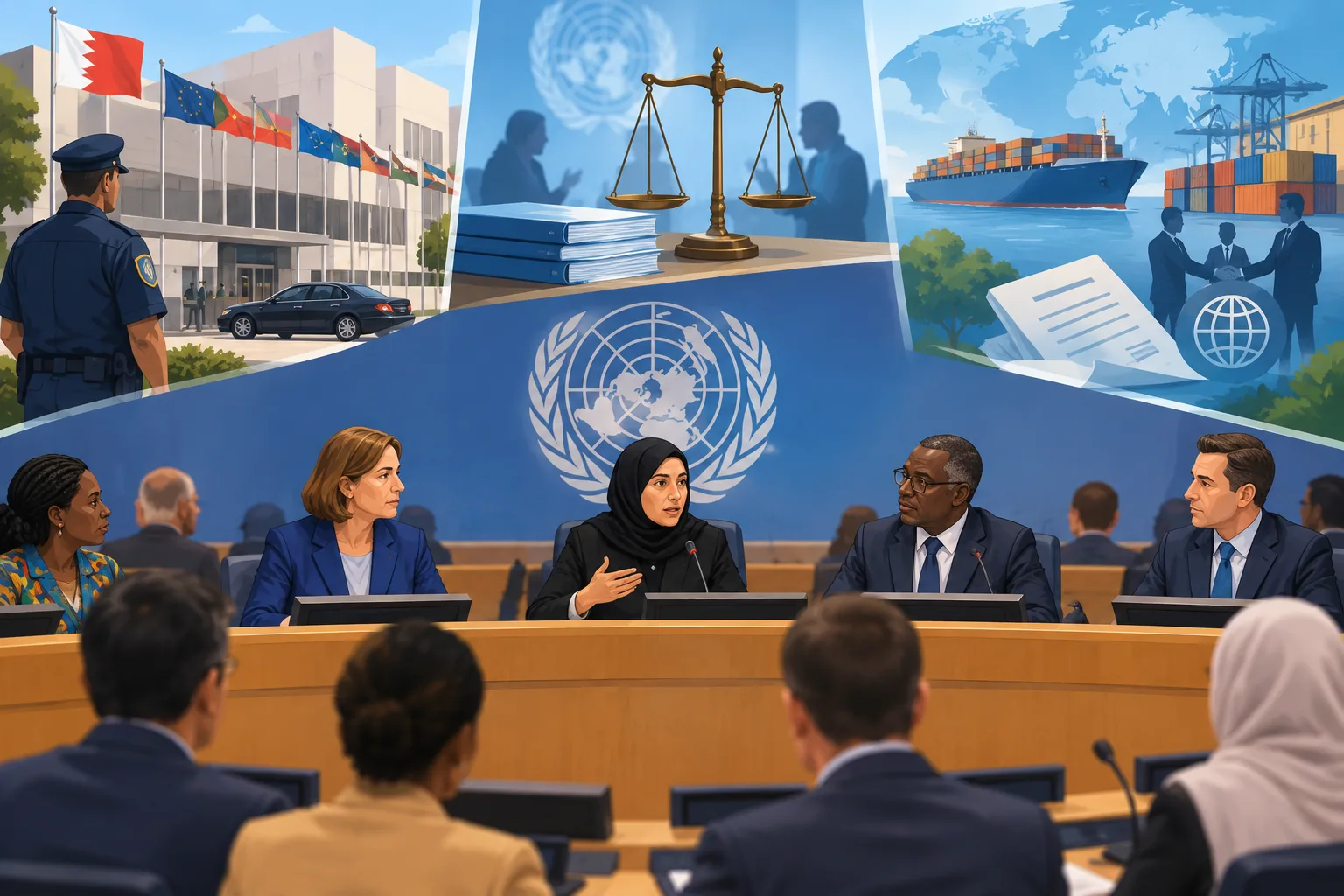
UN delegates call for stronger diplomatic protection and fairer trade rules
UN delegates called for stronger protection of diplomatic missions, faster and better-resourced internal justice, and trade rules that developing countries can use effectively.
Review information is loading.
The UN General Assembly’s Sixth Committee heard calls for stronger protection of diplomatic missions, a well-resourced internal justice system and more inclusive international trade rules during a wide-ranging debate on 20 October. The discussion brought together concerns about security, delays in resolving staff cases and the capacity of developing countries to shape and apply trade law. [1]
Speaking for the Gulf Cooperation Council, Bahrain’s representative said the central problem was not a lack of legal rules but weak enforcement. She cited cross-border attacks, cyberthreats and social-media incitement as risks to diplomats, and said the growing burden on host countries made respect for diplomatic rules essential.
The European Union’s representative said attacks on diplomatic premises remained unacceptable, including in armed conflicts, and urged host countries to assess risks continuously and take appropriate protective measures. Belgium’s representative said protection also required coordination among government, police, intelligence and security services, and an environment of trust for foreign officials to do their work.
Calls for timely and accessible UN justice
CARICOM’s representative said the UN’s internal justice system should be independent, impartial and accessible, with timely remedies. She welcomed the Office of the UN Ombudsman and Mediation Services’ work in 2025, when it handled 2,201 cases and conducted 127 mediations.
Zambia’s representative said the UN’s liquidity crisis had contributed to poorer representation and delays in disposing of cases. He warned that budget constraints would continue to hamper the administration of justice in 2027 and backed a recommendation to provide adequate resources to the Ombudsman’s office.
The United States supported informal dispute resolution, saying it saved staff time and money. Its representative also backed the Internal Justice Council’s recommendation against further consideration of a judicial mediation mechanism, including as a pilot, and stressed the importance of timely decisions.
Trade rules and developing countries
The committee also discussed the work of the UN Commission on International Trade Law (UNCITRAL). Panama’s representative said harmonising trade law should encourage cooperation without undermining states’ autonomy. He called for dispute-settlement reform that protects investors’ legitimate rights while safeguarding decision-makers’ independence and impartiality, and said a planned advisory centre could help address differences in legal and institutional capacity.
Haiti’s representative urged UNCITRAL to take account of developing countries’ limited institutional, technical and financial resources. Shared rules, he said, should help states understand and implement them and benefit from them while respecting national priorities. He also called for reform of investor-state dispute resolution.
Representatives welcomed UNCITRAL work on investment dispute proceedings, electronic arbitration and paperless trade. Indonesia’s representative said a UN convention on negotiable cargo documents was due to open for signature in Accra and could support connectivity, logistics and trade financing. Japan, Singapore and Russia highlighted other work on digital dispute resolution, electronic arbitration and legal frameworks for paperless trade. [1]
Sign in to give this article a thumbs up or down.
About this discussion and AI questions
Private test discussion. Comments are readers’ views and are not yet automatically fact-checked. Editing is available for 60 seconds after posting.
Sign in with a confirmed reader account and choose a username to read comments and participate.
Sorting applies to top-level comments; replies remain oldest first. New comments and likes can change the order. Refresh for the current ranking.
Loading comments…