US announces AI chip access curbs ahead of Trump-Xi talks in Shenzhen
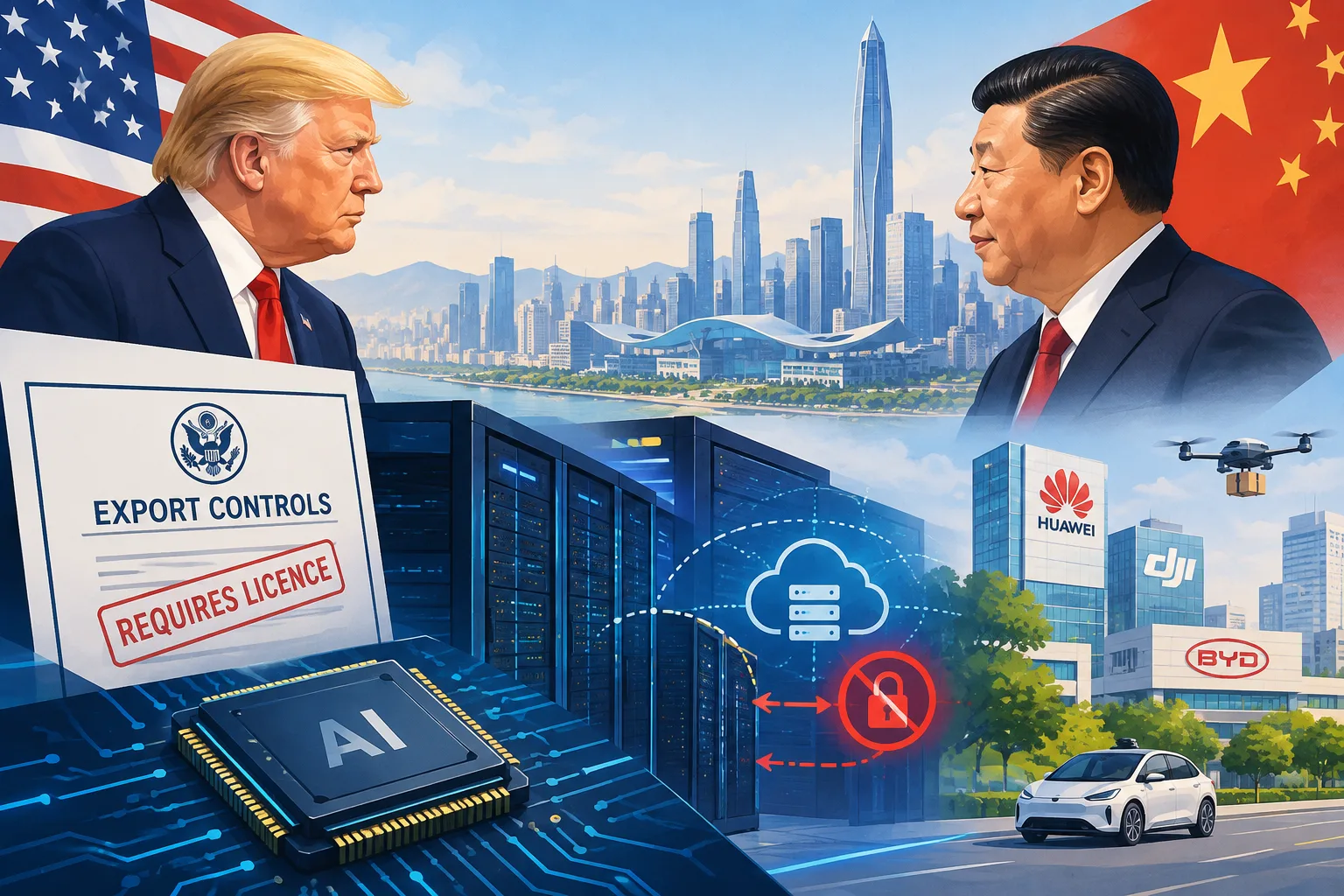
Washington is seeking to curb Chinese companies’ use of advanced US computing power through overseas data centres, as Donald Trump prepares for talks with Xi Jinping in Shenzhen.
Review information is loading.
The US Commerce Department has announced an interim rule designed to restrict Chinese companies’ remote access to advanced American computing power through data centres overseas. It is scheduled for publication on 19 November, when the text says it will take effect.
The announcement comes before Trump is expected to meet China’s president, Xi Jinping, on the sidelines of the Asia-Pacific Economic Cooperation summit in Shenzhen. Trump has already met Quad leaders in Manila; a separate meeting with Xi and Russia’s Vladimir Putin is also planned, CNN reported.
Shenzhen is home to Chinese technology companies including Huawei, drone maker DJI and electric vehicle manufacturer BYD. CNN also reports that self-driving taxis and delivery drones operate in parts of the city.
CNN has argued that US efforts will not stop China’s rise as a technology power. Shenzhen’s companies and services show what has been developed in the city, but they do not establish how much US restrictions have slowed China’s technology sector nationally, or what effect the measures will have on its future development.
What the rule covers
The Commerce Department says the measure is intended to prevent existing restrictions from being circumvented through remote computing arrangements. CNN reported that Beijing called the move an abuse of export controls and unjustifiable suppression.
Under the rule, a licence is required in certain circumstances to export, re-export or transfer specified advanced computing products to data centres that provide substantial computing power to companies headquartered in China, Macau or other designated locations, or whose ultimate parent company is based there. The threshold is more than 12 million in aggregate total processing performance, a measure of computing power. The rule is not a blanket ban on all access to computing services.
The text also requires licences for certain advanced semiconductor shipments to Indonesia, Malaysia, Singapore, Thailand and Brazil. An exception to that destination-based requirement applies, subject to reporting conditions, when the products are destined for companies headquartered in the US or with a US-headquartered ultimate parent.
The separate remote-access restriction contains an exception for computing used exclusively for commercial recommendation systems, subject to reporting conditions. Data centres already providing services covered by the new rule must obtain a licence within 90 days of its taking effect if they wish to continue, or face future export restrictions.
Sign in to give this article a thumbs up or down.
From the discussion
Private test discussion. Comments are readers’ views and are not yet automatically fact-checked. Editing is available for 60 seconds after posting.
Sign in with a confirmed reader account and choose a username to read comments and participate.
Sorting applies to top-level comments; replies remain oldest first. New comments and likes can change the order. Refresh for the current ranking.
Loading comments…