US prosecutor Aaron Reitz probes Democrats’ oversight plans
Aaron Reitz’s inquiry into planned investigations of the Trump administration has prompted a dispute over Congress’s powers. Supreme Court rulings give lawmakers broad protections for legislative work, while placing limits on their inquiries.
Review information is loading.
Aaron Reitz, the US attorney for the Southern District of Texas, says he is conducting a preliminary inquiry into whether Democratic lawmakers have stepped outside the legitimate legislative purpose of their planned committee work.
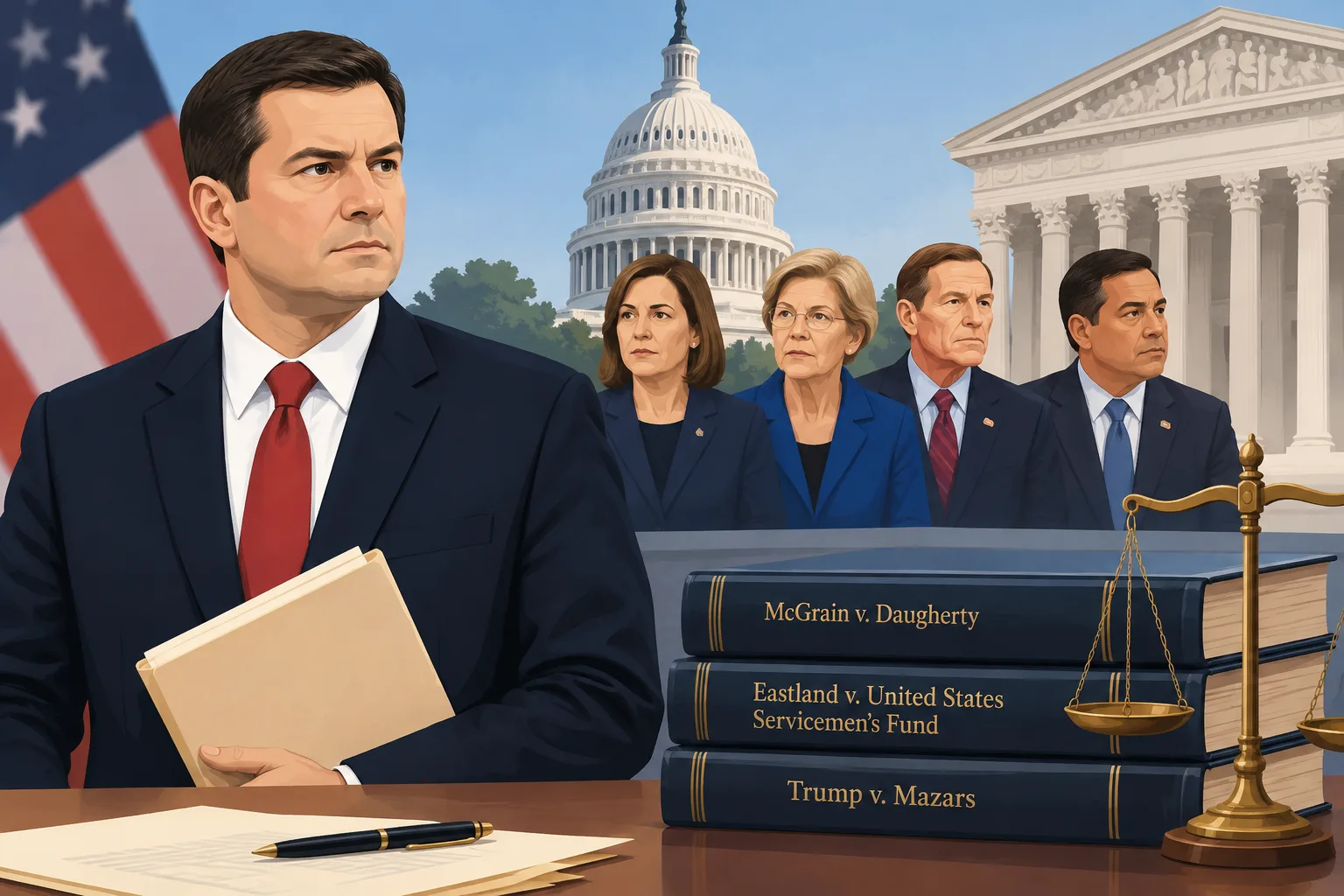
His inquiry follows letters to senators Elissa Slotkin, Elizabeth Warren and Richard Blumenthal, and Representative Robert Garcia. Reitz asked them to preserve documents and communications relating to their planned investigations and warned of possible legal consequences, according to MS NOW and Democracy Docket.
Reitz has raised concerns that investigations could violate the constitutional rights of people associated with President Donald Trump. He has not announced a formal criminal investigation, Democracy Docket reported.
The dispute comes after Democrats won control of Congress in the November elections and outlined plans to scrutinise the administration. Blumenthal, who has sought information about funding for the White House ballroom, said he would not be intimidated by Reitz’s letter, according to the Associated Press.
The Teapot Dome precedent
Lisa Rubin, a legal reporter and former litigator writing for MS NOW, argues that the history of congressional inquiries and constitutional protections for lawmakers undermine Reitz’s warnings. She points to a Supreme Court case that arose from scrutiny of the Justice Department after the Teapot Dome scandal.
In 1924, a Senate committee investigated allegations that Attorney General Harry Daugherty had failed to prosecute people implicated in the scandal and other cases. His brother Mally Daugherty, a bank president, failed to appear after being subpoenaed and was taken into custody. A lower court released him, but the Supreme Court reversed that decision in 1927.
In *McGrain v Daugherty*, the court held that Congress could compel testimony needed for a legislative task. It accepted that examining how the Justice Department was performing its duties was a matter on which legislation could be informed by the inquiry.
A later ruling, *Eastland v United States Servicemen’s Fund*, confirmed that the Constitution’s Speech or Debate Clause protects members of Congress from interference when they act within the legitimate legislative sphere. Those protections are not blanket immunity for everything a lawmaker does.
Congressional investigative powers also have limits. In *Trump v Mazars* in 2020, the Supreme Court said a congressional subpoena must serve a valid legislative purpose, and that recipients retain their constitutional rights. Congress cannot use subpoenas simply to carry out law enforcement.
Those rulings do not themselves decide whether any particular action by the four lawmakers is protected, or how a court would assess Reitz’s warnings.
Sign in to give this article a thumbs up or down.
About this discussion and AI questions
Private test discussion. Comments are readers’ views and are not yet automatically fact-checked. Editing is available for 60 seconds after posting.
Sign in with a confirmed reader account and choose a username to read comments and participate.
Sorting applies to top-level comments; replies remain oldest first. New comments and likes can change the order. Refresh for the current ranking.
Loading comments…