US tightens chip controls as Trump and Xi discuss AI cooperation in Shenzhen
A US rule aims to limit Chinese companies’ access to advanced computing through data centres, while adding chip licensing requirements for five other countries.
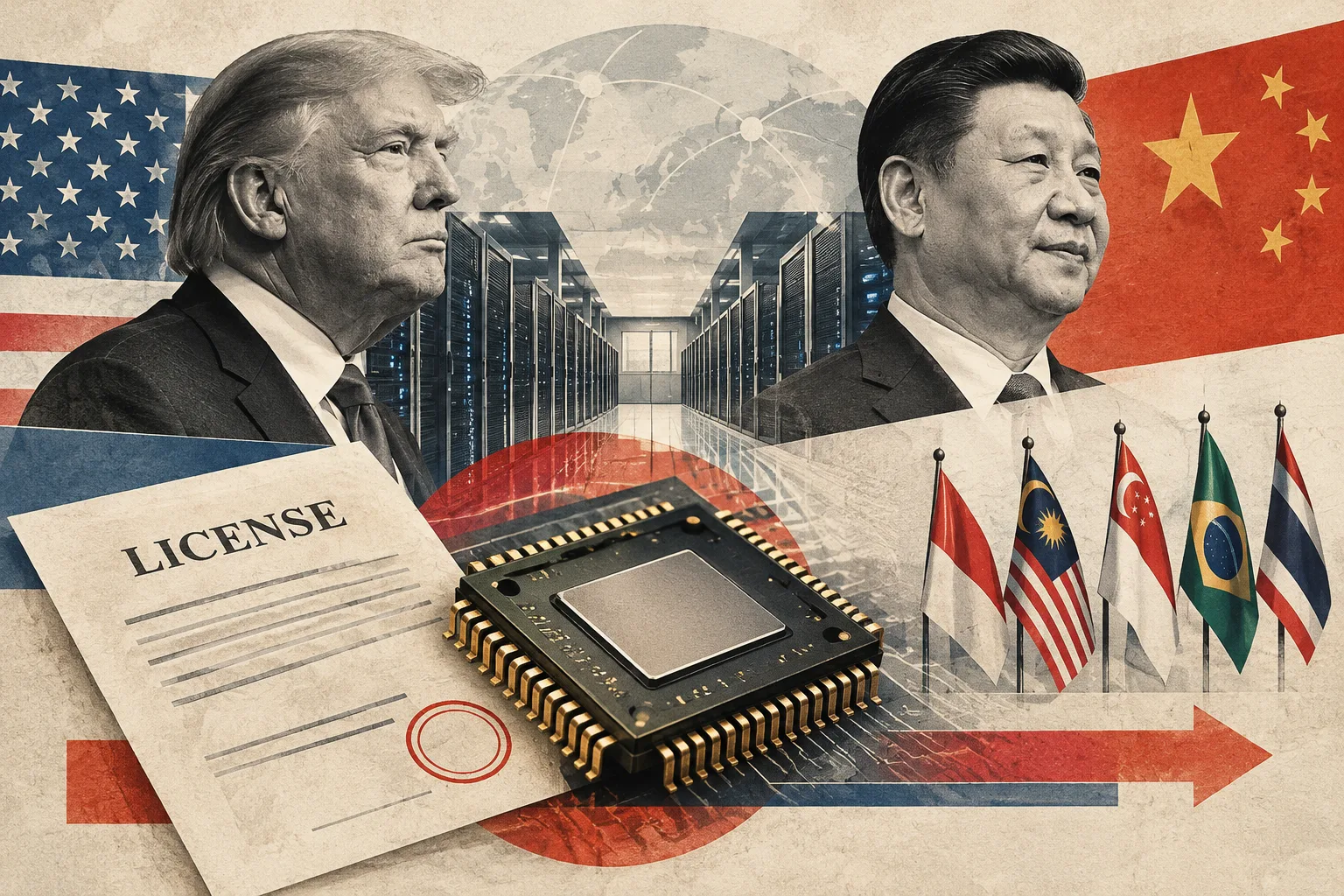
The US has introduced licensing requirements aimed at limiting Chinese companies’ access to advanced computing power through data centres, as Donald Trump and Xi Jinping discussed artificial intelligence cooperation at a summit in Shenzhen.
The interim rule took effect on 19 November 2026. It targets certain shipments of advanced chips and related products to data centres that provide substantial computing power to or for companies based in China and other specified jurisdictions. It also adds licensing requirements for shipments to five countries where Washington says there is a risk of chips being diverted.
At their 19 November meeting, Xi called for closer US–China communication to prevent AI safety risks and keep the technology under human control, according to Chinese state news agency Xinhua. Xinhua also reported that Trump called for cooperation in areas including advanced AI.
Under the data-centre provision, a licence is required for certain advanced computing products when the exporter knows they are destined for a data centre that will provide access above a specified processing-power threshold to or for companies headquartered in China, Macau or other specified jurisdictions. The rule also covers companies whose ultimate parent is headquartered in those places.
The threshold is more than 12 million in aggregate total processing performance, a measure of combined computing power, whether at one data centre or across linked centres. The provision exempts computing used exclusively for commercial recommendation systems, subject to reporting requirements, although other licensing rules may still apply.
Certain advanced chips and related products now require a licence for export, re-export or transfer to or within Indonesia, Malaysia, Singapore, Brazil and Thailand. The US Bureau of Industry and Security says applications for those destinations will be assessed individually. An exception applies to certain recipients headquartered in the US, or whose ultimate parent is headquartered there, provided reporting requirements are met.
The changes also reorganise existing controls. They remove an earlier worldwide destination-based licensing requirement while retaining a licensing requirement for certain advanced computing products destined for entities headquartered in China, Macau or other specified jurisdictions.
CNN reported that, before the summit, China’s commerce ministry warned it would take countermeasures if Washington continued with new chip restrictions. The temporary trade truce extended in September is due to expire on 10 January, CNN reported, adding that US officials had expressed concerns about China’s fulfilment of its commitments.
Sign in to give this article a thumbs up or down.
From the discussion
Private test discussion. Comments are readers’ views and are not yet automatically fact-checked. Editing is available for 60 seconds after posting.
Sign in with a confirmed reader account and choose a username to read comments and participate.
Sorting applies to top-level comments; replies remain oldest first. New comments and likes can change the order. Refresh for the current ranking.
Loading comments…