What does the USAID document Mike Benz cited say?
According to Mike Benz, USAID staff were allowed to keep pressuring social media companies behind the scenes. We compared his widely viewed post with the released legal advice.
The U.S. government put internal files from the development agency USAID online this week. They include talking points prepared by a lawyer for staff who were in contact with social media companies. The documents are fueling a public debate about when contact between the government and platforms crosses the line into pressure over what users can post. [5] [6] [8]
Mike Benz, who publicly pushed for the files to be released, wrote on X on November 28 that a USAID lawyer had told staff they could ‘keep privately pressuring the social media platforms’ after a preliminary injunction. He added the quote ‘KEEP IT OUT OF THE WASHINGTON POST’. When we captured the post, it had more than 582,000 views. [1]
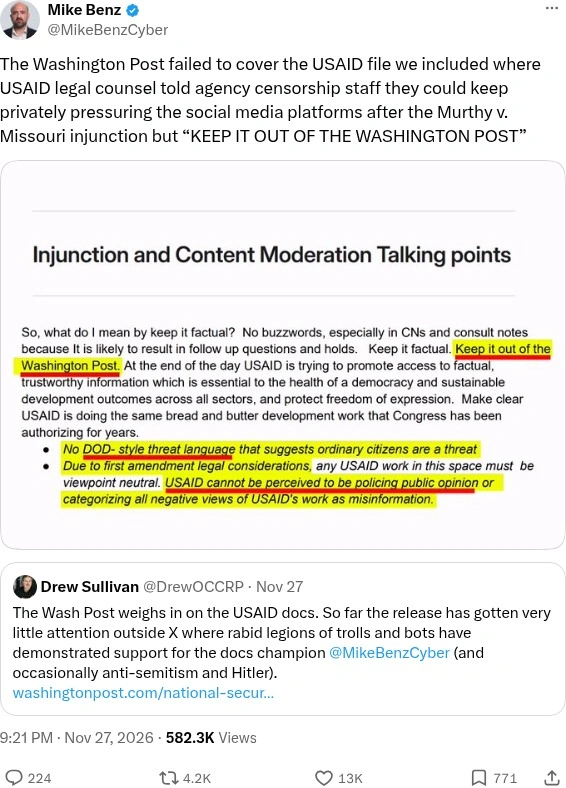
The phrase ‘Keep it out of the Washington Post’ does appear in the document. The New York Post previously quoted it in an article about USAID’s contacts with tech companies. NMC FACTS compared the phrase with the advice on those contacts in the same document. The warning about staying out of the newspaper appears alongside advice to stick to the facts and avoid jargon. The lawyer also says staff should write emails and chat messages as if they could be requested through a public records request or by Congress. [2] [7]
On contacts with platforms, the lawyer writes that USAID must not give a platform orders. She gives a hypothetical example in which several departments repeatedly approach Meta about the same program. Her instruction is to drop the issue once the question has been asked and answered. If a conversation starts to turn toward removing or promoting specific posts, staff should steer it away from that topic. [2]
Under the separate guidelines, staff could still make requests, for example when a post posed a serious threat to the safety of staff or aid recipients. Any such request had to be consistent with the platform’s rules and could not include threats of adverse consequences. The platform decided how to respond. [3]
Lower courts had issued a preliminary injunction in the case known at the U.S. Supreme Court as Murthy v. Missouri. On June 26, 2024, the Supreme Court ruled that the plaintiffs had not shown they had standing to seek such an injunction. The ruling concerned their standing to bring the case. According to the talking points, USAID’s existing guidelines remained in effect afterward. [2] [4]
Mike Benz gives an inaccurate account of the legal advice. The warning about The Washington Post appears in the writing advice. The lawyer told staff to stop pressing the issue once a platform had answered. That distinction matters for users. When the government flags a post, the platform still decides what to do with it. When the government applies pressure, it is trying to steer that decision. The documents explain what staff were supposed to do. What they did in specific contacts and how that affected individual moderation decisions require separate evidence. [2] [3]
Illustration: News Made Clear / ChatGPT ImageGen.
Sign in to give this article a thumbs up or down.
From the discussion
Private test discussion. Comments are readers’ views and are not yet automatically fact-checked. Editing is available for 60 seconds after posting.
Sign in with a confirmed reader account and choose a username to read comments and participate.
Sorting applies to top-level comments; replies remain oldest first. New comments and likes can change the order. Refresh for the current ranking.
Loading comments…