Who paid Trump’s tariffs, and who gets the money back?
US businesses and households bore most of the cost of Trump’s 2025 tariffs, researchers estimate. Since the Supreme Court invalidated some of those tariffs, importers have been able to request refunds. Shoppers who paid higher prices cannot apply through the customs scheme themselves.
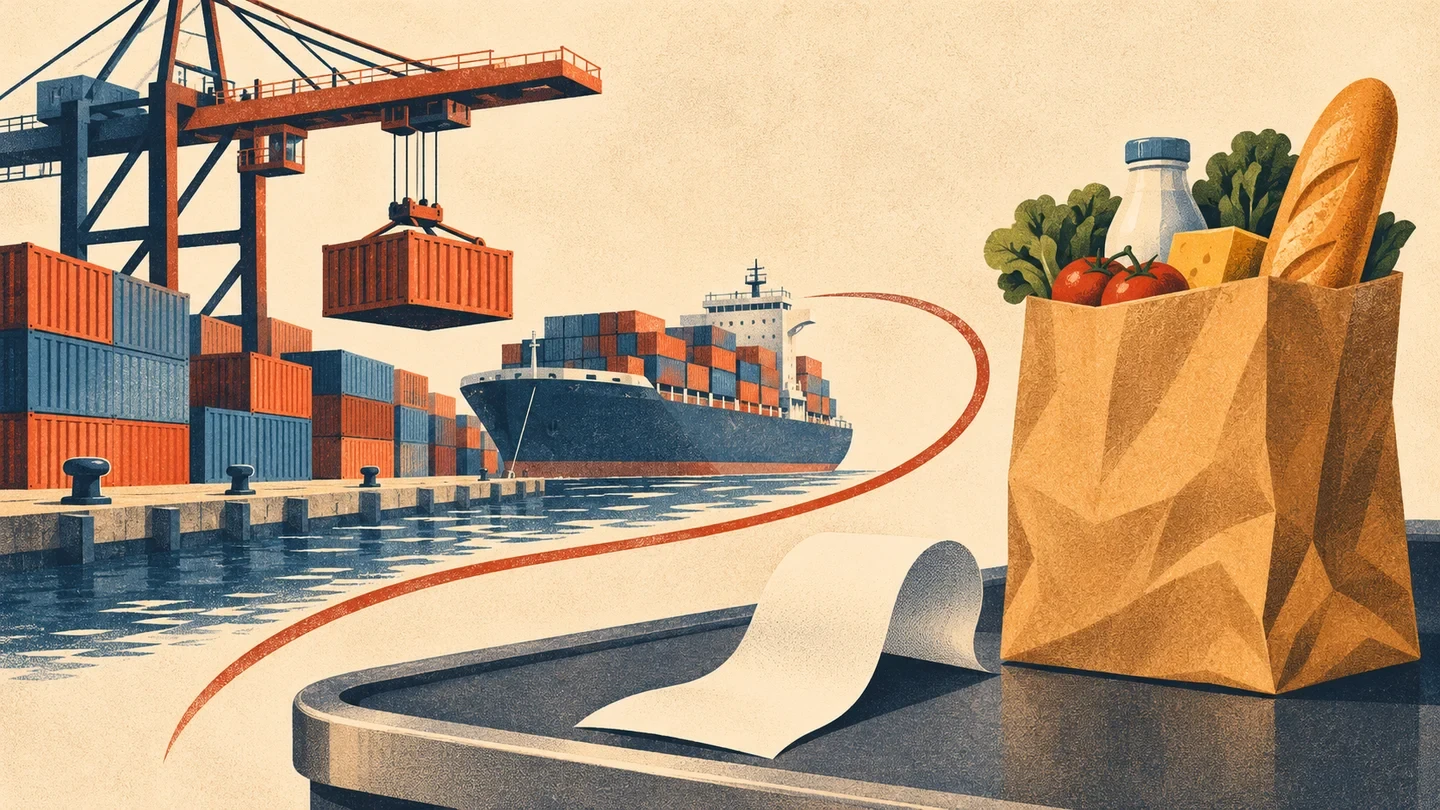
A US importer pays a tariff to customs. It can then absorb the cost, ask its overseas supplier to cut its price or raise the selling price. In the last case, the customer pays part of the cost. If customs later refunds the duty, the customer does not automatically get the price difference back. That distinction is at the centre of a public disagreement between Democratic senator Elizabeth Warren and US Treasury Secretary Scott Bessent. [1]
Where does Warren’s 95 per cent figure come from?
On 23 September, Warren wrote on X that Americans would pay up to 95 per cent of Trump’s tariffs. In a letter dated 11 November, she cited a projection by the Congressional Budget Office (CBO) for that figure. [2] [3]
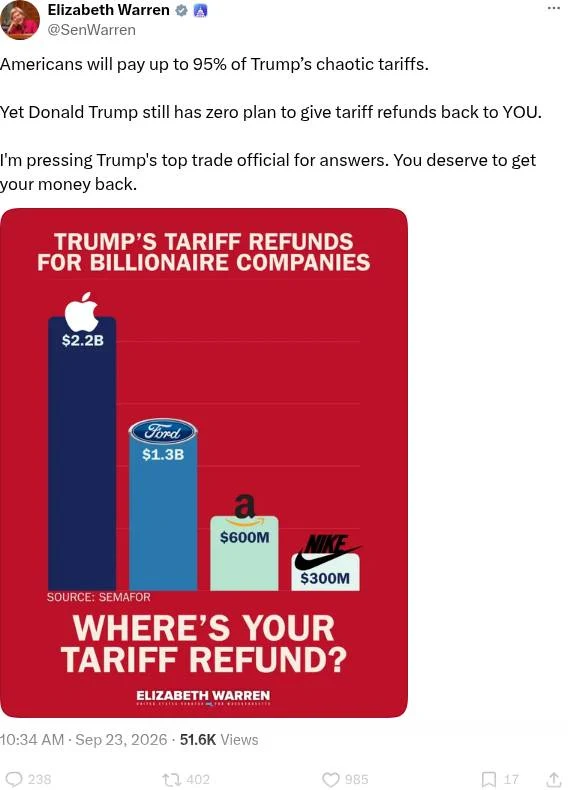
The CBO estimated that foreign suppliers would absorb 5 per cent of the cost. It expected US importers to absorb some of the higher import costs in the short term through lower profit margins. It also expected US producers competing with imports to raise prices as competition eased. If those effects offset each other, the full domestic burden would eventually show up in higher consumer prices. That is how the CBO reached 95 per cent in a projection based on trade policy as of November 2025. [4]
What did researchers measure?
Researchers at the Federal Reserve Bank of New York examined import prices through November 2025. They estimated that nearly 90 per cent of the cost fell on the US side. Their analysis shows how much foreign suppliers absorbed by lowering prices. It does not estimate separate shares for US businesses and households. A separate study using purchase data found higher retail prices for affected products and a disproportionate burden on lower-income households. [5] [6]
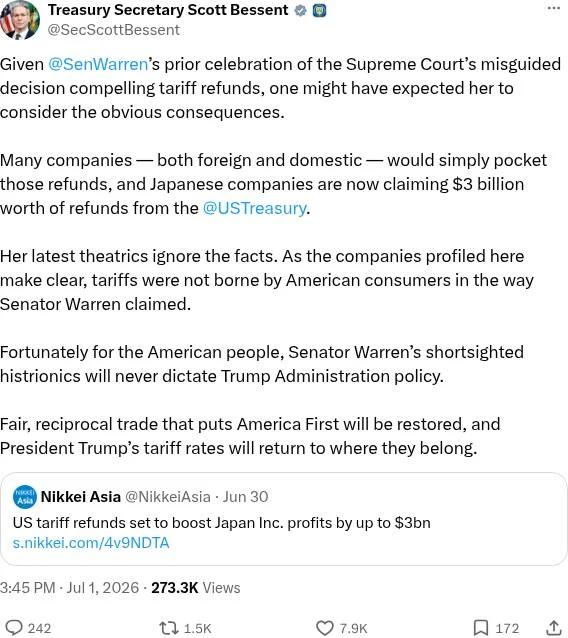
On 1 July, Bessent pointed to companies seeking refunds. He said the examples showed that consumers had not borne the costs in the way Warren claimed. A refund application tells us nothing by itself about the price customers paid. Suppose an importer pays $20 in duty and passes $10 on in the retail price. If customs issues a full refund, the importer receives $20. Whether the customer sees their $10 again depends on what happens next. [7] [1]
Who can apply for a refund?
On 20 February, the US Supreme Court held that the emergency law Trump invoked did not authorise the president to impose tariffs. US Customs and Border Protection set up a refund process for duties imposed under that law. The importer of record or an authorised customs broker can submit a request through that process. [8] [1]
On 11 November, Warren and seven other senators asked the Federal Trade Commission to investigate whether companies break the law by keeping refunds after raising prices. Their letter requests an investigation. Establishing who bore the cost for a particular product requires records of the duty paid, the price increase and the eventual refund. National estimates cannot settle that question. [3]
Sign in to give this article a thumbs up or down.
From the discussion
Private test discussion. Comments are readers’ views and are not yet automatically fact-checked. Editing is available for 60 seconds after posting.
Sign in with a confirmed reader account and choose a username to read comments and participate.
Sorting applies to top-level comments; replies remain oldest first. New comments and likes can change the order. Refresh for the current ranking.
Loading comments…