Wind and solar helped lower Australia’s wholesale electricity prices
Electricity on Australia’s National Electricity Market (NEM) cost an average of 27 percent less from July through September 2026 than in the same months of 2025. That figure applies to the wholesale market: it does not show how much a household saved on its electricity bill.
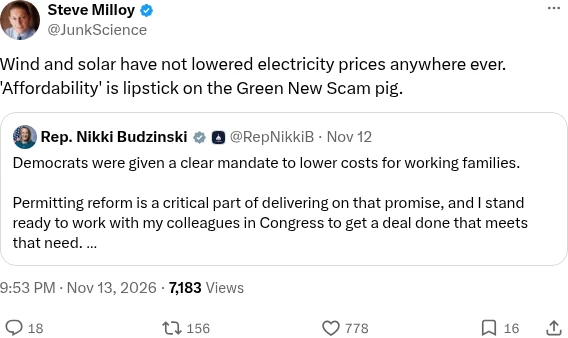
Steve Milloy claims on X that wind and solar power have never led to lower electricity prices anywhere in the world. [1]
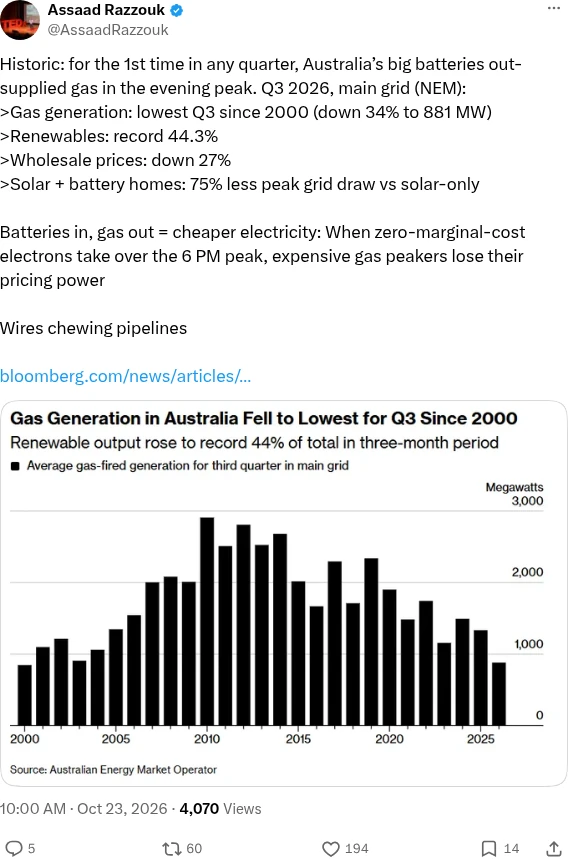
In a separate, earlier post on X, Assaad Razzouk says wholesale electricity prices in Australia fell by 27 percent. He points to larger batteries and a smaller share of gas-fired power during the evening peak. [2]
The Australian Energy Regulator (AER) provides a counterexample to Milloy’s claim. In 2025, wholesale prices fell in every region of the National Electricity Market (NEM). According to the regulator, a greater supply of wind and solar power and the use of batteries helped ease price pressure. There were also fewer extreme price spikes. [4]
What does the 27 percent measure?
Razzouk’s figure is correct for the average spot price, the price at which electricity is traded for short-term delivery. According to market operator AEMO, it averaged 63 Australian dollars per megawatt-hour from July through September 2026. That was 27 percent lower than from July through September 2025. [3]
In that quarter, large solar farms and hydroelectric plants generated more electricity. Batteries stored more electricity and later fed it back into the grid. According to AEMO, this helped lower prices in the evening, when demand peaks. [3]
For households, the wholesale price is only one part of the bill. According to the AER, a drop in wholesale prices takes time to show up in household bills and does not translate dollar for dollar. [4]
Regulated default tariffs for households are a separate measure. The AER set them in May 2026 for the 2026–2027 tariff year, before the third quarter. For households that pay a single rate per kilowatt-hour, the default offer was cheaper than in the previous tariff year in New South Wales and South East Queensland, and slightly more expensive in South Australia. These are not measured savings for the third quarter. [5]
Sign in to give this article a thumbs up or down.
From the discussion
Private test discussion. Comments are readers’ views and are not yet automatically fact-checked. Editing is available for 60 seconds after posting.
Sign in with a confirmed reader account and choose a username to read comments and participate.
Sorting applies to top-level comments; replies remain oldest first. New comments and likes can change the order. Refresh for the current ranking.
Loading comments…