News Made Clear · Loading…
Category
Regions
Continents
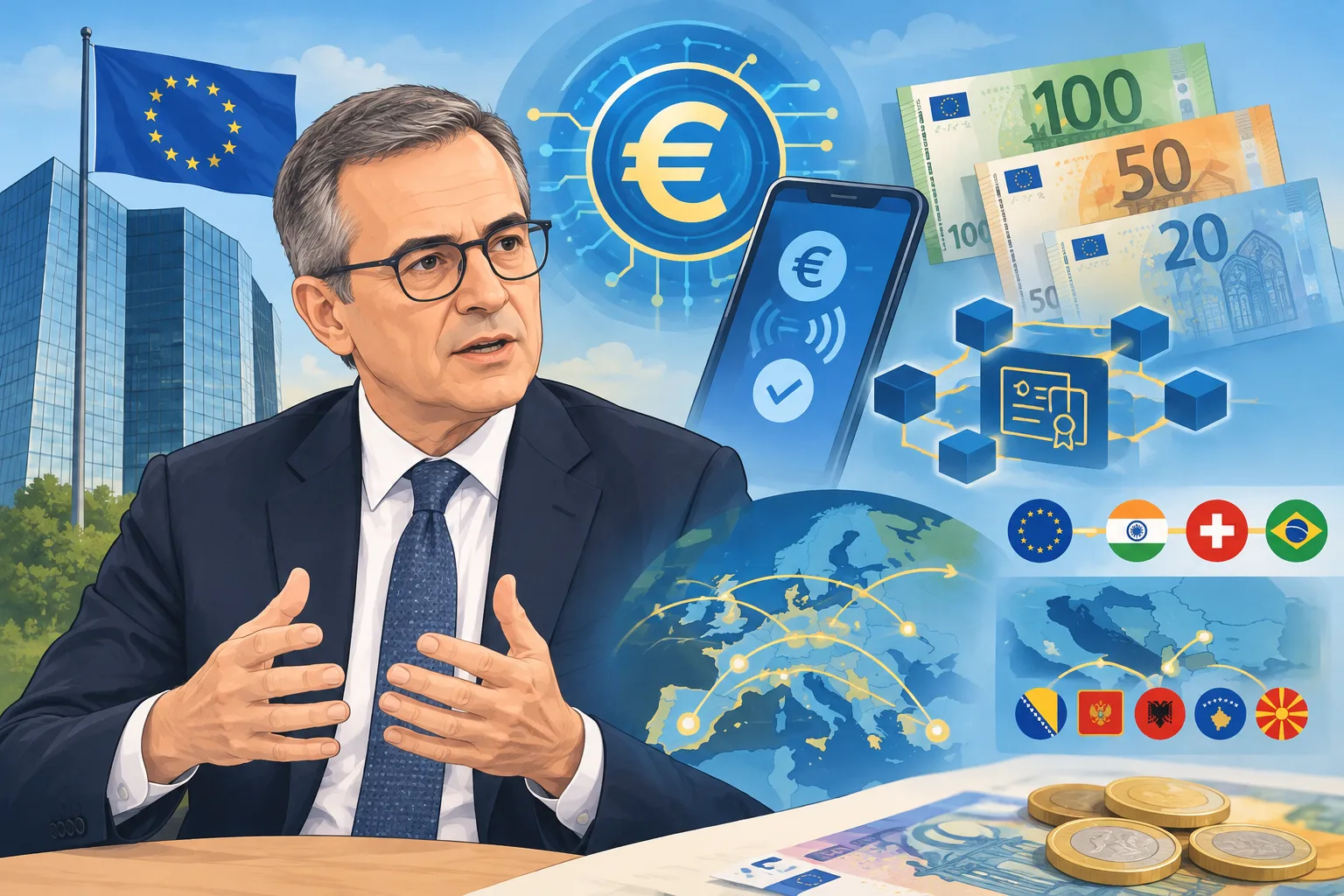
ECB sets out plans for digital euro and wider payments overhaul
Loading statistics…
The ECB’s Piero Cipollone has outlined plans spanning a digital euro, new banknotes, tokenised-asset settlement and faster cross-border payments. A possible digital euro launch in 2029 depends on EU legislation being completed by the end of 2026.
Review information is loading.
The European Central Bank is advancing plans for a digital euro, tokenised finance and faster cross-border payments, while also preparing new euro banknotes, executive board member Piero Cipollone said in a speech in Tirana on 5 November. He presented the initiatives as part of a broader effort to keep central bank money accessible as payments and financial markets become more digital.
Cipollone said the Eurosystem’s approach was not to replace private payment providers or pick a winning technology, but to provide a public foundation for payments and finance. The speech set out four strands of work: modernising banknotes, preparing a digital euro, enabling tokenised-asset settlement in central bank money, and linking fast payment systems across borders.
The digital euro would be a digital form of cash for use across the euro area, complementing rather than replacing banknotes and coins. Cipollone said it is being designed for online and offline payments, with free basic use for consumers. Banks and other supervised payment providers would distribute it and handle customer services.
The project remains subject to the EU legislative process. The Council agreed its position in December 2025 and the European Parliament adopted its position in July 2026; negotiations between EU institutions are under way. The ECB aims to be ready for a possible first issuance in 2029, assuming the legislation is completed by the end of 2026. A 12-month pilot is planned to begin in the second half of 2027.
Cipollone said safeguards would include no interest on digital euro holdings and limits on how much an individual could hold. A linked bank account would allow payments above the holding limit to be sent or received. The design, he said, is intended to make it a means of payment rather than an investment.
The ECB is also preparing a new generation of euro banknotes, with enhanced security, improved accessibility and a smaller environmental impact. Cipollone said the governing council expects to choose a design concept around the end of 2026, with new notes due to enter circulation gradually from the early 2030s. Existing notes would remain valid.
On tokenised finance, the Eurosystem’s Pontes service, launched in September, connects market platforms using distributed-ledger technology to its payment services so tokenised assets can be settled in central bank money. Cipollone said it had recently settled a €1 billion transaction involving bonds issued on a distributed ledger by the European Stability Mechanism. The ECB’s separate Appia project aims to produce a blueprint by 2028 for an integrated European ecosystem for tokenised finance.
Cipollone also described work to connect fast payment systems internationally. He said discussions were under way on links between the Eurosystem’s TIPS service and India’s Unified Payments Interface, and that the ECB was examining possible connections with Nexus Global Payments and payment systems in Switzerland and Brazil. Such links, he argued, could make transfers faster and cheaper while leaving participating jurisdictions in control of their own currencies and domestic infrastructure.
How do we know?
1 listed sources · explore evidence, limitations and provenance.
Sign in to give this article a thumbs up or down.
About this discussion and AI questions
Private test discussion. Comments are readers’ views and are not yet automatically fact-checked. Editing is available for 60 seconds after posting.
Sign in with a confirmed reader account and choose a username to read comments and participate.
Sorting applies to top-level comments; replies remain oldest first. New comments and likes can change the order. Refresh for the current ranking.
Loading comments…