News Made Clear · Loading…
Category
Regions
Continents
IMF meetings expose competing forces shaping the global economy
Loading statistics…
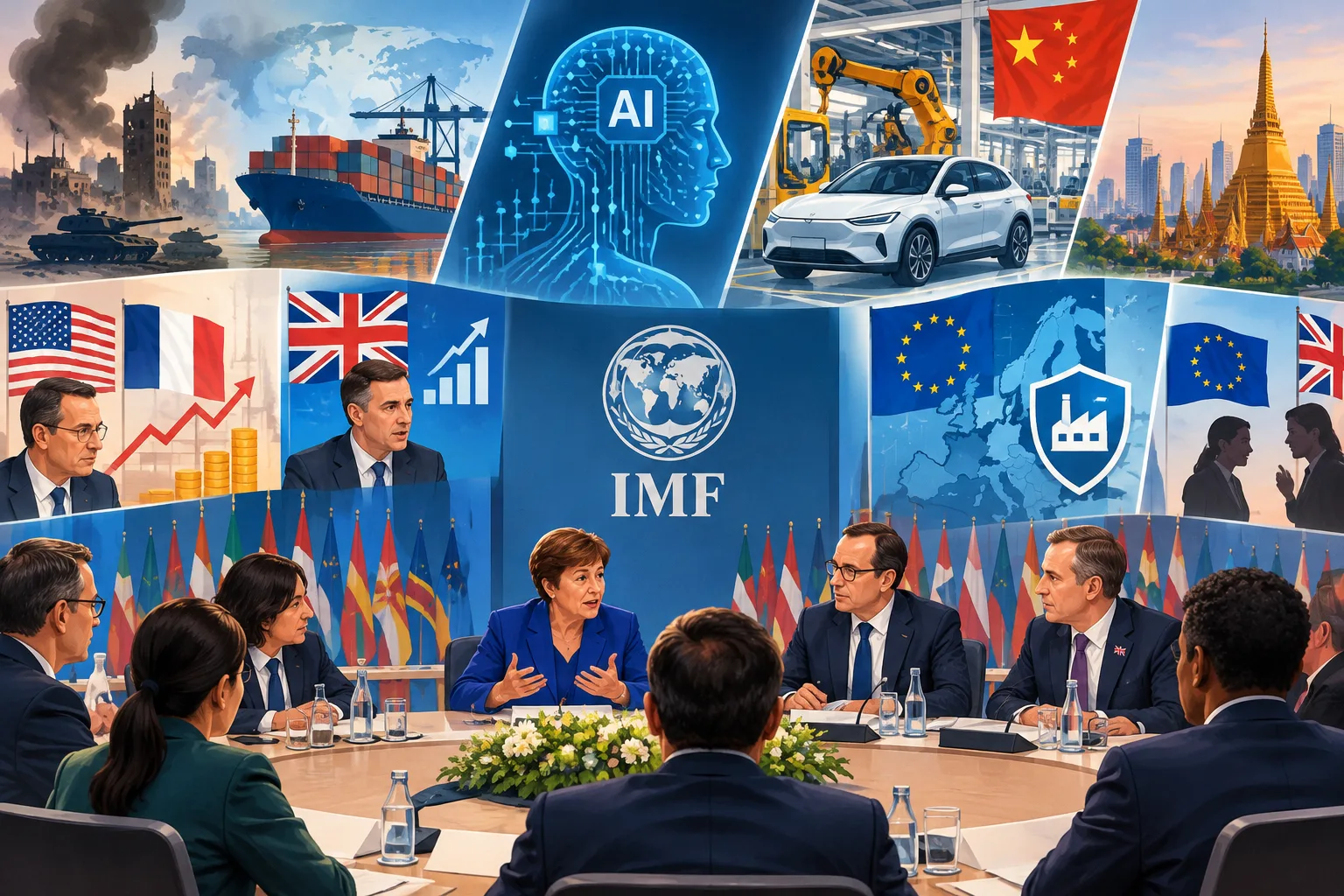
At IMF meetings in Bangkok, leaders weighed economic support from AI investment against conflict, market uncertainty and intensifying competition from China, as the UK’s borrowing outlook and ties with the EU came under discussion.
Review information is loading.
At this week’s International Monetary Fund meetings in Bangkok, finance ministers and central bankers faced a global economy pulled between conflict and trade disruption, heavy investment in artificial intelligence and China’s rapid rise in advanced manufacturing. None could say with confidence which force would prevail, BBC economics editor Faisal Islam reports. [1]
The strains are showing in higher borrowing costs for advanced economies, while the AI investment boom and the resilience of smaller economies are providing support. Islam writes that markets are watching the United States and France closely. French finance minister Roland Lescure said he had continued to sell government debt, albeit at greater cost, and argued that France’s budget was on track.
The UK, meanwhile, has won more favourable attention from bond investors and the IMF. Chancellor John Healey told Islam that UK growth had outperformed expectations and that he saw early signs of technology investment adding to growth. The IMF’s favourable view, however, rests on accepting the government’s budget plans, Islam notes.
Another concern is the growing competition from Chinese manufacturing. Thailand, sometimes called the “Detroit of Asia”, has seen Chinese electric vehicles reach nearly a third of car sales, according to Islam. He describes this as a second “China shock”, following the expansion of basic manufacturing in the 2000s.
The shift is prompting the European Union to consider stronger “Made in Europe” protections. Those rules could affect Britain: if it stays outside them, Chinese carmakers might redirect excess production to the UK, where tariffs are lower; alternatively, the EU could invite Britain to join the new approach, potentially requiring it to raise tariffs.
Britain’s relationship with the EU also featured in conversations in Bangkok. IMF managing director Kristalina Georgieva joked that the Brexit “divorcees are now dating again”, while Finland’s finance minister described the UK as “flirting” with the bloc, Islam reports.
AI remains a hoped-for source of economic growth, but also a risk. Finance ministers discussed its transformative potential, while central bankers raised concerns about cybersecurity vulnerabilities in banking. The scale and durability of the financial boom around AI remain uncertain.
How do we know?
1 listed sources · explore evidence, limitations and provenance.
Sign in to give this article a thumbs up or down.
About this discussion and AI questions
Private test discussion. Comments are readers’ views and are not yet automatically fact-checked. Editing is available for 60 seconds after posting.
Sign in with a confirmed reader account and choose a username to read comments and participate.
Sorting applies to top-level comments; replies remain oldest first. New comments and likes can change the order. Refresh for the current ranking.
Loading comments…