News Made Clear · Loading…
Category
Regions
UN committee backs journalist protections and multilingual communications in two draft resolutions
Loading statistics…
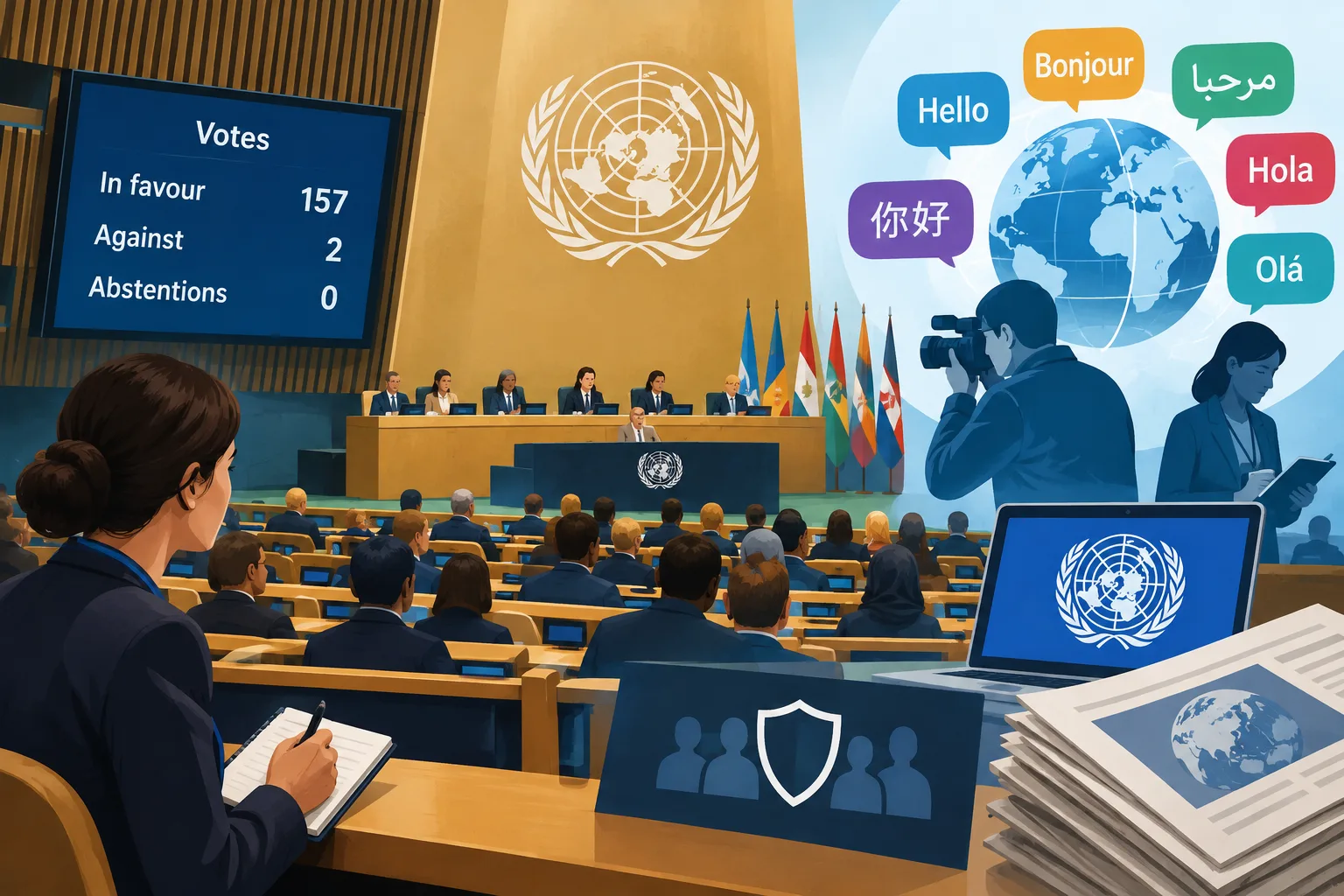
The UN General Assembly’s Fourth Committee approved two draft resolutions on journalist safety, information integrity and multilingual UN communications by 157 votes to two. The texts now go forward in the Committee on Information’s report to the General Assembly.
Review information is loading.
The UN General Assembly’s Fourth Committee has approved two draft resolutions calling for stronger protection of journalists and continued multilingual communication by the United Nations. Both passed by 157 votes to two, with Argentina and the United States opposed and no abstentions.
The drafts now form part of the Committee on Information’s report to the General Assembly. They urge countries and UN bodies to reduce inequalities in information flows and support journalists’ ability to carry out their work. One also calls for practical training programmes for broadcasters and journalists in developing countries.
The second draft condemns attacks and violence against journalists and media workers, and addresses misinformation and disinformation, including online. It asks the UN Secretary-General to keep working towards balanced and equitable information in all six official UN languages, and urges the Department of Global Communications not to let measures responding to the organisation’s liquidity problems undermine multilingualism.
The United States representative, explaining his country’s vote against the texts, called them “30 pages of bureaucratic jargon” and “mission creep in print”. He said the US would not accept efforts to restrict freedom of speech in the name of countering disinformation, and objected to references to issues including climate change and gender.
Ireland’s representative, speaking for the European Union as an observer, said the texts reaffirmed freedoms including expression and the press. He regretted that last year’s resolutions had not been adopted by consensus after 38 years of consensus, according to the UN meeting account.
Canada’s representative, speaking for Australia and New Zealand, welcomed the multilingualism provisions but called for the texts to be streamlined. She also urged that one resolution be considered every three years rather than every two, to allow more meaningful review.
Delegates also raised concerns about misinformation, hate speech and language access. Bangladesh’s representative highlighted the use of artificial intelligence to spread fake news, while Brazil’s representative cited complaints that major technology companies may have favoured some candidates and failed to address false information and hate speech. The UN describes its account of the meeting as “For information media. Not an official record.”
How do we know?
1 listed sources · explore evidence, limitations and provenance.
Sign in to give this article a thumbs up or down.
About this discussion and AI questions
Private test discussion. Comments are readers’ views and are not yet automatically fact-checked. Editing is available for 60 seconds after posting.
Sign in with a confirmed reader account and choose a username to read comments and participate.
Sorting applies to top-level comments; replies remain oldest first. New comments and likes can change the order. Refresh for the current ranking.
Loading comments…