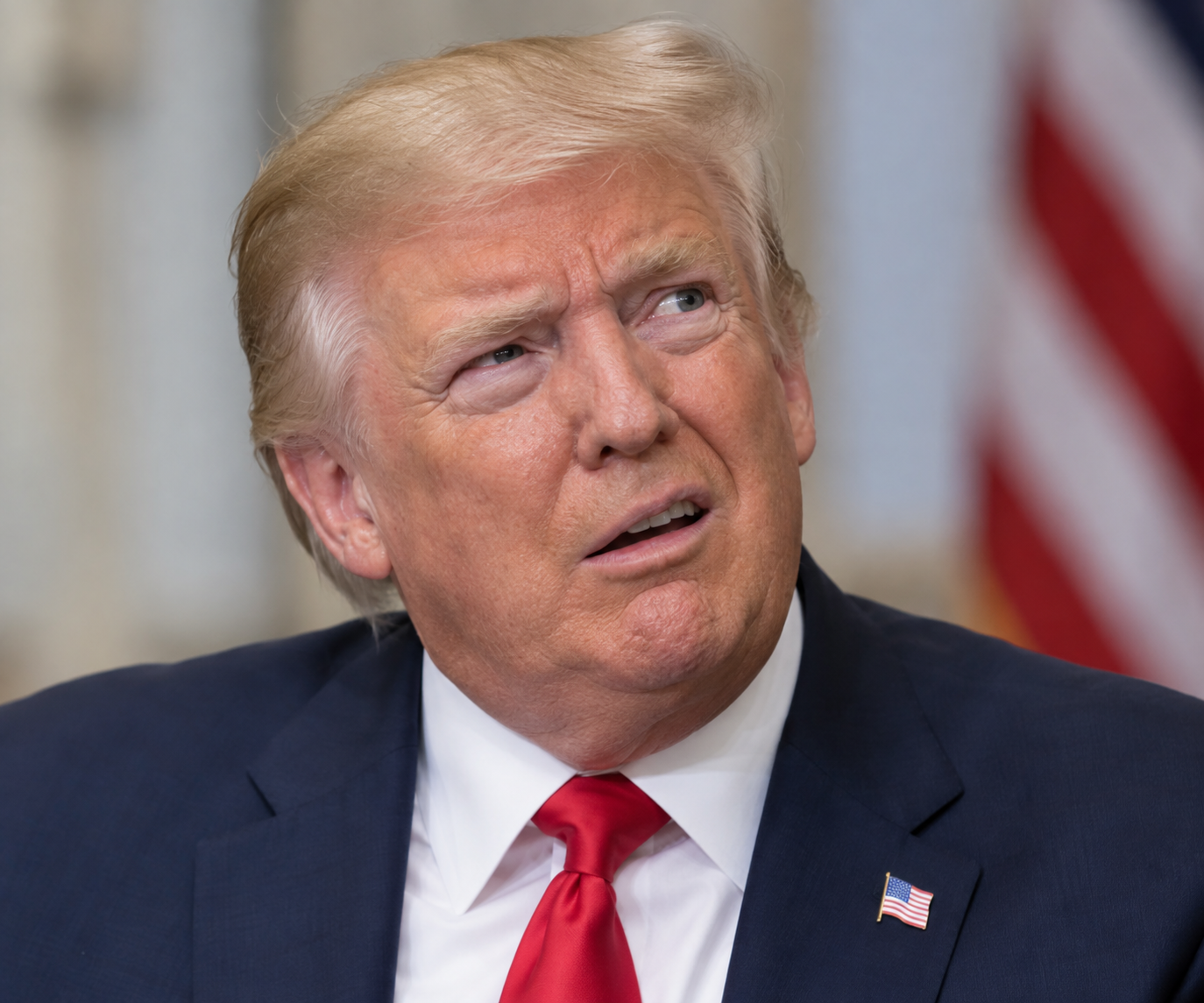
AI-generated editorial illustration of Donald Trump.
Loading statistics…
After the hearing, the judge said the prescribed process for revoking the press passes did not appear to have been followed, but issued no ruling. The shared television pool remains suspended, while about fifty organisations support the plaintiffs through an amicus brief.
AI translation of the original article. Independent human translation review is pending. Read the original
Review information is loading.
Updated September 24, 2026, 01:12 CEST. The September 23 hearing has concluded. The judge said the prescribed process for revoking press passes did not appear to have been followed, but issued no ruling. An amicus brief from about fifty media and press organisations was also added.
Donald Trump wanted to shut three critical newsrooms out of the White House. Now their competitors are refusing to fill the gap in the shared television service. Fox News is among them. CNN, MS NOW and Politico have also filed a lawsuit to regain access. [2][3]
Trump’s attack on what he calls ‘fake news’ has thus become a conflict over who sets the terms for independent reporting. More than three press passes are at stake: can a president make access depend on the tone of the news about him?
Fox will not take over the camera
The television pool’s five main participants — ABC, CBS, CNN, NBC and Fox News — share the task of filming presidential events. This means that not every network needs to bring its own crew into the same small room. The footage is then distributed to other newsrooms. When CNN was prevented from carrying out its assigned work, the participants decided to suspend their joint pool coverage. [2][7]
The announcement came from the pool’s chair, Bryan Boughton, who also heads Fox News’s Washington bureau. His message was practical: there would be no replacement pool. CNN’s exclusion would therefore not be quietly absorbed by a competitor that was still allowed inside. [7]
AP, The Washington Post and The New York Times also decided not to publish photographs of presidential events on Monday. That broadened the protest, but did not make it a total news boycott. Written reports and other coverage continued. The newsrooms stopped providing particular shared services and publishing certain images; they did not stop covering the president. [7][8]
How do we know?
22 listed sources · explore evidence, limitations and provenance.
Sorting applies to top-level comments; replies remain oldest first. New comments and likes can change the order. Refresh for the current ranking.
Loading comments…
Loading earlier articles…
CNN’s continued reporting outside the White House was visible on September 22 at the United Nations in New York. CNN anchor Kaitlan Collins questioned Trump there. Trump said CNN should not be there; Collins replied that the United Nations had granted CNN access. That does not establish restored White House access or a resumption of the shared television pool. It shows why access must be distinguished by venue and accreditation from a general news boycott. [13]
‘Sabotage’ is a loaded description of that decision. In concrete terms, newsrooms are withdrawing their cooperation from an existing service. This affects the distribution of Trump’s appearances, but their stated reason is to protect their access. Nor does solidarity mean that Fox suddenly endorses every CNN report. They are defending a rule on which all the participants depend.
In their joint statement, the five networks say the government should not restrict access because it objects to reporting. [12]
Negative does not mean untrue
Trump announced the ban on September 18. The next day, those turned away included CNN’s Betsy Klein, MS NOW’s Akayla Gardner and Politico’s Cheyenne Haslett. Their existing press passes no longer provided access. On September 21, Trump defended the move as an attack on ‘fake news’, not on the free press. [1][2]
His own explanation makes that distinction difficult to sustain. Asked what prompted the decision, he pointed to the accumulation of reporting over two years. He complained that the stories were one-sided and never positive. Those are statements about the treatment he receives, not the identification of a particular falsehood for which these three reporters were responsible. [6]
The White House has indeed supplied examples of reporting that the administration considers inaccurate. It also refers to restrictions imposed under Obama and Biden. Saying ‘Trump has presented no examples at all’ would therefore overstate the case. But the allegations cited have not thereby been proved, let alone all the reporters at three organisations exposed as unreliable. [5]
An error should be investigated, corrected and, where necessary, challenged in court. Excluding entire newsrooms because of an accumulation of unwelcome stories does something else: it ties access to power to the satisfaction of the person being covered. Our assessment is that Trump’s own explanation provides more grounds for that reading than for seeing this as a targeted measure against demonstrated disinformation.
The court must draw the line
CNN, MS NOW, Politico and the three reporters concerned filed suit on September 21 against Trump and three administration officials. They invoke the First Amendment, which protects freedoms including speech and the press, and the procedural protections of the Fifth Amendment. Their complaint is that they are being punished for the content of their work and lost access without proper prior process. That is their legal position, not an established court ruling. [3]
They are also seeking a temporary court order immediately restoring their press passes and access. The case has been assigned to federal judge Timothy Kelly. The hearing took place on September 23. Kelly did not rule immediately and said he would decide as soon as possible. These source checks therefore still did not establish that a temporary order restoring access had been granted. [2][4][14][20]
New: the Justice Department files its opposition
On September 22, the Justice Department asked the court to deny temporary restoration of access. The administration invokes national security and journalistic conduct standards. It denies that the exclusion is retaliation for criticism. This is its defence, not a judicial ruling. [16]
The attached letters to CNN, MS NOW and Politico are dated September 22. The White House cites reporting on subjects including the East Wing bunker and ballroom, the Iran war and an alleged leak investigation. It accuses the outlets of inaccurate reporting and publishing sensitive information; those accusations are not thereby proved. [17][18][19]
The letters allow written objections by Friday, September 25 at 5 p.m.; they do not specify a time zone. Without a response, the initial decision becomes final according to the letters. That refers to the White House’s decision, not a final court judgment. The opportunity to respond was offered only after the exclusion. Whether this subsequent process provides the required procedural protection remains undecided. [17][18][19]
New: hearing concluded, ruling pending
The hearing on the request for temporary relief took place on September 23. Judge Timothy Kelly said two federal appellate precedents require due process before journalists’ White House passes are revoked. Kelly said it was fair to say that the process prescribed by those cases had not been followed here. He neither granted nor denied the request during the hearing and said a decision would follow. [20]
Kelly specifically questioned whether the September 22 letters could provide advance notice: the news organisations received them only after access had already been revoked and after the lawsuit was filed. His comments indicate how he viewed the procedural objection, but they are not a temporary order, an appeal or a final judgment. [20]
That same day, the Reporters Committee for Freedom of the Press and about fifty media and industry organisations, including the WHCA, filed an amicus brief supporting the plaintiffs. Reuters reports that Fox News also signed the brief. The filing states the position of third parties; it does not restore access or bind the judge. [20][21][22]
Trump said on Monday that he would appeal an expected loss. That is a stated future step, not a filed appeal. On September 22, he said he would ‘probably’ allow the journalists back into the White House if the court rules against his ban. That statement is likewise neither restored access nor a court order. [14][15]
The White House argues that publishing is a right, but access to the complex is a privilege. It is true that not every journalist can claim every place. The dispute here, however, concerns the reason for withdrawing existing access: practical selection and security are different from retaliation against an editorial position. That distinction lies at the heart of the complaint. [5][3]
WHCA president Jacqui Heinrich warned that the same standard could later be used against any other newsroom. The Knight First Amendment Institute has announced that it will support the news organisations in court. Their legal assessments must also be read as their assessments; the judge decides on the requested relief. [9][10]
The White House adds Trump TV
The White House now offers ‘Trump TV’. Its official livestream page presents the channel as a 24/7 service alongside the regular livestream, with a link to YouTube. [11]
This gives the administration its own route for distributing footage. Our assessment: that does not resolve the access dispute. The government decides what it broadcasts; independent reporters choose their own questions.
Readers lose out too
The solidarity has a concrete logic. Anyone who takes an excluded competitor’s place today without objection accepts a condition that could be used against them tomorrow. That is why Fox’s participation matters: criticism of the exclusion does not require political agreement with CNN.
For the public, the loss lies elsewhere. A reporter who can be inside can ask questions, observe and follow up directly. A newsroom shut outside can still report the news, but loses some of that direct access. A press release or camera footage selected by the administration does not replace that opportunity.
Trump does not have to like journalists. Journalists do not have to portray him favourably. Once access depends on whether the president is satisfied with the answer, a press pass changes from a tool of the trade into a reward. That is precisely where the competing newsrooms are now drawing a line together.
 Editorial illustration