News Made Clear · Loading…
Category
Regions
Continents
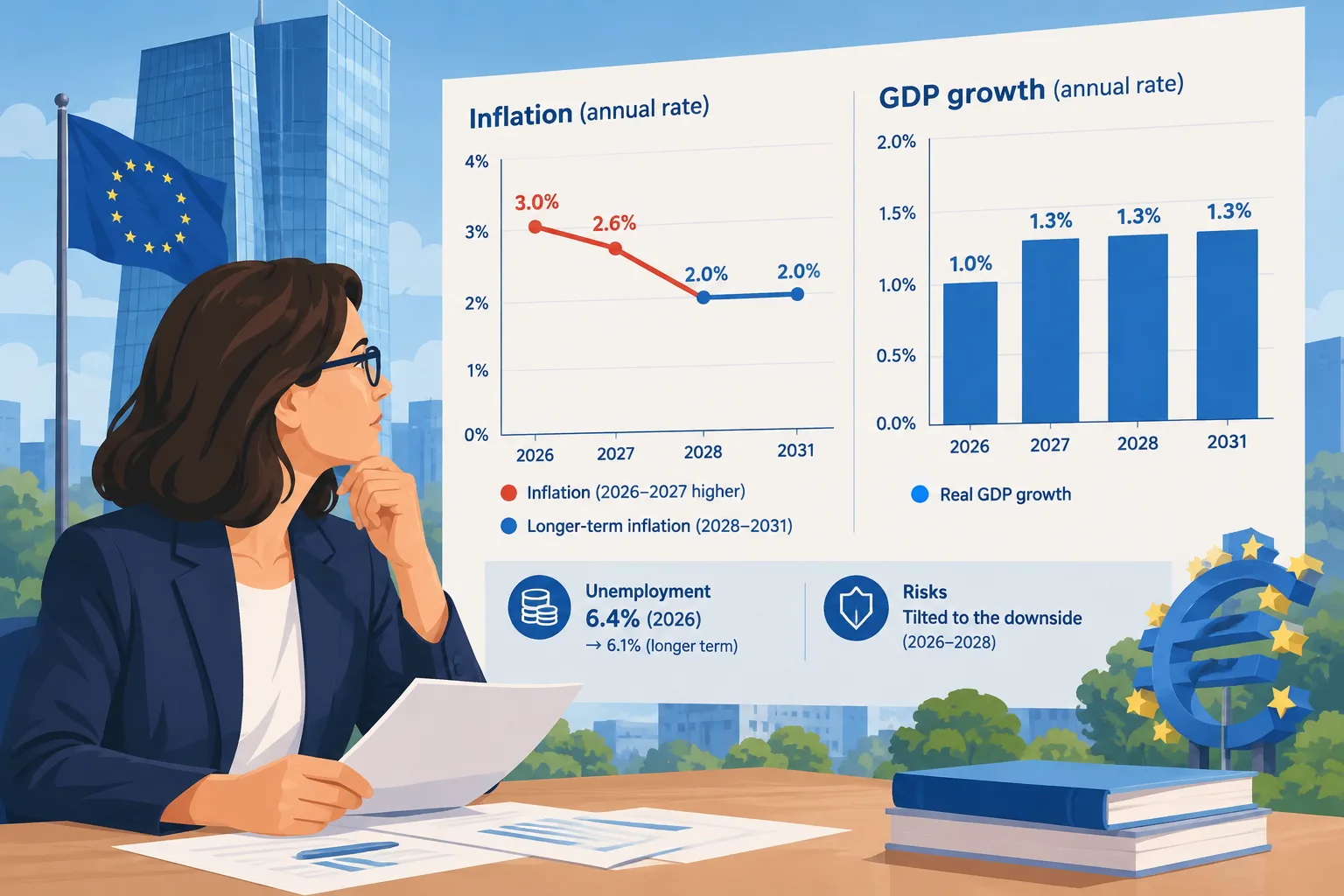
ECB forecasters raise near-term inflation expectations as growth outlook improves
Loading statistics…
The ECB’s latest survey of professional forecasters points to higher euro-area inflation in 2026 and 2027, alongside an improved near-term growth outlook. Longer-term inflation expectations remain at 2%.
Review information is loading.
Professional forecasters have raised their euro-area inflation expectations for 2026 and 2027, while also revising up their near-term growth outlook, according to the European Central Bank’s latest quarterly survey. The forecasts reflect higher energy prices and recent economic data, but respondents still expect inflation to return to 2% in the longer term.
The survey puts headline inflation at 3.0% in 2026 and 2.6% in 2027, up by 0.3 and 0.4 percentage points respectively from the previous round. The forecast for 2028 remains 2.0%, as do longer-term expectations for 2031.
The ECB said respondents attributed the higher near-term inflation outlook primarily to energy prices and their indirect effects. Answers to a special question about the war in the Middle East suggested that further effects from the energy shock are expected mainly in 2027, while second-round effects are expected to remain limited. Respondents saw inflation risks tilted upwards for 2026 to 2028, but more balanced beyond that.
Growth outlook improves
Forecasters expect real GDP to grow by 1.0% in 2026 and 1.3% in each of the following two years. That is an upward revision of 0.4 percentage points for 2026 and 0.1 points for 2027; the 2028 forecast is unchanged. Longer-term growth expectations for 2031 rose by 0.1 points to 1.3%.
Despite the improved forecasts, respondents judged the risks to growth to be somewhat tilted to the downside at all forecast horizons. They put unemployment at 6.4% in 2026, 0.1 points higher than in the previous survey, before a gradual decline to 6.1% in the longer term.
The survey was conducted from 2 to 7 October and received 52 responses from experts affiliated with financial and non-financial institutions based in Europe. The ECB says the results do not represent the views of its decision-making bodies or staff. Its next euro-area staff projections are due on 18 December 2026.
How do we know?
1 listed sources · explore evidence, limitations and provenance.
Sign in to give this article a thumbs up or down.
About this discussion and AI questions
Private test discussion. Comments are readers’ views and are not yet automatically fact-checked. Editing is available for 60 seconds after posting.
Sign in with a confirmed reader account and choose a username to read comments and participate.
Sorting applies to top-level comments; replies remain oldest first. New comments and likes can change the order. Refresh for the current ranking.
Loading comments…