News Made Clear · Loading…
Category
Regions
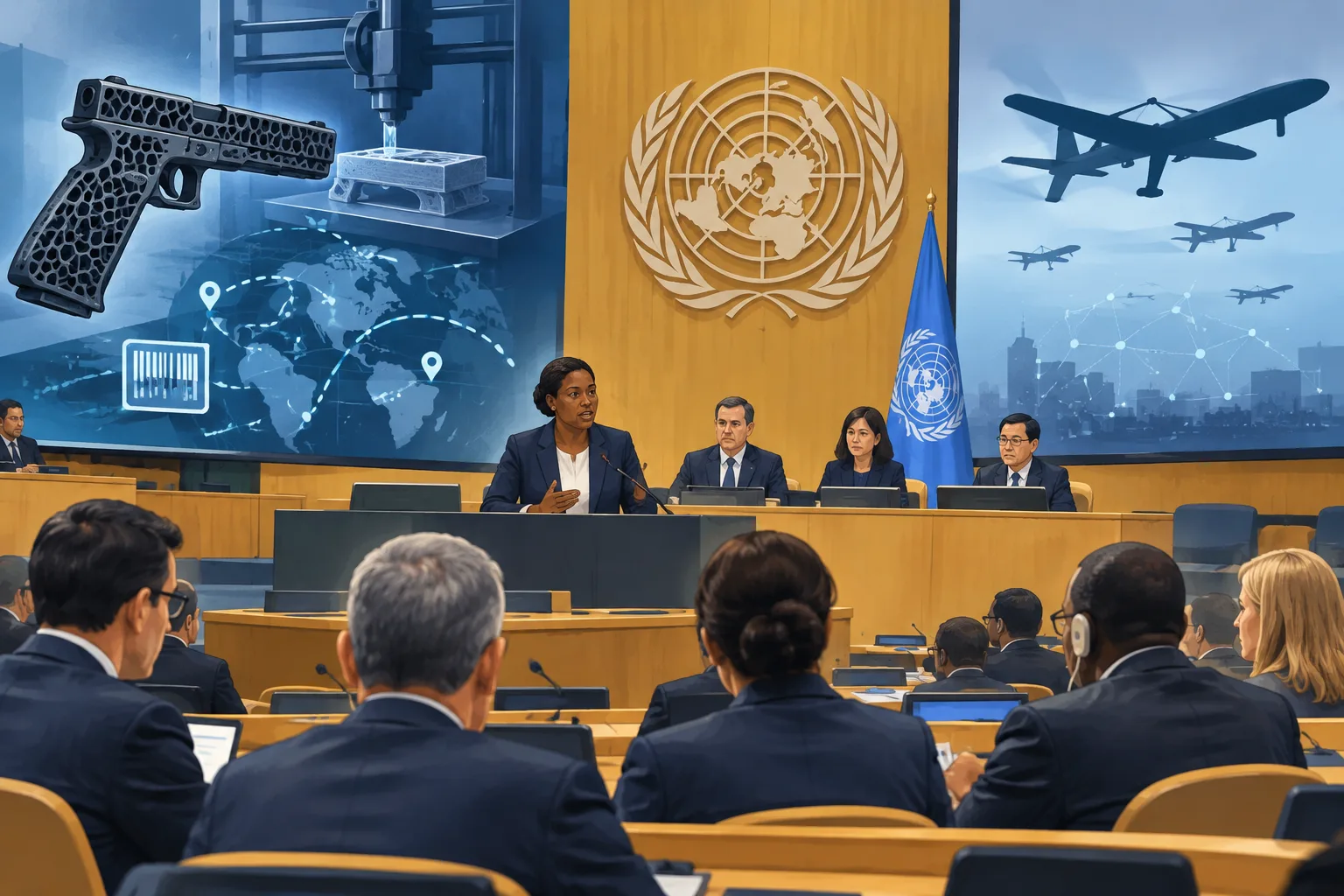
UN delegates call for stronger arms tracing as 3D-printed weapons pose new challenge
Loading statistics…
UN delegates called for stronger tracing of conventional arms and action on illicit transfers, as debate over the future rules for autonomous weapons continued.
Review information is loading.
Delegates at the UN General Assembly’s First Committee called for stronger controls on conventional arms, warning that 3D-printed weapons can be harder to trace and urging progress on rules for autonomous weapons.
The debate on 22 October covered illicit arms transfers, civilian harm from explosive weapons and the challenges posed by new technologies. Burkina Faso’s representative warned that polymer and 3D-printed weapons could become “another vector for proliferation” if the tracing problem is not addressed.
The meeting also exposed a gap between agreement on the need for further work on autonomous weapons and disagreement over what that work should produce. Ireland, speaking for 50 countries, welcomed a consensus report setting out elements for a possible instrument. New Zealand backed negotiations on a legally binding agreement, while Switzerland said any agreement could combine legally and politically binding elements.
That consensus report was adopted on 4 September by the Group of Governmental Experts working under the Convention on Certain Conventional Weapons. Its mandate was to formulate elements for a possible instrument without deciding what form it should take; it was not a binding agreement. The group’s chair presented the report to a preparatory committee on 8 September.
Elsewhere in the debate, Mexico called for stronger traceability and controls throughout the life cycle of arms and ammunition. The Philippines urged a whole-of-government and whole-of-society approach to preventing diversion, while the United States pointed to unsecured state stockpiles, corruption and weak governance as factors that can facilitate it.
Delegates also raised the effects of mines, cluster munitions and explosive weapons on civilians. Austria’s representative said nearly 70 per cent of child casualties verified by the UN in 2025 were caused by explosive weapons. The figures and other claims in the debate were statements by delegates, rather than findings independently assessed in the UN meeting coverage.
The First Committee’s discussion reflected wider disagreements over arms transfers and disarmament. Russia criticised the supply of military goods to conflict zones, while Canada linked five countries’ withdrawal from the Mine Ban Convention to what it called the threat posed by Moscow. Yemen accused Iran of supplying weapons and technical assistance to the Houthi movement; Iran’s response was not included in the meeting coverage.
How do we know?
2 listed sources · explore evidence, limitations and provenance.
Sign in to give this article a thumbs up or down.
About this discussion and AI questions
Private test discussion. Comments are readers’ views and are not yet automatically fact-checked. Editing is available for 60 seconds after posting.
Sign in with a confirmed reader account and choose a username to read comments and participate.
Sorting applies to top-level comments; replies remain oldest first. New comments and likes can change the order. Refresh for the current ranking.
Loading comments…