News Made Clear · Loading…
Category
Regions
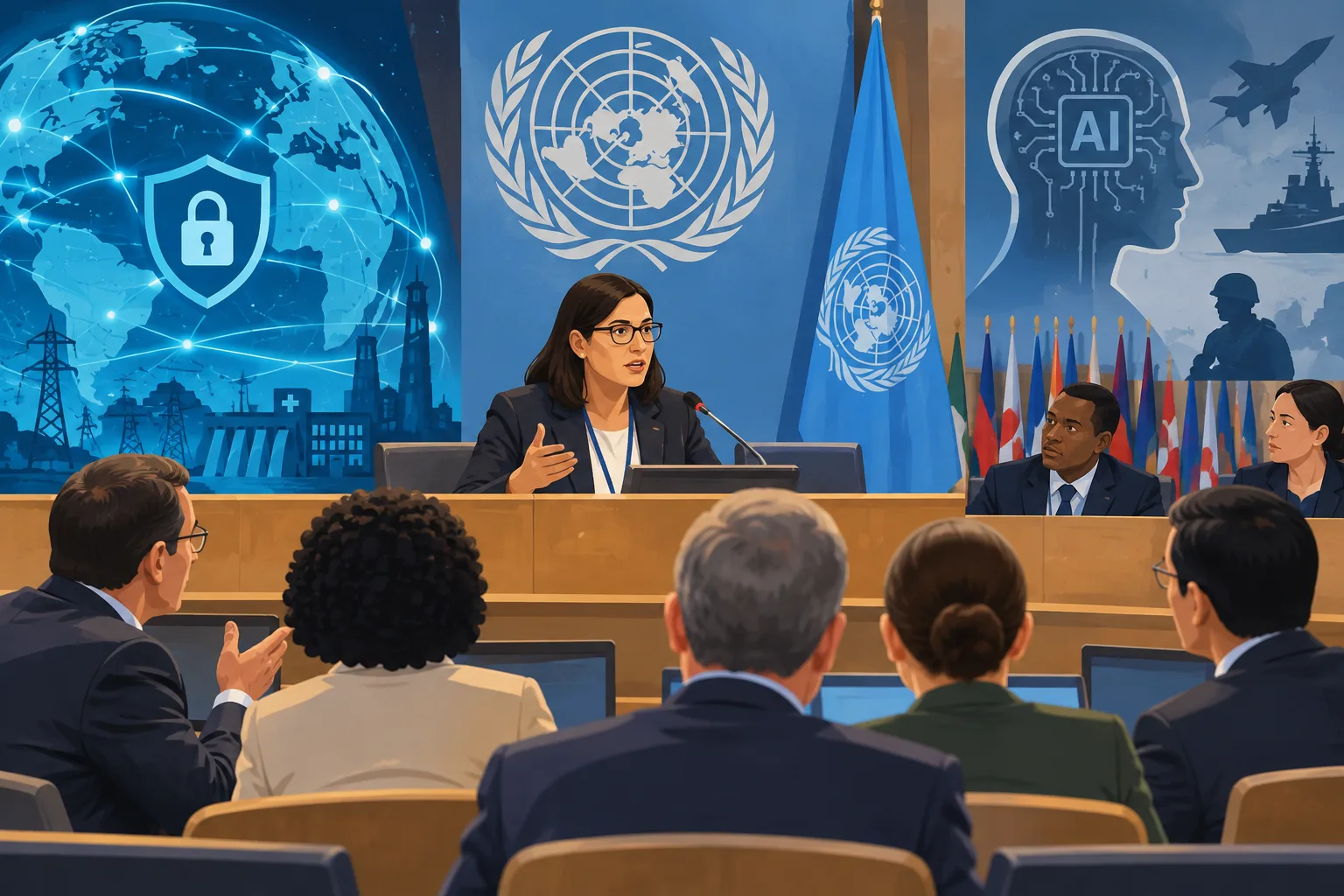
UN delegates debate cyber rules as states split over rival proposals
Loading statistics…
UN delegates warned that cyber threats can disrupt essential services and undermine international security, while disagreeing over competing proposals for governing cyberspace. The debate also exposed different positions on military AI and the application of international law.
Review information is loading.
The UN General Assembly’s First Committee has heard warnings that malicious cyber activity can disrupt essential services and threaten international peace and security, as countries debate how to govern cyberspace and manage military uses of artificial intelligence.
At a meeting on 23 October, Egriselda López of El Salvador, chair of the UN’s new Global Mechanism on information and communications technology (ICT) security, said cyber threats affect countries across all regions and levels of technological development. The mechanism is intended to provide an inclusive forum for work on cyber threats, responsible state behaviour, international law, confidence-building and capacity-building.
The debate exposed disagreement over how that work should proceed. Delegates broadly supported the mechanism, which succeeds the Open-Ended Working Group that ran from 2021 to 2025. But they differed over competing draft resolutions: supporters of a proposal from the mechanism’s chair warned that parallel initiatives could fragment the process, while Russia defended its own draft as complementary, including through proposed UN-sponsored cyber exercises.
Brazil, Switzerland and the UK urged states to bring new initiatives into the mechanism. Russia rejected the claim that its proposal would create a parallel track.
López said the mechanism’s thematic working groups are due to hold their first meetings in December. Delegates called for attention to protecting critical infrastructure and for developing countries to receive technical assistance, training and financial support to strengthen cyber resilience and take part in global discussions.
The committee also heard differing views on AI in the military. Australia backed the development of inclusive norms grounded in existing international law; the Philippines, Pakistan and France stressed human control and safeguards against risks including miscalculation and escalation. The US supported cooperation on emerging technologies but opposed using the UN to discuss military “super intelligence”, arguing that such talks would turn towards restricting innovation. Venezuela, meanwhile, said international law and international humanitarian law were not automatically applicable in cyberspace.
The UN account described the meeting as media information, not an official record.
How do we know?
1 listed sources · explore evidence, limitations and provenance.
Sign in to give this article a thumbs up or down.
About this discussion and AI questions
Private test discussion. Comments are readers’ views and are not yet automatically fact-checked. Editing is available for 60 seconds after posting.
Sign in with a confirmed reader account and choose a username to read comments and participate.
Sorting applies to top-level comments; replies remain oldest first. New comments and likes can change the order. Refresh for the current ranking.
Loading comments…