News Made Clear · Loading…
Category
Regions
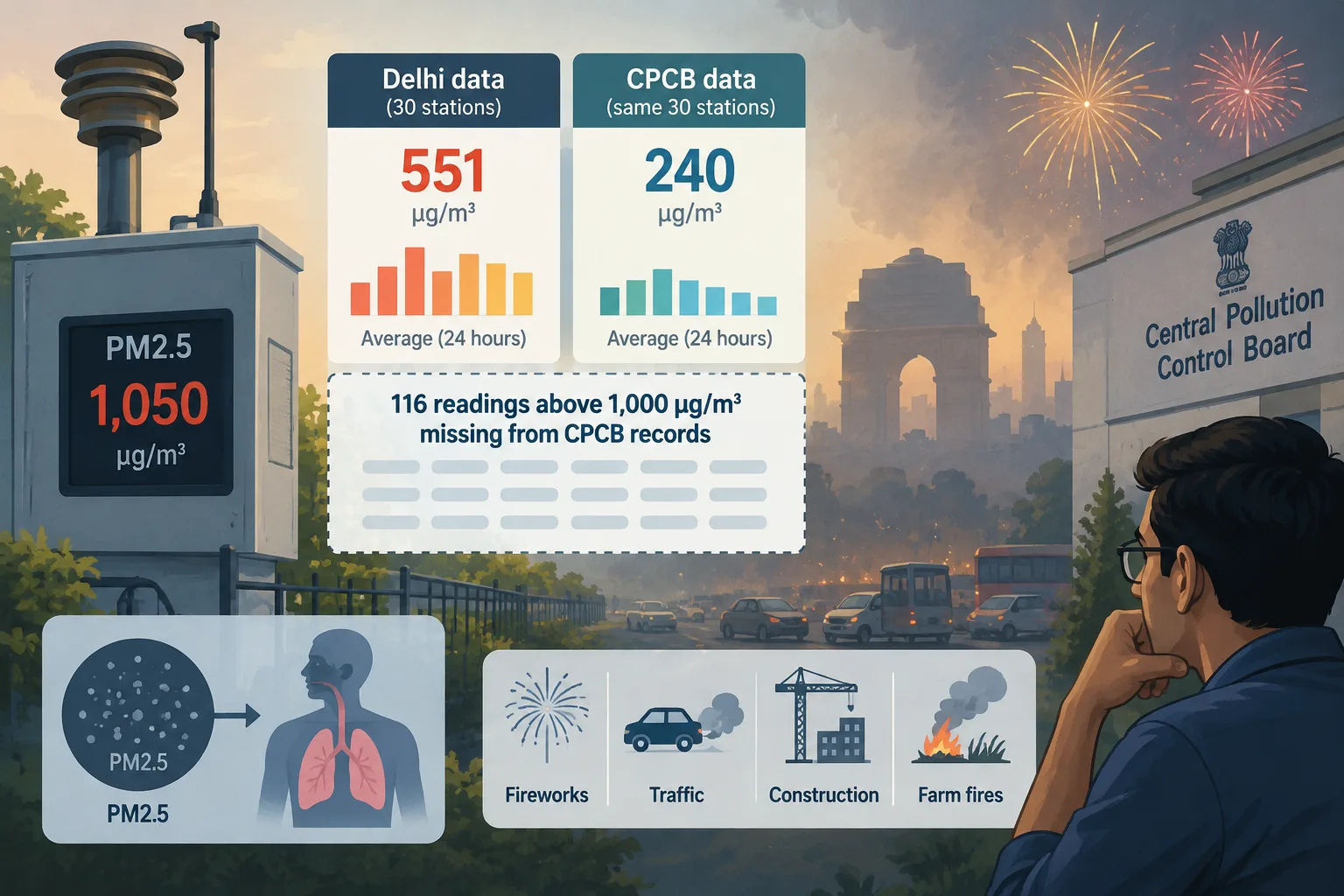
High Delhi pollution readings missing from national data during Diwali
Loading statistics…
A comparison of pollution records found that some of the highest readings around Diwali were absent from India’s published data, raising questions about whether the figures captured the full extent of Delhi’s air pollution.
Review information is loading.
BBC Verify compared data from 30 stations run by the Delhi Pollution Control Committee with the published records of India’s Central Pollution Control Board (CPCB). It found that none of the 116 hourly PM2.5 readings above 1,000 micrograms per cubic metre in the Delhi data appeared in the national records.
PM2.5 is fine particulate matter that can damage the lungs and cause other serious health problems. Delhi’s air was already rated “very poor” before the festival, when authorities tightened pollution controls. Fireworks can add to pollution from sources including traffic, construction and farm fires.
For the same 30 stations over 24 hours around Diwali night, BBC Verify calculated an average PM2.5 concentration of 240 micrograms per cubic metre from available CPCB readings, compared with 551 in the Delhi data. Those figures are not air quality index scores, and the comparison does not establish exactly how the missing readings affected Delhi’s published index.
The CPCB said readings above 1,000 are treated as outside the range for which its system is calibrated. Such hours can appear as gaps and do not contribute to the relevant station’s 24-hour average for that pollutant. Values beyond that range cannot automatically be assumed to be precise.
The Hindustan Times separately found gaps in PM2.5 readings at 43 of Delhi’s 59 monitoring stations between 10pm on 8 November and 6am the following morning. At 14 of those stations, the last reading before the gap was at least 900 micrograms per cubic metre.
Under the CPCB’s method, a pollutant sub-index generally needs at least 16 hours of data. A station’s air quality index is based on its worst pollutant sub-index, so it is distinct from a PM2.5 concentration.
Manoj Kumar, a researcher at the Centre for Research on Energy and Clean Air, told the BBC that excluding high readings risked misrepresenting pollution levels and undermining trust. The CPCB has said it is reviewing how data beyond the system’s designed range is processed, Moneycontrol reported.
How do we know?
4 listed sources · explore evidence, limitations and provenance.
Sign in to give this article a thumbs up or down.
About this discussion and AI questions
Private test discussion. Comments are readers’ views and are not yet automatically fact-checked. Editing is available for 60 seconds after posting.
Sign in with a confirmed reader account and choose a username to read comments and participate.
Sorting applies to top-level comments; replies remain oldest first. New comments and likes can change the order. Refresh for the current ranking.
Loading comments…