News Made Clear · Loading…
Category
Regions
Continents
Topics
Delhi air quality worsens days before Diwali as controls tighten
Loading statistics…
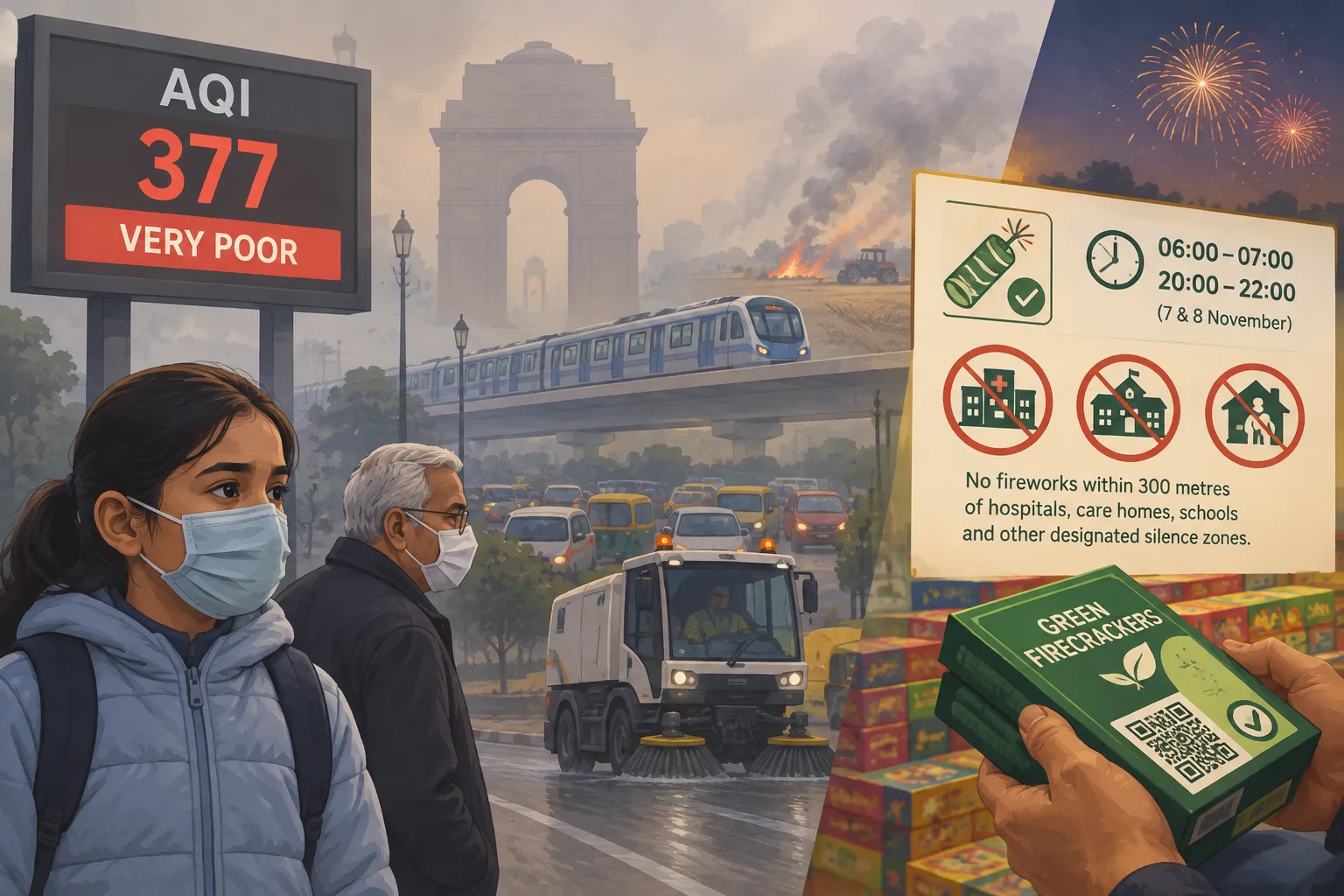
Delhi’s air quality reached the “very poor” category on Wednesday, days before Diwali. Authorities have stepped up pollution controls, while a Supreme Court order allows certified green firecrackers for limited hours on 7 and 8 November.
Review information is loading.
Delhi’s air quality has deteriorated to “very poor” levels days before Diwali, prompting authorities to tighten measures against pollution as the Supreme Court permits the limited use of certified green firecrackers during the festival.
The city’s air quality index (AQI) stood at 377 on Wednesday morning, within India’s “very poor” range of 301 to 400. Prolonged exposure can cause respiratory problems and aggravate existing illnesses, with children and older people particularly vulnerable, according to the BBC.
Delhi has activated Stage II of its Graded Response Action Plan. Measures include more intensive road cleaning, higher parking charges and additional public transport. Delhi Metro has added 20 weekday train trips, while government offices have been told to stagger working hours to ease congestion. Officials said forecasts suggested the air would remain very poor over the coming days.
The deterioration follows an unusually clean October, when Delhi recorded its lowest monthly average AQI in eight years. The BBC reports that experts have pointed to falling temperatures, slow winds and increased crop-residue burning in neighbouring Punjab and Haryana. A recent storm temporarily improved conditions with rain and stronger winds, before northwesterly winds returned and carried smoke towards the capital.
The Supreme Court on Monday allowed certified green firecrackers to be made, sold and used in Delhi and neighbouring areas for a limited period. They may be set off only between 06:00 and 07:00, and 20:00 and 22:00 local time, on 7 and 8 November. Fireworks are prohibited within 300 metres of hospitals, care homes, schools and other designated silence zones.
Green firecrackers are designed to produce fewer emissions than conventional ones and must carry QR codes showing manufacturer and certification details. But enforcement has been difficult: the court acknowledged that conventional crackers had continued to be sold as green alternatives even during a complete ban. It has directed police to patrol sales areas, check QR codes at random and seize illegal fireworks.
Fireworks are one contributor to Delhi’s seasonal pollution, alongside vehicle exhaust, industrial emissions and crop burning. The BBC also reports elevated pollution in Mumbai in recent weeks, although the city’s AQI had improved to 89 on Wednesday, in the “satisfactory” category.
How do we know?
1 listed sources · explore evidence, limitations and provenance.
Sign in to give this article a thumbs up or down.
About this discussion and AI questions
Private test discussion. Comments are readers’ views and are not yet automatically fact-checked. Editing is available for 60 seconds after posting.
Sign in with a confirmed reader account and choose a username to read comments and participate.
Sorting applies to top-level comments; replies remain oldest first. New comments and likes can change the order. Refresh for the current ranking.
Loading comments…