News Made Clear · Loading…
Category
Regions
Continents
Topics
EU advocate general says Gemini may infringe news publishers’ rights
Loading statistics…
An EU advocate general says Google’s Gemini chatbot may infringe news publishers’ rights if it bypasses access restrictions or gives answers that recognisably substitute for articles. The advice is not a final court ruling.
Review information is loading.
Google’s Gemini chatbot could infringe news publishers’ rights when it retrieves online articles and reuses their expression in answers, an EU advocate general has advised. The opinion says that depends on how the material is accessed and whether a response substitutes for the original article; it is not a final ruling on Google’s liability.
Maciej Szpunar’s opinion, delivered on 3 November in a case brought by Hungarian publisher Like Company against Google Ireland, sets out conditions under which publishers’ rights may apply to chatbot answers. He said infringement may arise if a chatbot bypasses effective restrictions such as a paywall, or if an answer reproduces a recognisable form of expression from an article to the extent that readers no longer need to visit the original.
A chatbot could also infringe publishers’ rights if that recognisable reuse happens systematically in answers to related queries. The opinion says a provider may be responsible where such use is inherent in its business model or it has failed to take appropriate measures to prevent it.
But the opinion draws a line between an article’s expression and the facts it reports. Publishers’ rights do not give them a monopoly over news facts, Szpunar said; a summary that conveys facts in a different form would not, on that basis alone, reproduce the article.
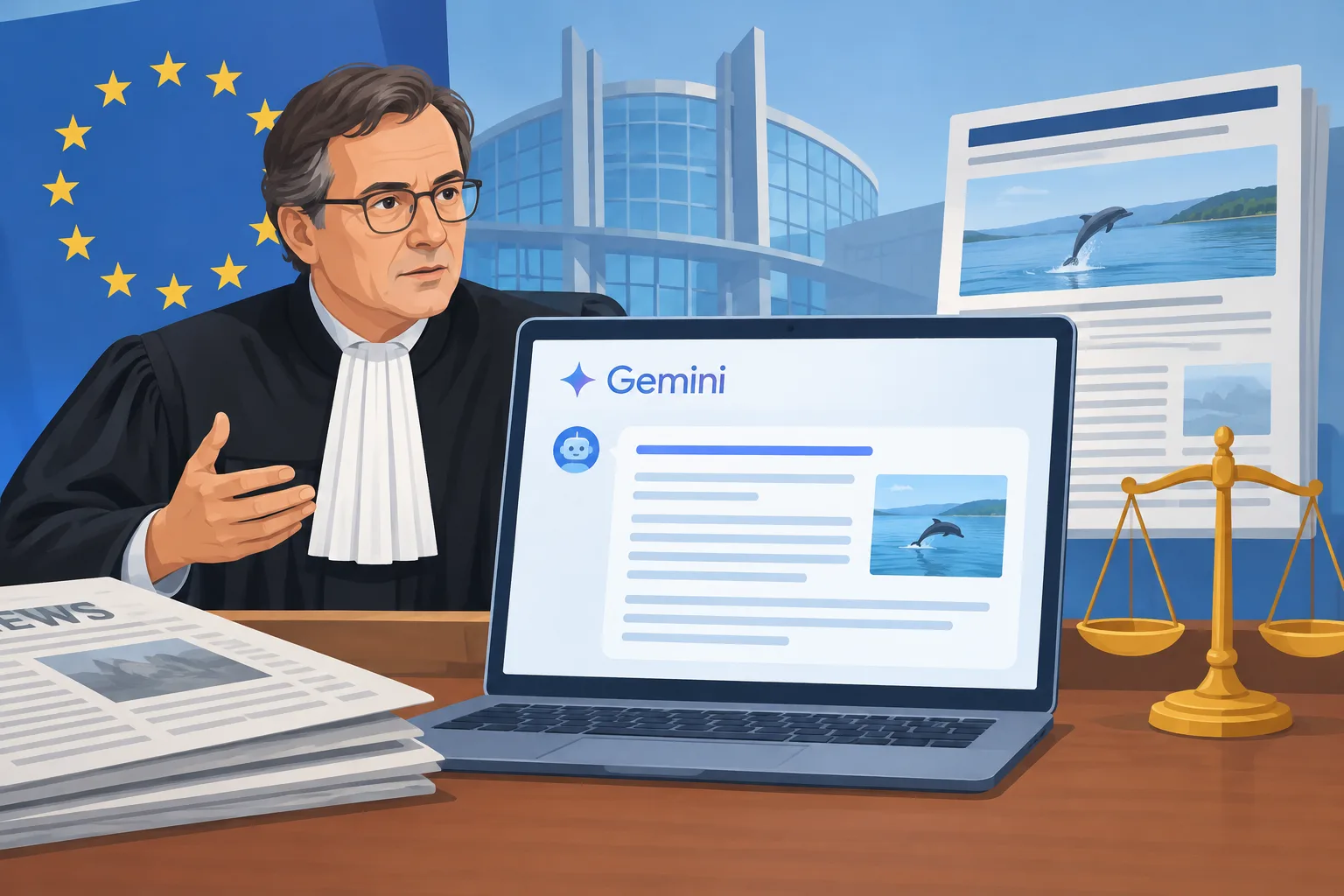
The case centres on Like Company’s claim that Gemini generated a summary of an article from one of its Hungarian websites. The article concerned singer Kozsó’s reported plan to bring dolphins to Lake Balaton. Szpunar noted that the chatbot’s answer included details not present in the article, and that the example did not appear to show recognisable reuse of its expression. He also said it was not apparent that the publisher had installed effective technical restrictions.
The advocate general advised the Court to set aside questions about whether Like Company’s articles had been used to train Gemini’s language models: he considered them hypothetical because the case file contained no evidence those articles were used for training. His opinion instead focuses on Gemini’s real-time retrieval of online material to answer users.
Advocates general give independent legal opinions to help the Court of Justice decide cases, but their advice is not binding. The Court will issue its judgment later; the Hungarian court will then resolve the dispute in light of that ruling.
How do we know?
3 listed sources · explore evidence, limitations and provenance.
Sign in to give this article a thumbs up or down.
About this discussion and AI questions
Private test discussion. Comments are readers’ views and are not yet automatically fact-checked. Editing is available for 60 seconds after posting.
Sign in with a confirmed reader account and choose a username to read comments and participate.
Sorting applies to top-level comments; replies remain oldest first. New comments and likes can change the order. Refresh for the current ranking.
Loading comments…