News Made Clear · Loading…
Category
Regions
NASA tests lidar designed to fill gaps in 3D maps of Earth
Loading statistics…
NASA says an airborne test of its CASALS lidar produced science-quality data, a step towards filling gaps in laser maps of Earth. The instrument still needs upgrades before it could be prepared for space.
Review information is loading.
NASA’s CASALS instrument has produced science-quality measurements during an airborne test, demonstrating how it could fill gaps in current laser maps of Earth’s surface. The technology is still being prepared for possible use in space, and several upgrades are planned before a space-ready prototype is built. [1]
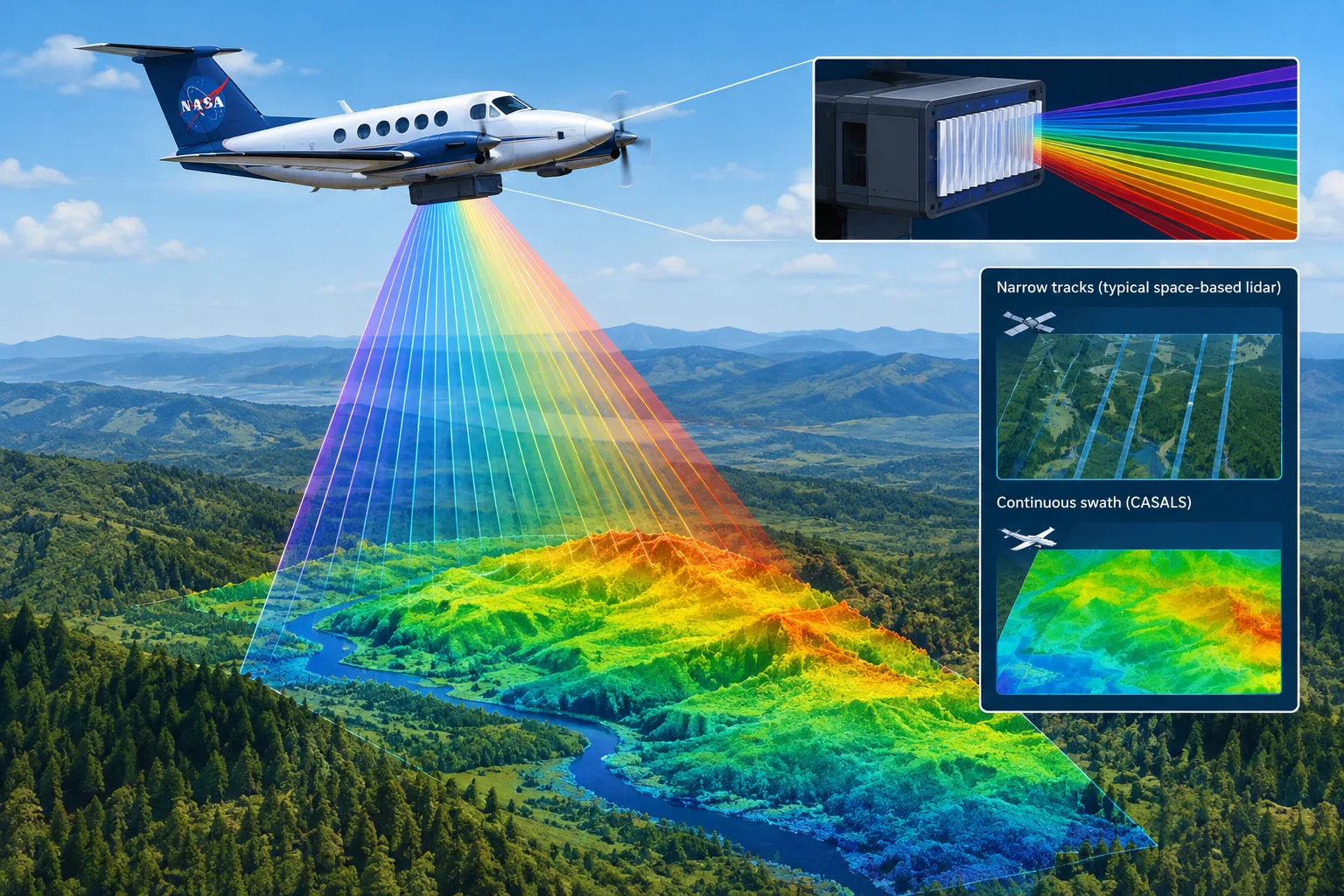
Most space-based lidar instruments measure the ground in narrow tracks, leaving large areas between them unobserved. CASALS, developed by researchers at NASA’s Goddard Space Flight Center with support from the agency’s Earth Science Technology Office, is designed to scan a continuous swath instead.
Rather than moving mirrors to steer its laser, CASALS sends pulses at 256 different wavelengths through an optical grating. Because each wavelength bends at a slightly different angle, the pulses are directed to separate positions across the flight path. NASA says the design avoids bulky moving parts and could reduce the instrument’s size, weight and power needs.
An airborne prototype flew aboard a NASA B200 King Air in November 2024. At an altitude of about five kilometres, it achieved a horizontal resolution of 22 centimetres, according to NASA, and produced what the agency describes as science-quality data on its first campaign. The instrument’s detector has a reported quantum efficiency of 80%, a measure of how effectively it converts returning light into an electrical signal.
The team plans another flight during the ASCENT campaign, scheduled for summer 2027. Before CASALS could be adapted for space, NASA says the team intends to widen its scanning swath and add onboard data-processing software. The agency says that, if successful, the system could map forests and terrain as continuous three-dimensional swaths rather than isolated profiles. [1]
How do we know?
1 listed sources · explore evidence, limitations and provenance.
Sign in to give this article a thumbs up or down.
About this discussion and AI questions
Private test discussion. Comments are readers’ views and are not yet automatically fact-checked. Editing is available for 60 seconds after posting.
Sign in with a confirmed reader account and choose a username to read comments and participate.
Sorting applies to top-level comments; replies remain oldest first. New comments and likes can change the order. Refresh for the current ranking.
Loading comments…