News Made Clear · Loading…
Category
Regions
Continents
Topics
Netherlands targets Europe’s strongest medtech sector by 2035 with €302.5m backing
Loading statistics…
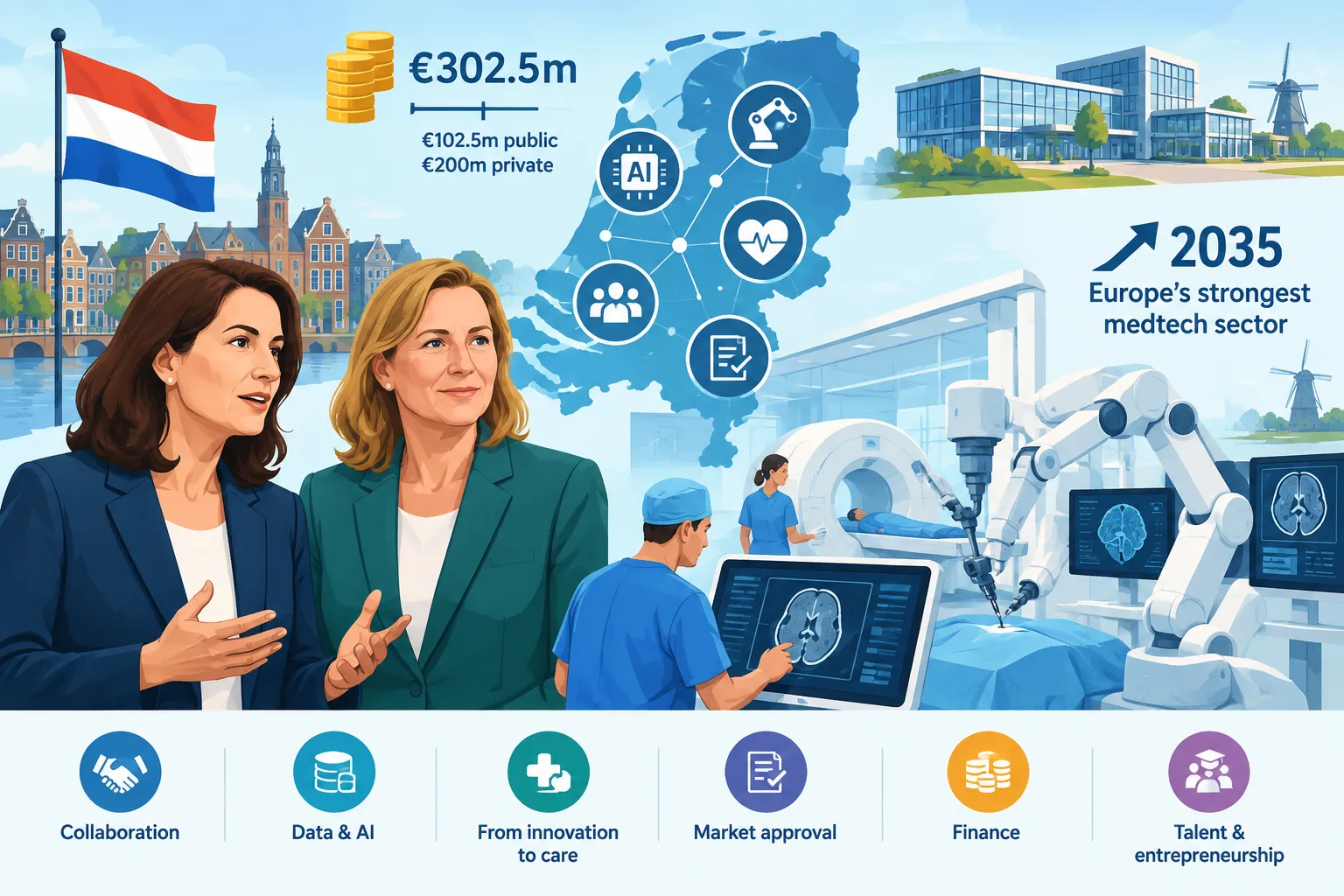
The Netherlands is aiming to have Europe’s strongest medical technology sector by 2035, with €102.5 million in public funding and €200 million in announced private investment. The government’s plan focuses on AI, robotics and getting innovations into healthcare.
Review information is loading.
The Dutch government has set an ambition to make the Netherlands home to Europe’s strongest medical technology sector by 2035, backed by €102.5 million in public funding and a further €200 million announced by investors and Philips.
Invest-NL and institutional investors, including pension funds, announced €150 million in private financing on Monday. Philips had announced a €50 million investment in July, according to the government. The funding is intended to support the country’s medical technology sector, though the government has not set out how much of the total will go to each initiative.
The government’s MedTech 2035 agenda, presented jointly with businesses, research institutions, investors and healthcare organisations, identifies six priorities: collaboration across regional ecosystems, data and AI infrastructure, putting technology into use in healthcare, market approval, finance, and talent and entrepreneurship.
Two initiatives are singled out for investment: a new generation of image-guided therapies using AI and robotics, and technology for future healthcare. The government says image-guided treatments could improve care for conditions including heart disease, stroke, cancer and trauma. It also points to a “Hospital of the Future” project in Twente, where regional innovations are intended to be approved and scaled up more quickly.
Economic affairs minister Heleen Herbert said medical technology could help address staff shortages and rising demand linked to an ageing population, as well as strengthen the Dutch economy. Health minister Sophie Hermans said AI and robotics could help care teams treat more patients with the same number of staff, or give them more time with patients.
The agenda also acknowledges growing international competition from outside the EU in image-guided therapies. The government says closer cooperation between companies, research bodies and healthcare providers should help the Netherlands retain and build on its position in the field.
How do we know?
1 listed sources · explore evidence, limitations and provenance.
Sign in to give this article a thumbs up or down.
About this discussion and AI questions
Private test discussion. Comments are readers’ views and are not yet automatically fact-checked. Editing is available for 60 seconds after posting.
Sign in with a confirmed reader account and choose a username to read comments and participate.
Sorting applies to top-level comments; replies remain oldest first. New comments and likes can change the order. Refresh for the current ranking.
Loading comments…