News Made Clear · Loading…
Category
Regions
Topics
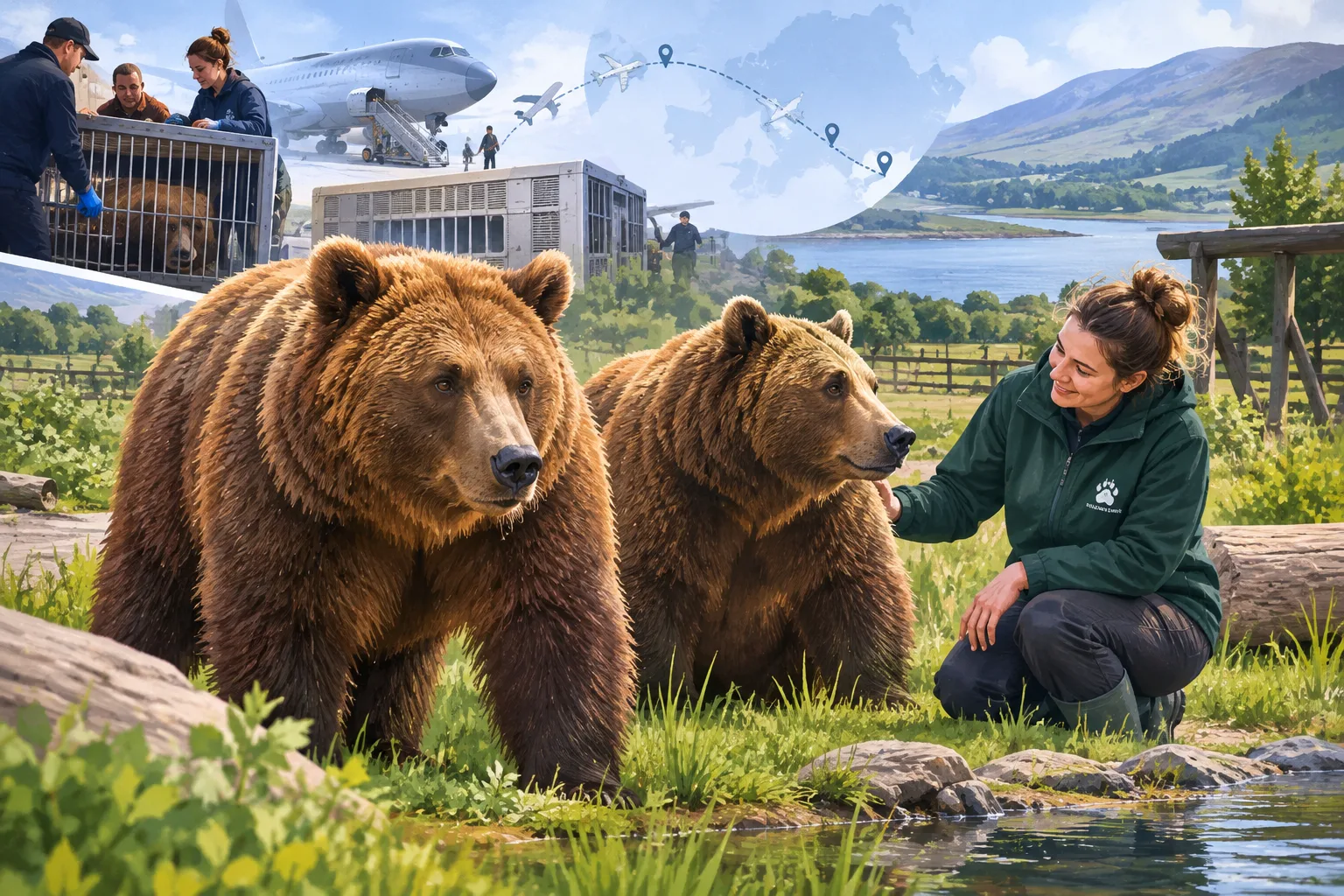
Rescued bears reach Donegal sanctuary after five-year journey
Loading statistics…
Bu and Tyapa arrived at a sanctuary in County Donegal in August after a five-year rescue effort involving more than 100 people and repeated delays caused by conflict and transport disruption.
Review information is loading.
Two brown bears rescued from cramped cages in Russia have arrived at a wildlife sanctuary in County Donegal after a five-year operation disrupted by the wars in Ukraine and the Middle East.
Bu and Tyapa reached Wild Ireland, in Burnfoot, on 3 August after travelling from Moscow via Abu Dhabi to Dublin. The sanctuary’s founder, Killian McLaughlin, said the bears had been in very poor health when rescued and were now gaining weight, with improved coats and kidney function returning to normal in follow-up blood tests.
The rescue began in 2021, when McLaughlin committed to bringing the bears to safety. Russia’s invasion of Ukraine in February 2022 ruled out the planned route through the country, he said. A route through the Middle East was later considered, but airspace closures and flight disruption amid the conflict involving Iran delayed plans again in February 2026.
In October 2025, Dima and Yana Kim, who work at a sanctuary near St Petersburg, drove for 36 hours to Dagestan to collect the bears. They had to be cut from their rusting cages, sedated and moved in secure crates to the sanctuary, where they received veterinary care and were quarantined before their onward journey.
McLaughlin said former circus bear Bu had spent years in a small indoor cage. Tyapa had been kept in a cage measuring 2.5 metres by 2.5 metres by two metres, too low for the bear to stand upright, and without a roof. McLaughlin said Tyapa had no water dish and was given water by hose; he was being raised to be killed for a taxidermy display.
Both bears were severely malnourished and showed signs of psychological trauma when rescued, the BBC reported. Blood tests found serious kidney problems associated with prolonged dehydration.
More than 100 people took part in the operation, including volunteers, lawyers, vets, animal-transport specialists, cargo teams and officials in Russia, the United Arab Emirates and Ireland.
At Wild Ireland, the bears now have woodland, water and room to explore, as well as sheltered areas where they can retreat from view. Staff have hidden food around their habitats to encourage foraging. Team member Chloe McElhatton said the bears’ confidence had grown and that staff had seen physical and behavioural changes.
“We hope they can now have a full and happy life,” McLaughlin said.
How do we know?
1 listed sources · explore evidence, limitations and provenance.
Sign in to give this article a thumbs up or down.
About this discussion and AI questions
Private test discussion. Comments are readers’ views and are not yet automatically fact-checked. Editing is available for 60 seconds after posting.
Sign in with a confirmed reader account and choose a username to read comments and participate.
Sorting applies to top-level comments; replies remain oldest first. New comments and likes can change the order. Refresh for the current ranking.
Loading comments…