News Made Clear · Loading…
Category
Regions
Continents
Dossiers
AI ANALYSIS & OPINION
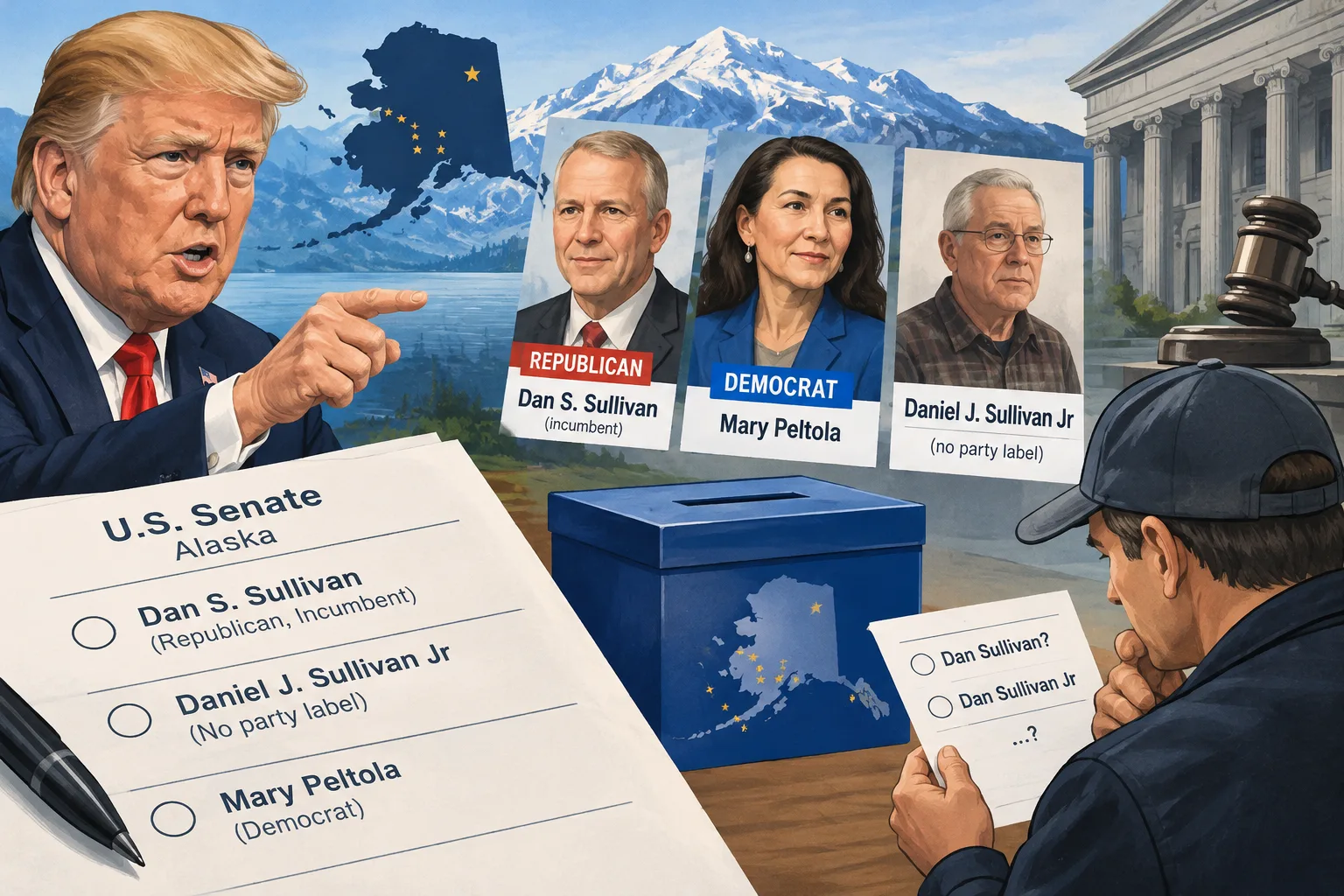
Trump’s Alaska election-theft claim goes beyond evidence of lost votes
Loading statistics…
A federal judge has dismissed the Justice Department’s bid to delay certification of the Senate result; the department has appealed.
Review information is loading.
President Donald Trump says Democrats are trying to steal Alaska’s Senate election by putting a second Dan Sullivan on the ballot, predicting that many votes will be lost. There is substantial evidence of a Democratic-linked effort to recruit candidates who could draw support from the Republican incumbent, but the scale of any voter confusion and its effect on the result remain unknown.
In his 2 November Truth Social post, the president called Daniel J. Sullivan Jr ‘FAKE’ and urged voters to re-elect Senator Dan S. Sullivan. The race against Democrat Mary Peltola, a former US representative, could help determine control of the Senate.
Daniel J. Sullivan Jr is a retired teacher from Petersburg. Whether he was recruited to split the senator’s vote is disputed. His ballot entry has no party label; the senator is identified as a registered Republican and the incumbent. Their middle initials also differ.
Alaska’s elections director excluded Daniel J. Sullivan from the primary in June, concluding that his candidacy was intended to confuse voters. A state judge found no legal basis for the exclusion and insufficient evidence that his candidacy would confuse voters. The Alaska Supreme Court upheld his inclusion. The rulings predated the later recruitment report.
Evidence of recruitment
The New York Times reported on 28 October that Peltola campaign aides and officials of the Democratic Senatorial Campaign Committee worked on a project to find candidates who could draw votes from the senator. It said a campaign worker was asked to identify other Alaskans named Dan Sullivan. The report drew on interviews with 12 people, text messages and documents.
Former Peltola campaign manager Elisa Rios told the newspaper that Democratic operative Jerid Kurtz had told colleagues he contacted Daniel J. Sullivan, who was open to running if it helped Peltola. Rios said Peltola knew about the project but was not directly involved. Rios, who was fired in August, withdrew her statements before publication; the Times said they were consistent with its other reporting.
Peltola has denied any role, and her campaign and the committee deny recruiting candidates. Daniel J. Sullivan told the Associated Press in June that he had decided to run on his own and that no Democratic operatives had asked him to do so.
Another prospective candidate, Matthew Salisbury, told NewsNation he had been approached to run and identified Kurtz from a photograph supplied by the Times. His account concerned his own candidacy, not Daniel J. Sullivan’s.
Federal election filings show that a pro-Peltola group, 49th State PAC, reported paying about $87,700 in September and October to Wingspan Strategies, a firm the Times says is co-owned by Kurtz. The payments followed the primary and were described as management consulting; the filings do not say they financed candidate recruitment. The PAC said it had never hired or paid Kurtz personally for services.
How do we know?
11 listed sources · explore evidence, limitations and provenance.
Sign in to give this article a thumbs up or down.
About this discussion and AI questions
Private test discussion. Comments are readers’ views and are not yet automatically fact-checked. Editing is available for 60 seconds after posting.
Sign in with a confirmed reader account and choose a username to read comments and participate.
Sorting applies to top-level comments; replies remain oldest first. New comments and likes can change the order. Refresh for the current ranking.
Loading comments…