News Made Clear · Loading…
Category
Regions
Continents
Dossiers
AI ANALYSIS & OPINION
Trump’s rural healthcare attack on Susie Lee misrepresents her vote
Loading statistics…
Lee opposed a package combining rural health funding and tip relief with major healthcare cuts. Her subsequent effort to help tipped workers claim the deduction also complicates Trump’s attack.
Review information is loading.
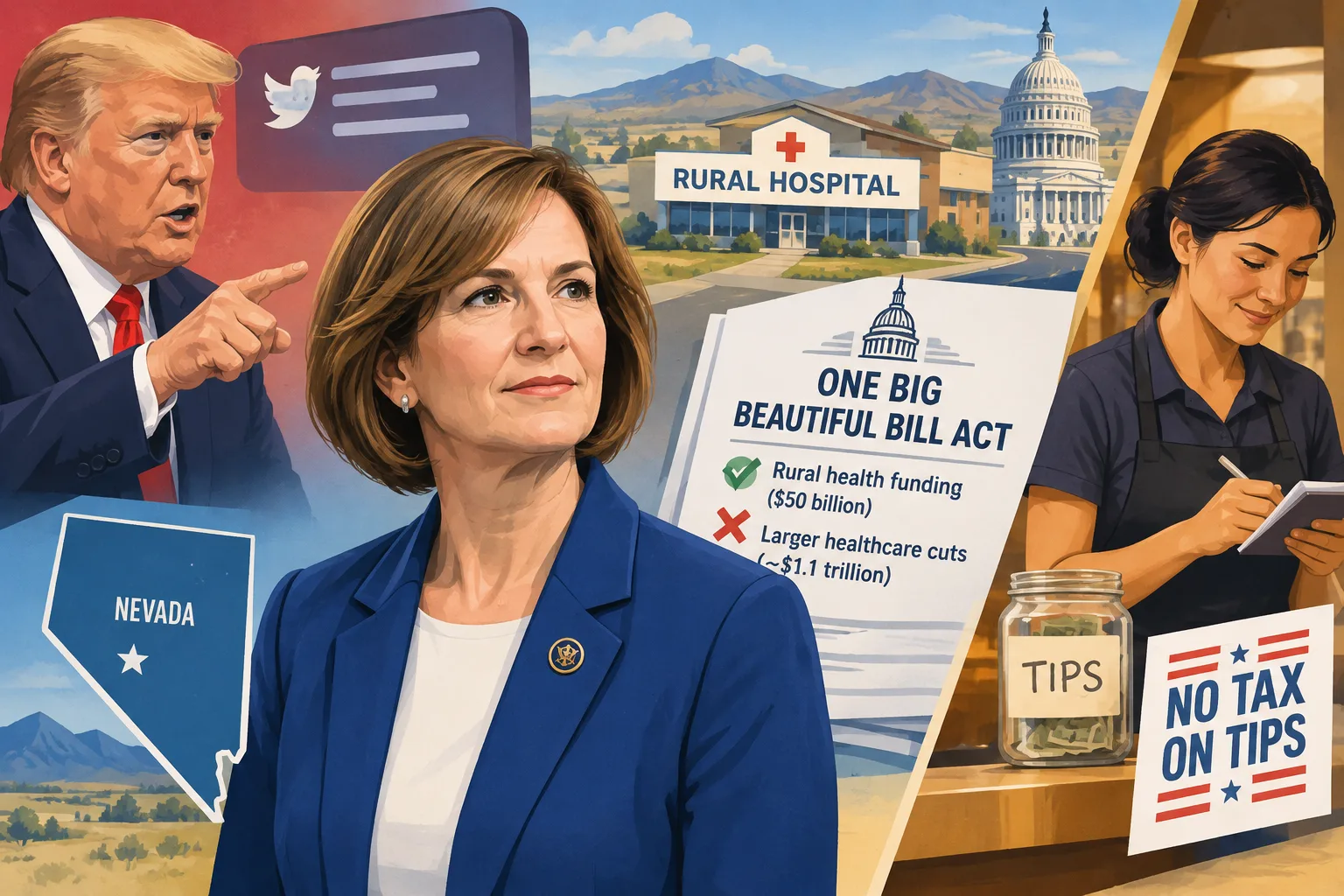
Donald Trump’s claim that Susie Lee fought to “knock out Rural Healthcare” is misleading: the Nevada Democrat voted against a sweeping law that paired new rural funding with far larger projected healthcare cuts. She later urged his administration to make the law’s tax relief on tips easier for service workers to claim.
Trump made the accusation in a Truth Social post on 26 October 2026 endorsing Republican Marty O’Donnell, who is challenging Lee in Nevada’s 3rd congressional district. He also highlighted her vote against legislation containing “NO TAX ON TIPS” and linked to Swamp the Vote USA’s Nevada voting appeal.
Lee voted against the Senate version of H.R. 1, known as the One Big Beautiful Bill Act, on 3 July 2025. The House approved it by 218 votes to 214, and Trump signed it into law the following day.
New rural funding alongside larger healthcare cuts
The law allocated $50 billion to the Rural Health Transformation Program: $10 billion for each fiscal year from 2026 to 2030, supporting approved state plans. Lee’s opposition to the package therefore did include a vote against legislation creating that funding.
But the Congressional Budget Office’s 2025 assessment, summarised by the non-partisan Congressional Research Service, projected a net reduction of about $1.1 trillion in federal healthcare spending over the 2025–2034 fiscal years. That assessment included spending on the new rural programme.
It also forecast that 10 million more people would be uninsured in 2034 than under CBO’s January 2025 baseline. Of that increase, 7.5 million was attributed to Medicaid provisions.
Medicaid is the joint federal-state health insurance programme for people on low incomes. The law tightened its eligibility and financing rules, including new work or other activity requirements for some adults, with exemptions, and restrictions on how states finance payments to healthcare providers.
A rural-specific analysis by the health-policy organisation KFF used CBO-based projections to estimate $137 billion less federal Medicaid spending on services used by rural enrollees over ten years. That exceeds the rural fund’s full $50 billion allocation over five years. The comparison is nationwide, rather than a calculation of the balance in Lee’s district.
The new funding is nevertheless being put into practice in Nevada. On 9 June 2026, the Nevada Health Authority announced $36 million in initial Flex Fund awards, part of a programme for which Nevada received a $180 million first-year allocation. Its funded-projects list includes equipment and infrastructure for Boulder City Hospital in Clark County.
The near-term effect on Nevada’s own budget was forecast to be limited. A July 2025 state assessment reported by The Nevada Independent anticipated no additional Medicaid funding request for the then-current two-year budget and about $60 million in extra state costs over five years. Those state-budget figures measure something different from federal funding reductions or residents’ insurance coverage.
How do we know?
12 listed sources · explore evidence, limitations and provenance.
Sign in to give this article a thumbs up or down.
About this discussion and AI questions
Private test discussion. Comments are readers’ views and are not yet automatically fact-checked. Editing is available for 60 seconds after posting.
Sign in with a confirmed reader account and choose a username to read comments and participate.
Sorting applies to top-level comments; replies remain oldest first. New comments and likes can change the order. Refresh for the current ranking.
Loading comments…