News Made Clear · Loading…
Category
Regions
Continents
Dossiers
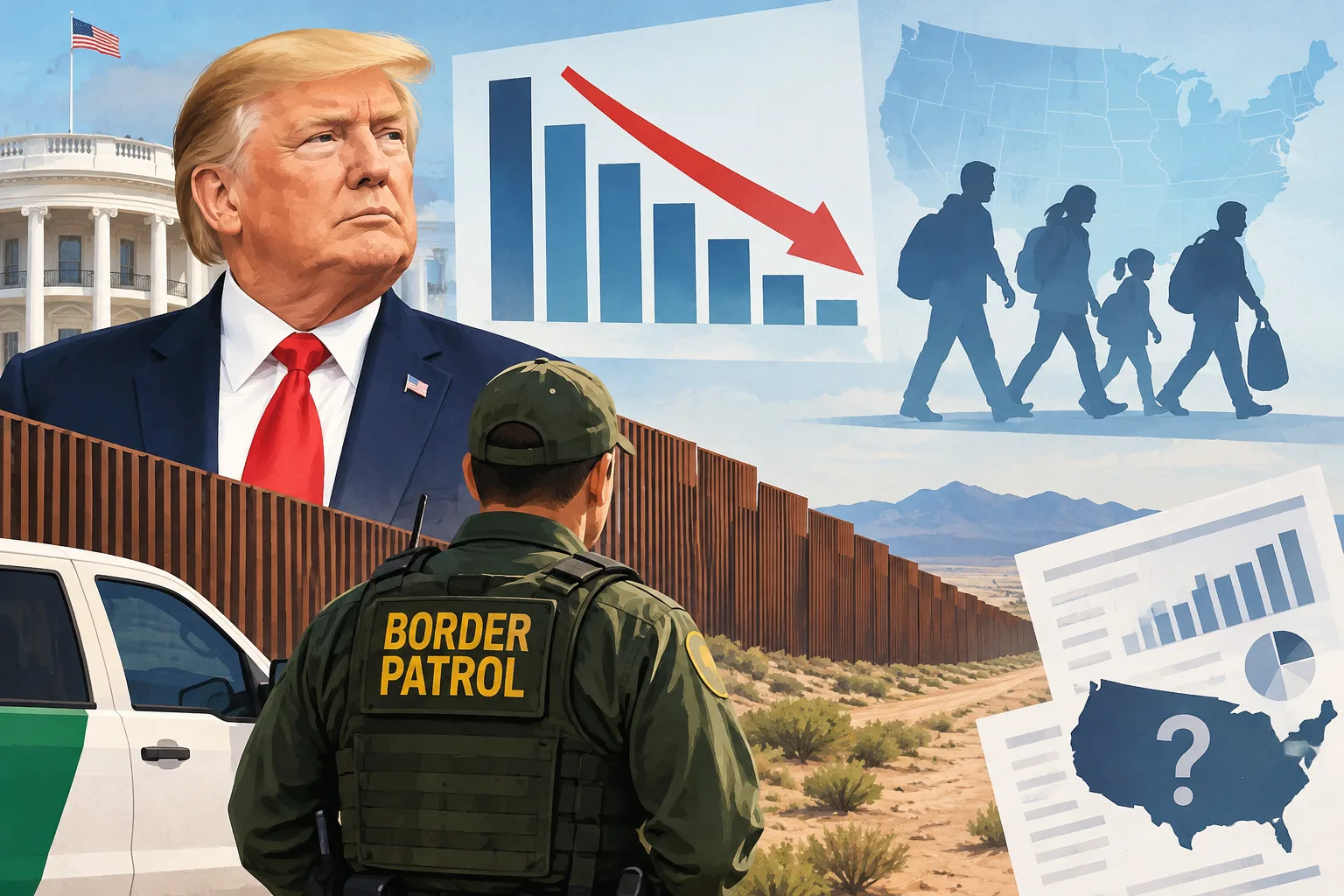
US border arrests plunge, but White House’s wider migration claims remain uncertain
Loading statistics…
US border arrests have fallen dramatically, but the White House’s claims about record-low crossings and millions of departures go further than the figures establish.
Review information is loading.
The White House said on 20 October that President Donald Trump had brought illegal border crossings to a historic low and that more than three million migrants had left the United States during his second term. Border Patrol’s provisional figures show a steep fall in arrests at the south-western border. They do not, however, establish how many migrants have departed, and the decline in border arrivals began before Trump returned to office. [1] [4] [8]
Border Patrol recorded 98,708 arrests between official crossing points on the south-western border in the financial year ending 30 September 2026, according to figures reported by KVIA. Border authorities compared that with more than 1.8 million arrests a year under Joe Biden — a fall of roughly 95%. They separately reported 379,243 migrant encounters nationwide, a broader measure. Arrests are not a count of everyone who crosses the border, including those who evade detection. [4]
The administration describes the latest border figure as the lowest in US history. But a historical Border Patrol table records 96,641 south-western border encounters in 1968, and lower totals in earlier years. Recording practices and terminology have changed, so the comparison does not measure every crossing in either period; it does not support an unqualified record-low claim for recorded arrests. [1] [4] [5]
Nor can the whole decline be assigned to one presidency. The Congressional Budget Office says immigration in its ‘other foreign nationals’ category fell after a June 2024 order issued under Biden and declined further following later government actions. Researchers at the Deportation Data Project say most of the fall in border arrivals occurred in Biden’s final year. Equally, the CBO attributes much of its subsequent reduction in migration forecasts to actions taken by the Trump administration. Those findings point to changes under both presidents, not a precise division of their effects.
How do we know?
10 listed sources · explore evidence, limitations and provenance.
Sign in to give this article a thumbs up or down.
About this discussion and AI questions
Private test discussion. Comments are readers’ views and are not yet automatically fact-checked. Editing is available for 60 seconds after posting.
Sign in with a confirmed reader account and choose a username to read comments and participate.
Sorting applies to top-level comments; replies remain oldest first. New comments and likes can change the order. Refresh for the current ranking.
Loading comments…