Assistance dog users face access challenges as businesses raise concerns over pets
Businesses have raised concerns about pets being passed off as assistance dogs, while disabled people report challenges to their access. The scale of misrepresentation remains unclear.
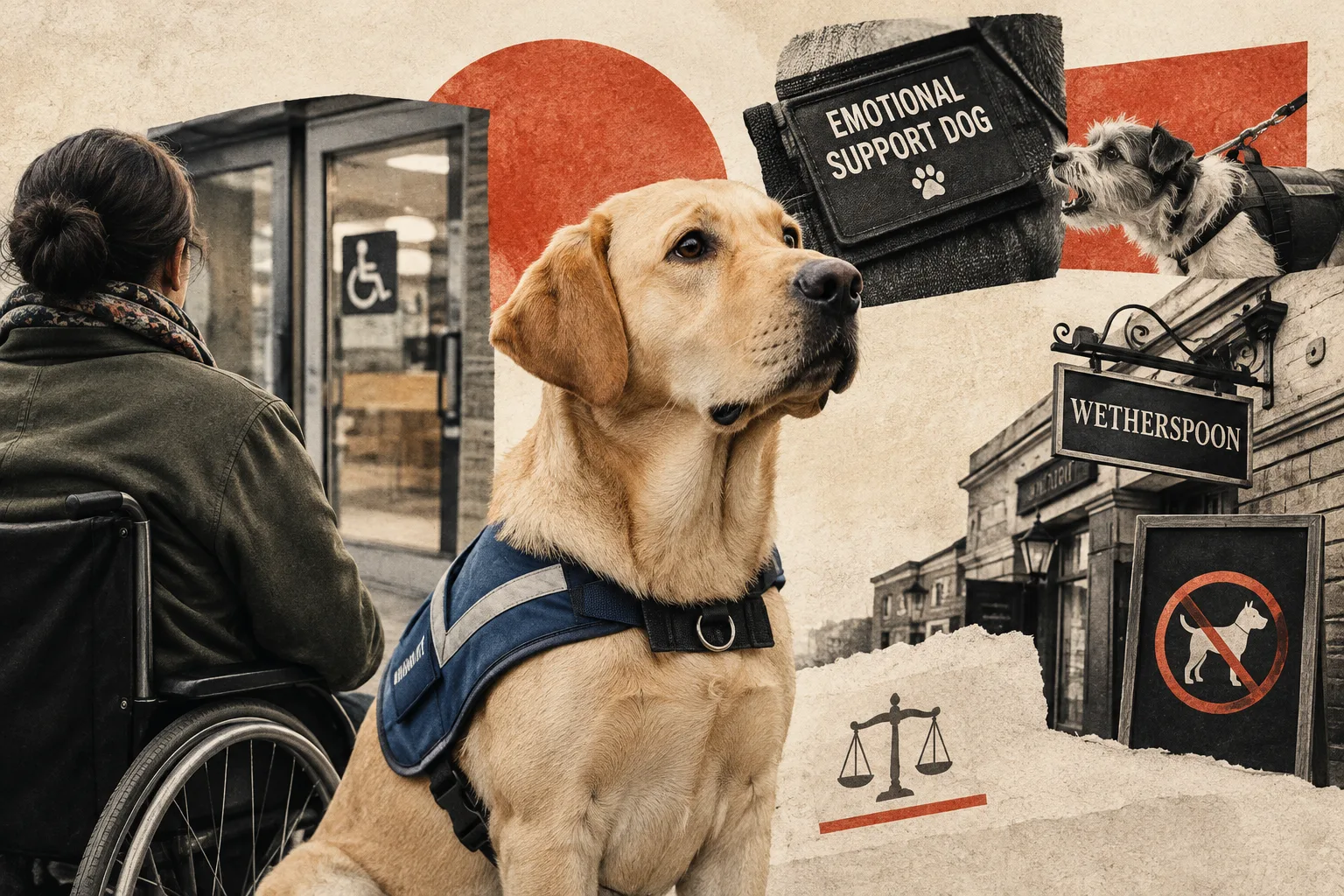
Several businesses told the BBC that customers sometimes present poorly behaved pets as assistance animals. They asked not to be named and said they feared aggressive dogs could pose a risk to customers.
The BBC reports that there are no official statistics counting medical assistance dogs. Some charities report rising demand for them, but that does not establish a rise in misrepresentation.
In a 2022 survey by Canine Companions, Independently verifiedcanine.org of respondents with dogs from accredited training programmes felt the problem of poorly trained assistance dogs had increased in recent years. The survey received 1,503 responses from North America, Europe and Oceania, including 37 from Europe. Its weighted results reflect respondents’ perceptions, not a count of misrepresented dogs or a measure of change in Britain.
In the same survey, 59% of respondents, excluding facility-dog users, reported being denied access to, or removed from, a public place. The result does not establish why they were refused.
Lauren Ruggles told the BBC that a small dog wearing an “emotional support dog” vest lunged at her guide dog, Kilko, at a Bournemouth hospital earlier this year. She believed the other dog had not been adequately trained and said Kilko was now nervous around small dogs.
Assistance dog user Chloe Hammond, who trained her own Labrador, told the BBC she was sceptical that there were large numbers of fake assistance dogs. Some people, she suggested, may rely on their dogs without knowing what training is expected.
Access checks have also prompted complaints. Pub chain Wetherspoon introduced an identification policy for assistance dogs in 2025. Guide Dogs told the BBC it had received 27 complaints from people who had either been challenged or refused entry at Wetherspoon.
In February, the Equality and Human Rights Commission said it had written to the chain and was concerned that the policy might not comply with the law. Wetherspoon said at the time that it believed the policy was lawful and reasonable after taking legal advice; it declined to comment for the BBC’s latest report.
Under the Equality Act 2010, service providers must make reasonable adjustments for disabled people; whether a particular policy is lawful depends on the circumstances and can be decided by a court. Assistance Dogs UK says its identification is not a legal requirement and not all assistance dog users carry it.
The charity’s chief executive, Vicky Worthington, wants a clearer legal definition of an assistance dog, potentially including minimum standards of behaviour. Sandra Fraser, of the Assistance Dog Assessment Association, told the BBC that long waiting lists led many owners to train their own dogs and that funding was lacking for a mandatory national training and testing system.
Sign in to give this article a thumbs up or down.
From the discussion
Private test discussion. Comments are readers’ views and are not yet automatically fact-checked. Editing is available for 60 seconds after posting.
Sign in with a confirmed reader account and choose a username to read comments and participate.
Sorting applies to top-level comments; replies remain oldest first. New comments and likes can change the order. Refresh for the current ranking.
Loading comments…