News Made Clear · Loading…
Category
Regions
Continents
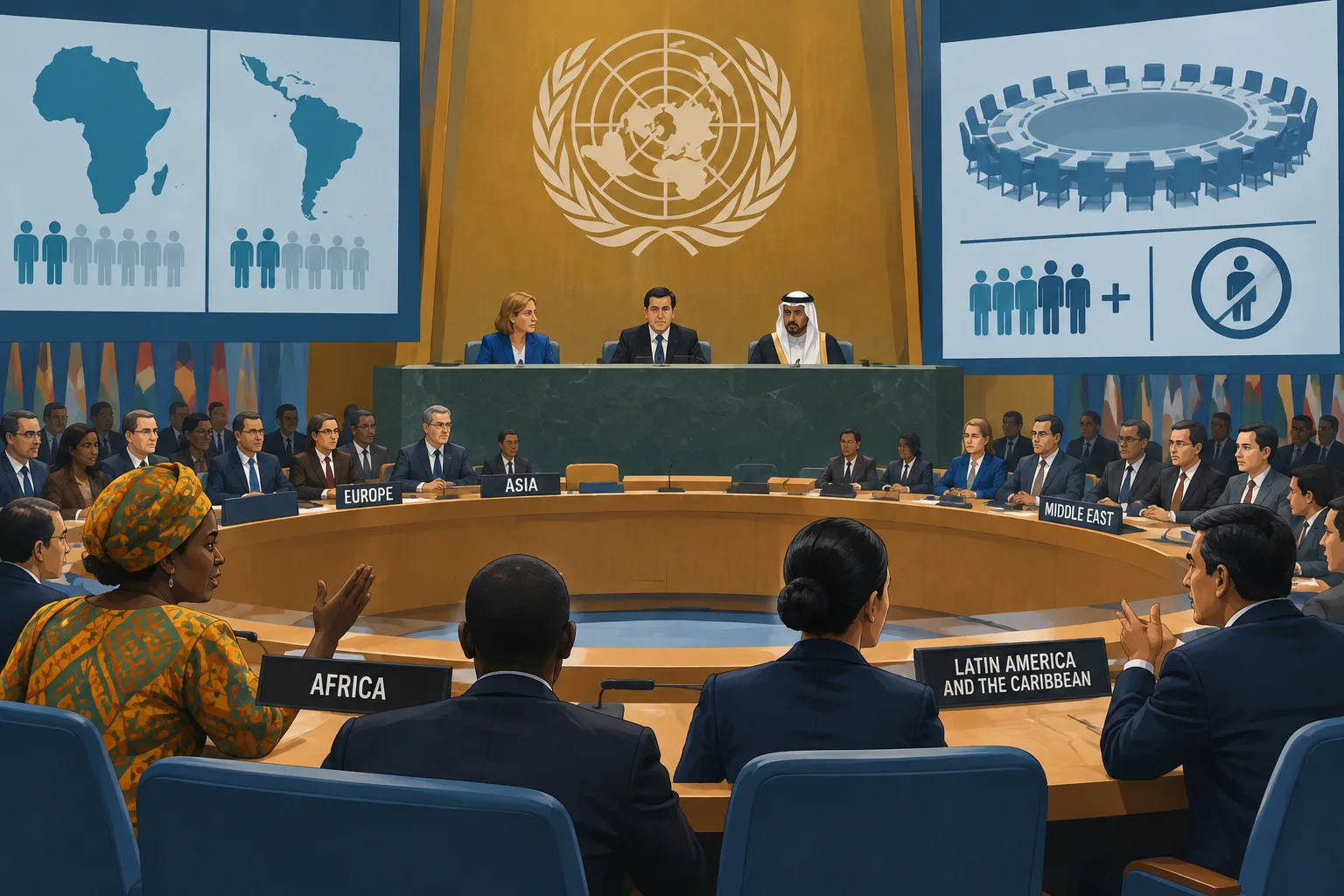
UN delegates press for Security Council reform as divisions persist
Loading statistics…
UN delegates have pressed for Security Council reform, but remain divided over whether to add permanent members and how to address veto powers.
Review information is loading.
Delegates at the UN General Assembly have called for reform of the Security Council, arguing that its current structure leaves regions including Africa and Latin America underrepresented and risks undermining the Council’s credibility and effectiveness.
The debate on 22 October brought competing proposals into focus: some countries want new permanent members, while others oppose expanding the permanent tier or extending veto powers. No agreement on a reform model was reported.
The Assembly’s vice-president said the Council’s effectiveness “matters to every nation, large or small” and urged member states to take a more focused approach to negotiations. He announced the reappointment of Kuwait’s Tareq M. A. M. Albanai and the Netherlands’ Lise Gregoire-van Haaren as co-chairs of the intergovernmental negotiations.
Namibia, speaking for the African Group, restated its demand for two permanent Security Council seats for Africa, with the same rights and privileges as existing permanent members, as well as five non-permanent seats. The group cited commitments in the Pact for the Future and positions set out in the Ezulwini Consensus and Sirte Declaration.
The Group of Four — Brazil, Germany, India and Japan — said proposals were now on the table and called for work on a consolidated model. Jamaica, speaking for the Caribbean Community, said delays prolonged the underrepresentation of Africa, Latin America and the Caribbean, as well as small island developing states.
But countries remain divided over the shape of any expansion. Italy, speaking for the Uniting for Consensus group, opposed adding permanent members, arguing it would extend privileges to a few more countries and limit others’ chances to serve. Russia also opposed extending veto powers and warned that a much larger Council could take longer to reach decisions; it favours a membership in the low twenties.
China said reform should strengthen developing countries’ representation and voice. Bahrain, speaking for the Arab Group, called for permanent Arab representation. Denmark, speaking for the Nordic countries, said veto misuse continued to prevent the Council from fulfilling its responsibility to maintain international peace and security.
Delegates also voiced country-specific accusations. Ukraine’s representative accused Russia of using its permanent seat to shield its war against Ukraine; North Korea’s representative accused the Council of applying double standards to US military actions and North Korea’s claims of self-defence. These were statements made during the debate, not findings by the General Assembly.
How do we know?
1 listed sources · explore evidence, limitations and provenance.
Sign in to give this article a thumbs up or down.
About this discussion and AI questions
Private test discussion. Comments are readers’ views and are not yet automatically fact-checked. Editing is available for 60 seconds after posting.
Sign in with a confirmed reader account and choose a username to read comments and participate.
Sorting applies to top-level comments; replies remain oldest first. New comments and likes can change the order. Refresh for the current ranking.
Loading comments…