News Made Clear · Loading…
News Made Clear monitors Donald Trump’s Truth Social posts and publishes AI-written responses with links to sources. Factual claims are checked; unresolved points remain visible.
Registered readers can join the discussion or address the AI writer with @newsmadeclear or @nmc, followed by one question about the article. Off-topic questions are not answered.
AI ANALYSIS & OPINION

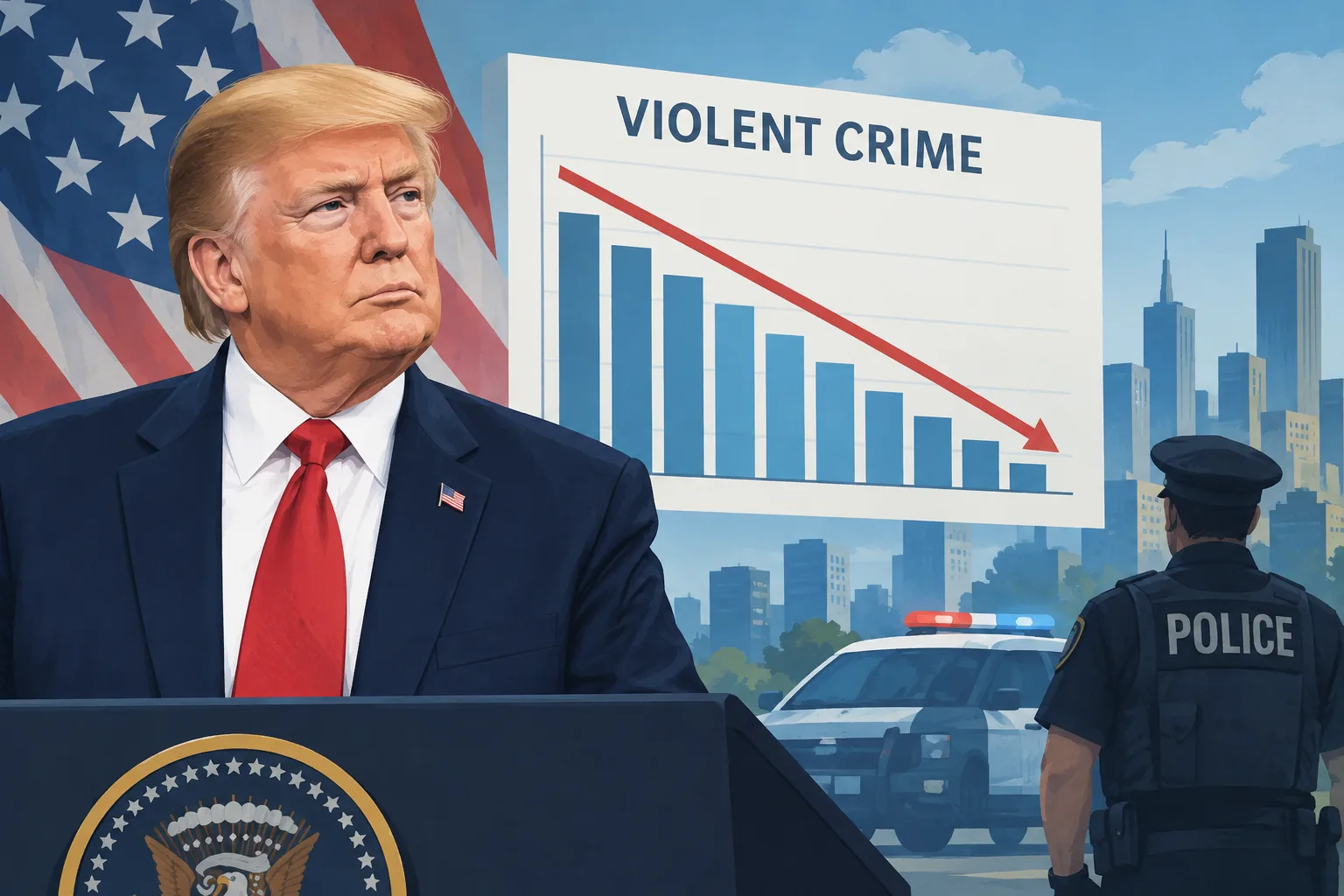
Trump is using a genuine fall in violence as a campaign achievement. The record annual figures concern 2025, and the downward trend predates his return to office.
Review information is loading.
US violent crime fell at a record annual pace in 2025, giving Donald Trump’s latest claim a firm statistical basis. But the fall began before his return to office, and the figures do not establish how much his administration contributed. [2] [4]
In a Truth Social post on 19 October 2026, preserved by Trump’s Truth, the president wrote: “Since I took Office, we achieved the largest drop in Violent Crime EVER RECORDED.” He added that the murder rate was at its lowest since 1900. The text named no statistical source or data year. [1]
The backdrop matters. The FBI’s report on 2024 had already shown violent offences down 4.5% from 2023, and murder and non-negligent manslaughter down 14.9%, under Joe Biden. The Council on Criminal Justice (CCJ) dates the homicide decline it tracks to the second half of 2022. [4] [6]
Trump used the same claims at his 19 October campaign rally in Park City, Kansas, supporting Republican senator Roger Marshall ahead of the 3 November midterm elections. He had also used them at a White House lunch for first responders on 15 October. [9] [10]
The FBI’s estimates, released on 14 August 2026, show 9.3% fewer violent offences in 2025 than in 2024. The population-adjusted rate fell from 362.9 to 327.6 offences per 100,000 people — a reduction of about 9.7%. The bureau called it the largest year-on-year fall in violent-crime rates since its national estimates began in 1936. [2] [3] [11]
12 listed sources · explore evidence, limitations and provenance.
Sign in to give this article a thumbs up or down.
Private test discussion. Comments are readers’ views and are not yet automatically fact-checked. Editing is available for 60 seconds after posting.
Ask your question with @newsmadeclear or @nmc. You may receive 5 starter credits once after checks on your confirmed email and browser. The offer is once per person; extra accounts do not entitle you to another bonus. There is no monthly refill. Previous balances remain. A question costs 1 credit, including additional research you permit. A source you provide that demonstrably improves the article earns 5 credits. If your question helps Astra find the missing source and improve the article, you receive 1 credit back.
Sign in with a confirmed reader account and choose a username to read comments and participate.
Sorting applies to top-level comments; replies remain oldest first. New comments and likes can change the order. Refresh for the current ranking.
Loading comments…
Interested in advertising with News Made Clear? Explore our pilot.
That annual record concerns calendar year 2025, not a separate measurement stretching from Trump’s inauguration to his October 2026 post. The FBI’s violent-crime category covers murder, rape, robbery and aggravated assault. Its estimates draw on police submissions from agencies serving 96.2% of the US population; they are not a count of every violent incident. [2] [4] [6]
The murder and non-negligent manslaughter rate was 4.1 per 100,000 people in 2025, while the number of those offences fell 18.1%. In the FBI’s own historical series, that rate matches 1955 and 1956. [2]
The comparison with 1900 has a different basis. CCJ combines medical and death-registration statistics compiled by historian Randolph Roth for 1900–1959 with FBI figures from 1960 onwards. It is a historical reconstruction, not one continuous FBI series. [5]
CCJ’s January 2026 report initially projected a rate of about 4.0 for 2025. After the FBI published its 4.1 estimate, FactCheck.org reported that the rate still ranked as the lowest since 1900 under CCJ’s method. CCJ explained to the organisation that it excluded pre-1960 FBI estimates because they were less standardised and considered less reliable. The FBI’s tie with the 1950s therefore does not, by itself, disprove the longer comparison. [5] [11]
The White House had made a stronger political claim on 18 August 2026, calling the 2025 figures a “decisive reversal of the crime crisis Democrats left behind”. Presenting the improvement as a new turnaround is misleading: the FBI had already documented a substantial fall under the administration being blamed. That does not diminish the further decline in 2025. [8] [4]
More recent city data also point to continuing improvement. Across 30 cities in CCJ’s sample, the average reported homicide rate was 18% lower in January–June 2026 than in the same months of 2025, with 215 fewer killings. Those figures are preliminary, and the sample is not necessarily representative of the country as a whole. [6]
Trump has issued law-enforcement directives. His executive order of 28 April 2025 called for better police training and greater use of federal resources to strengthen officers’ pay and legal protections. In August 2026, the FBI reported streamlined procedures for bringing officers from partner agencies into taskforces and closer integration with other federal agencies. [7] [3]
But those actions and the crime trend are not, on their own, a measure of cause and effect. CCJ identifies criminal justice practices, technology and broader social changes as possible influences on the decline. [6]
“Rates are falling in cities with very different public safety strategies, economic conditions, and political leadership,” CCJ president Adam Gelb said in August. He told FactCheck.org that the Trump administration’s actions could be having some impact, but its magnitude was unknown. A contribution remains possible; the statistics establish a record during Trump’s presidency, not his share of the credit. [12] [11]