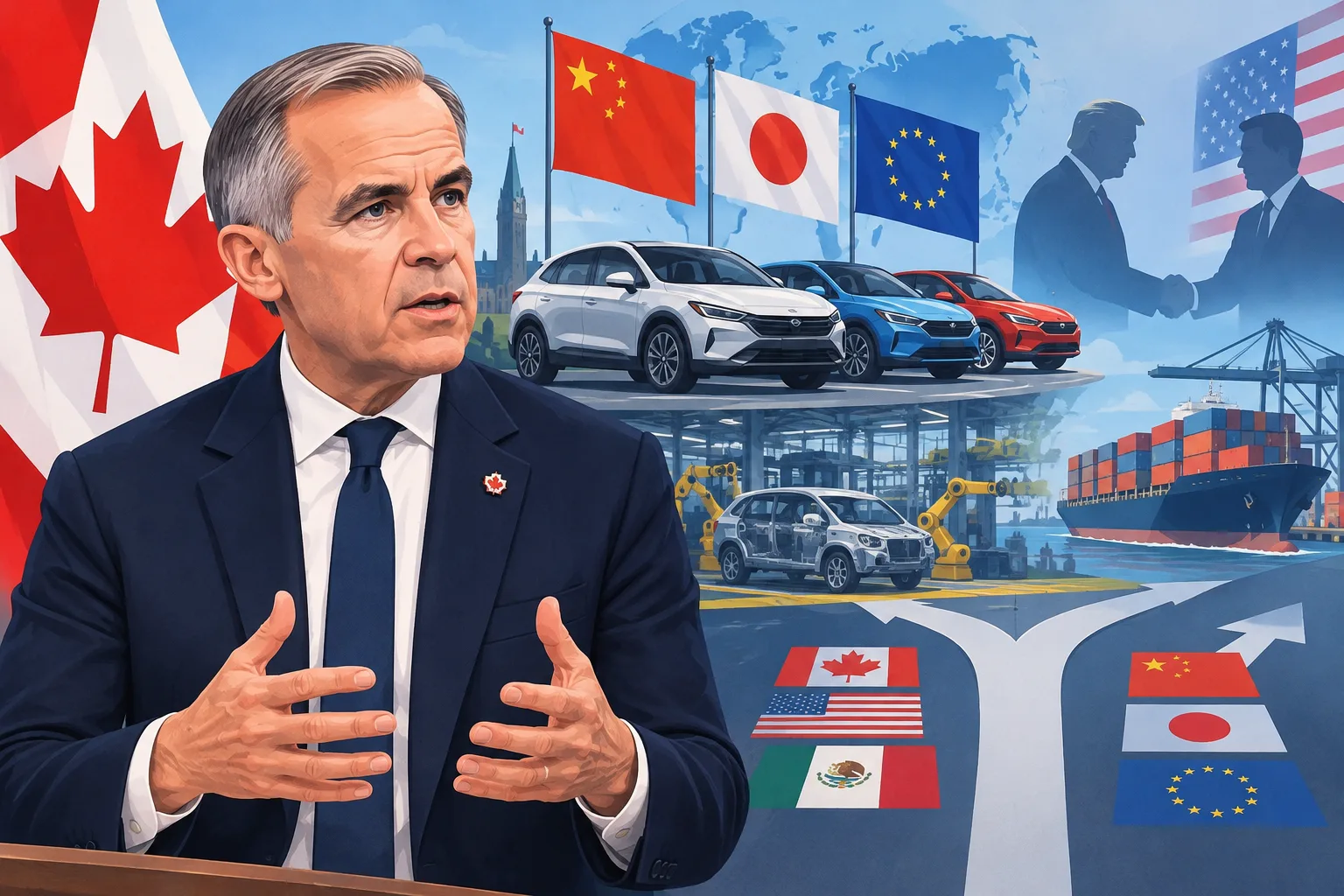
Carney says Canada could turn to Chinese carmakers if US trade talks falter
Canada’s prime minister says preserving an integrated North American car industry remains his priority, but alternatives could emerge if trade talks with Donald Trump do not secure its future.
Review information is loading.
Speaking at the Francophonie summit in Phnom Penh on Monday, Carney said Canada could look to Chinese and Japanese carmakers, as well as European companies, depending on the outcome of negotiations with Washington.
He said US trade actions had made the North American market less integrated. Asked whether potential Chinese investment gave Canada leverage in the talks, he replied: “It’s not leverage. But action, reaction.” He said other opportunities would arise if Canadian workers and manufacturing capacity were not fully used within North America.
The industry’s supply chains cross borders repeatedly: Ford, General Motors and Stellantis operate factories in Canada, the United States and Mexico. Ottawa recently threatened to sue Stellantis after it moved plans for Jeep Compass production from Ontario to Illinois and agreed to sell its idled Canadian assembly plant.
Carney said any Chinese investment would need to involve substantial manufacturing in Canada, rather than simply assembling imported parts, along with labour standards and domestic supply chains.
White House trade adviser Peter Navarro questioned whether Carney was threatening to play China against the United States, calling the suggestion “offensive in the extreme”, the Associated Press reported. Ontario Premier Doug Ford also warned that Chinese electric vehicle imports could threaten Canadian jobs and access to the US market.
Canada and China reached an agreement in January under which Canada removed its previous 100 per cent surtax on Chinese electric vehicles. From March, an initial annual quota of 49,000 vehicles could enter at a tariff of 6.1 per cent. Canadian government briefing papers said the quota represented less than 3 per cent of the market for new vehicles sold in Canada; it was an import arrangement, not a manufacturing investment.
Carney’s remarks came ahead of a planned meeting with Chinese President Xi Jinping in Shenzhen. The prime minister’s office had scheduled his departure from Cambodia for China on Monday.
Sign in to give this article a thumbs up or down.
About this discussion and AI questions
Private test discussion. Comments are readers’ views and are not yet automatically fact-checked. Editing is available for 60 seconds after posting.
Sign in with a confirmed reader account and choose a username to read comments and participate.
Sorting applies to top-level comments; replies remain oldest first. New comments and likes can change the order. Refresh for the current ranking.
Loading comments…