Cave teeth suggest Homo erectus survived in southern China until 184,000 years ago
Fossils from two caves in southern China suggest Homo erectus lived there as recently as 184,000 years ago and could navigate rainforest landscapes. One of the nine teeth found has not been identified.
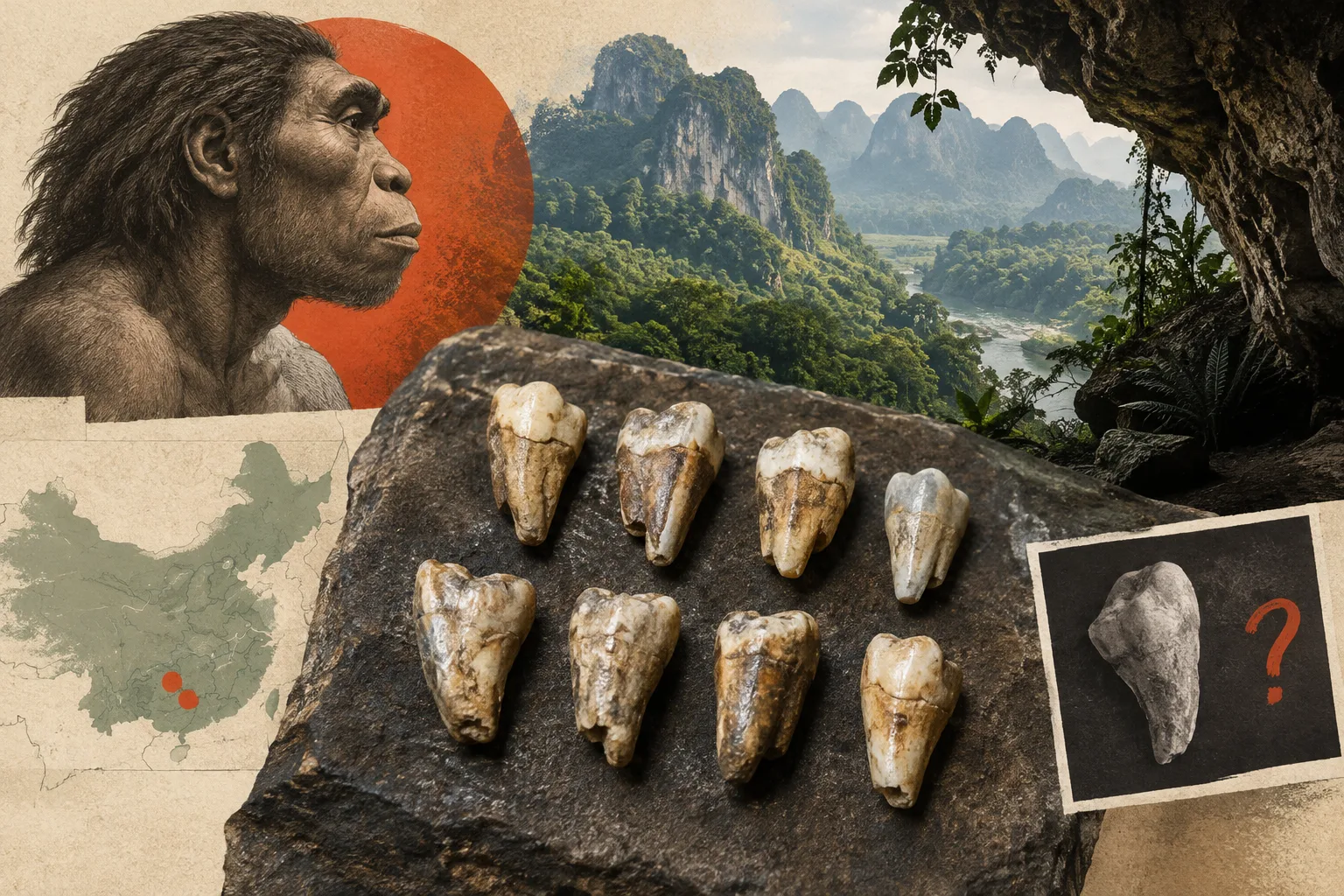
Eight teeth recovered from caves in southern China suggest Homo erectus survived in the region until at least 184,000 years ago and lived in rainforest environments once thought to be beyond its range. The findings, published in two studies in Nature, push back the species’ known presence there and point to greater adaptability than researchers had assumed.
The teeth came from two caves 15 kilometres apart in Guangxi province. Researchers identified eight of the nine human teeth as Homo erectus by their shape; they also analysed proteins in four teeth and used five methods to date the fossils and surrounding cave deposits. The results place the fossils between 324,000 and 184,000 years old.
That is later than the species was thought to have survived in southern China. The youngest previously known Homo erectus fossils, from Indonesia, date to about 108,000 years ago. Homo erectus was the first archaic human species known to leave Africa and spread across continents, and fossil evidence shows it existed for more than 1.5 million years.
The researchers also examined strontium in tooth enamel, which can reflect the geology where an individual lived as its teeth formed. Their results suggest some individuals may have moved across forested karst landscapes over distances of up to 250 kilometres. The evidence points to Homo erectus living in dense rainforest, an environment that researchers had considered especially challenging for humans without agriculture.
Patrick Roberts, a co-author of one of the studies, called this the first clear, direct evidence of a hominin other than Homo sapiens living in rainforest habitats. Ben Utting, an anthropologist at the University of Connecticut who was not involved in the research, said the findings suggest Homo erectus was more behaviourally flexible than previously thought. He added that journeys over such distances may have required knowledge of local terrain and seasonal river networks.
The discovery also bears on questions about the species’ extinction. One proposed explanation is that Homo erectus failed to adapt to rapidly changing environments. But the new evidence of rainforest survival complicates that account; it does not establish why the species eventually disappeared.
One tooth remains a mystery
Researchers could not confidently identify the ninth tooth. Its shape differed from those of Homo erectus, Homo sapiens and Neanderthals, and it lacked the protein signature found in the four teeth linked to Homo erectus.
It could belong to Denisovans, another ancient human population, or to offspring of Denisovans and Homo erectus, said Ryan McRae, a paleoanthropologist at the Smithsonian National Museum of Natural History who was not involved in the studies. Chris Stringer of London’s Natural History Museum also said interbreeding was possible. The tooth’s identity remains unresolved.
Sign in to give this article a thumbs up or down.
From the discussion
Private test discussion. Comments are readers’ views and are not yet automatically fact-checked. Editing is available for 60 seconds after posting.
Sign in with a confirmed reader account and choose a username to read comments and participate.
Sorting applies to top-level comments; replies remain oldest first. New comments and likes can change the order. Refresh for the current ranking.
Loading comments…