Claimed AI-assisted proof of Riemann hypothesis passes early computer checks
Anthropic mathematician Levent Alpöge says he and Claude have found a proof of the Riemann hypothesis. An MIT mathematician reports substantial formal checks, while further tests are under way.
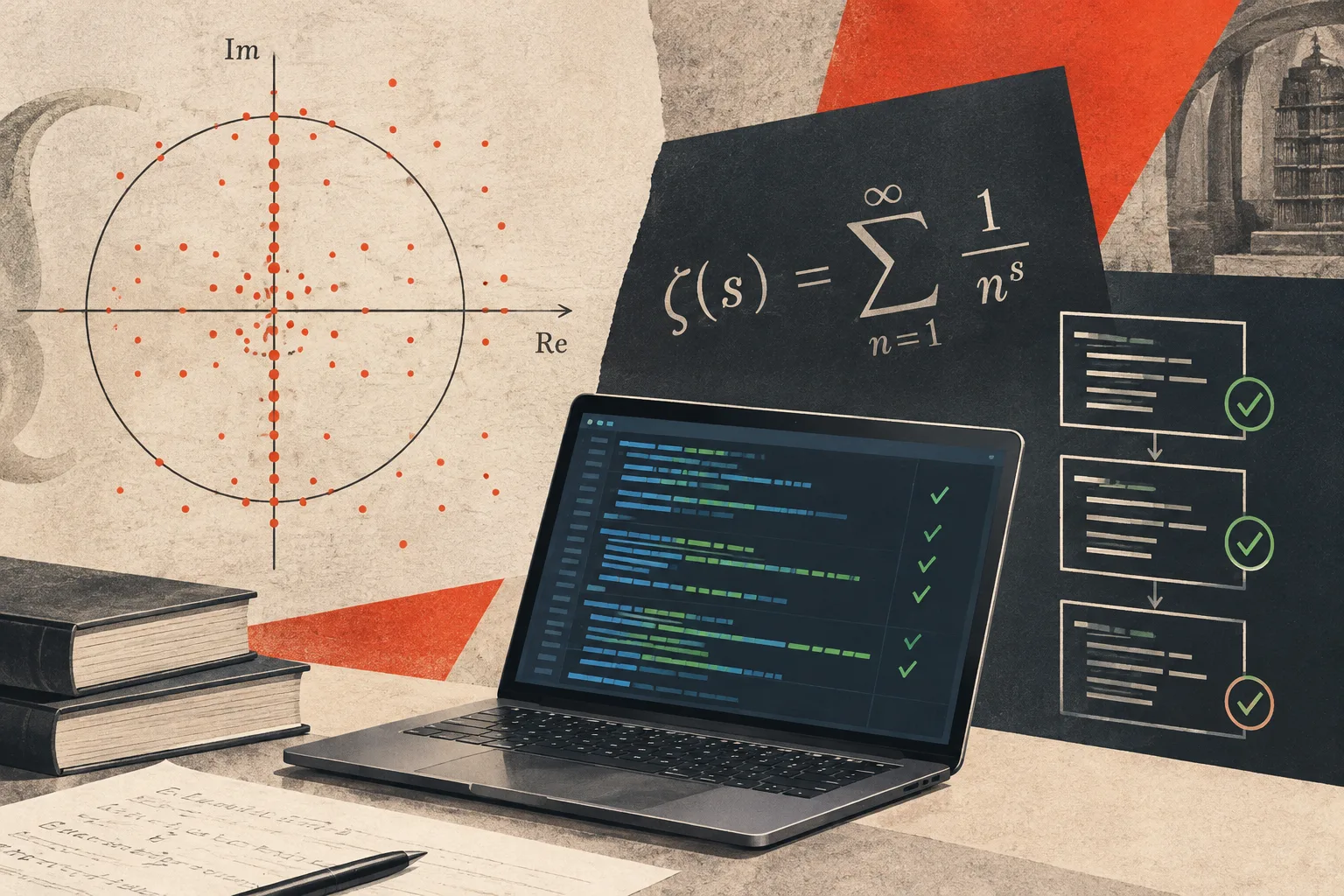
Anthropic mathematician Levent Alpöge says he believes he and the company’s AI assistant Claude have found a proof of the Riemann hypothesis, as well as a proof of a generalised version. An independent mathematician has reported successful computer checks of the formal argument, though further technical tests remain in progress.
The hypothesis, formulated by Bernhard Riemann in 1859, concerns the distribution of prime numbers. The Clay Mathematics Institute’s website Independently verifiedUnsolved Archives - Clay Mathematics Institute; the institute has offered $1 million for a solution.
Alpöge’s proposed proof is written in Lean, a programming language that allows computers to check mathematical reasoning. Alpöge said he had chosen to publish only the Lean version of the argument for now.
In an update at 22.05 UTC on 20 November, MIT mathematician Andrew Sutherland reported that all 175,187 modules of the Lean source compiled without errors. Two independently written checking programs, known as kernels, accepted the full exported proof, he said. Sutherland’s checks used Claude Code.
The checks support the formal statements as encoded, but depend on the correctness of the checking programs and on the definitions used. They do not by themselves provide a conventional, human-readable explanation of the argument.
Sutherland said a full Comparator check and a separate Lean-kernel check of the export were still running at the time of his update. The build had also run without a protective sandbox and had not yet been compared with an export from a fully sandboxed build. The generalised result checked in the code concerns Dirichlet L-functions, not every type of related L-function.
A second proposed proof was announced on 20 November by Stanford professor Ravi Vakil, who said mathematician Alessandro Masullo had produced it without AI. Vakil said Brian Conrad had been examining the work for months and had given extensive feedback.
Conrad told Scientific American that the manuscript was undergoing major revision and needed more work before the method could be judged, according to an article republished by the World Programming Society.
Sign in to give this article a thumbs up or down.
From the discussion
Private test discussion. Comments are readers’ views and are not yet automatically fact-checked. Editing is available for 60 seconds after posting.
Sign in with a confirmed reader account and choose a username to read comments and participate.
Sorting applies to top-level comments; replies remain oldest first. New comments and likes can change the order. Refresh for the current ranking.
Loading comments…