News Made Clear · Loading…
Category
Regions
Continents
Topics
Why US politics is ageing — and why age is only part of the story
Loading statistics…
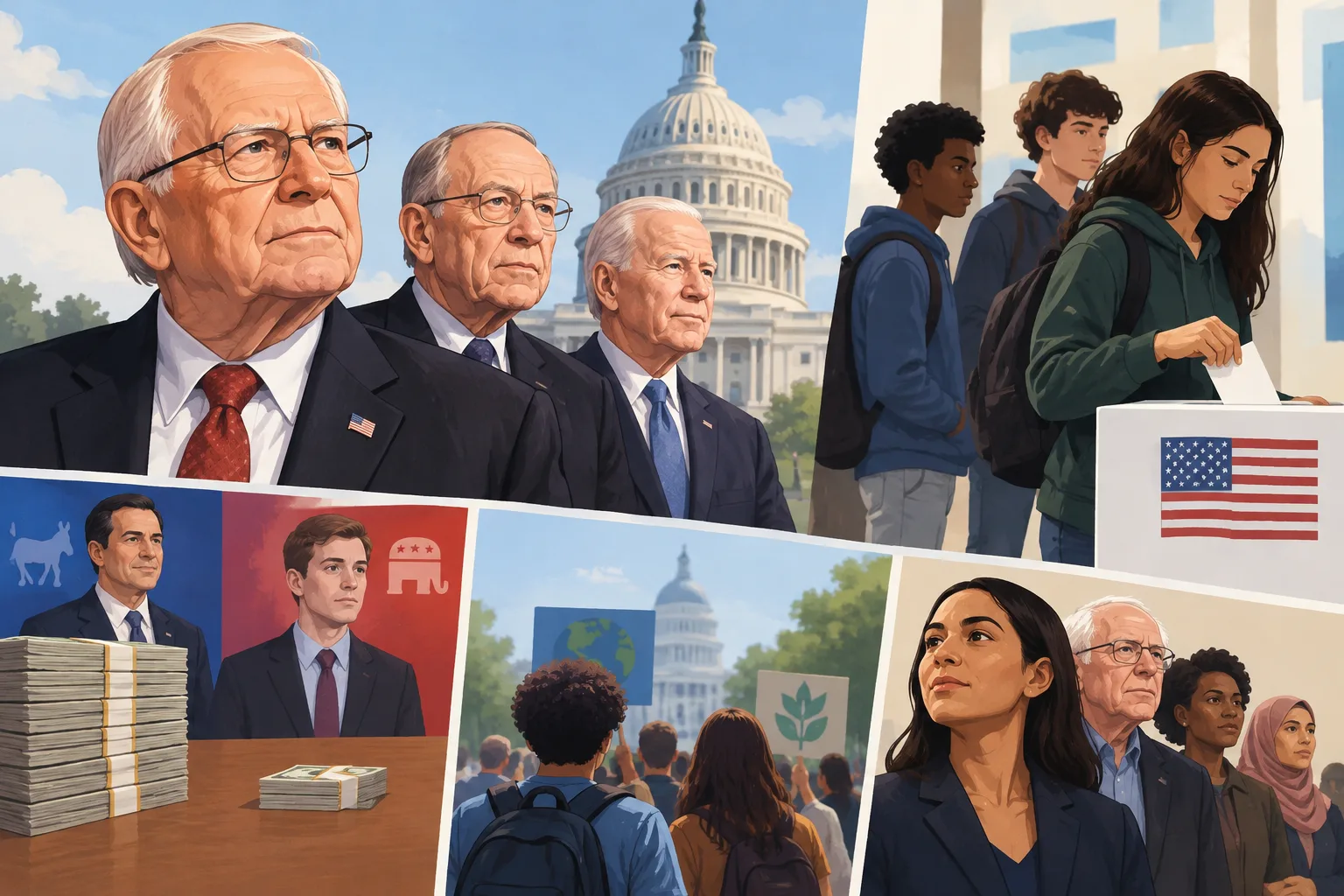
Older politicians continue to dominate US public life, while younger people vote less and report greater distrust of elected officials. The reasons include barriers to entering politics, the structure of the two-party system and the demands of political careers — but age alone does not determine a politician’s ability.
Review information is loading.
US politics is dominated by older office-holders, while younger Americans are less likely to vote and often distrust elected officials. The gap helps explain why the country’s political leaders are ageing — and why simply imposing age limits may not address the causes.
Hal Rogers, 88, is seeking a 24th term in the House of Representatives. The Kentucky Republican has served since 1981 and is the chamber’s longest-serving member. He is among a number of politicians still in office or prominent in their 80s, including Senator Chuck Grassley, 93, and former president Joe Biden, who left office at 82.
The average age of a member of the House at the start of the current Congress was 58, and 65 for senators, according to the Pew Research Center. The median age of US citizens is 39. Both chambers recorded their lowest median ages in the early 1980s, according to congressional records.
### A cycle of low engagement
Young people are less visible not only among lawmakers but also at the ballot box. In the 2024 election, voters under 30 made up 20% of the voting-eligible population but 15% of votes cast, Pew data cited by the BBC show. The share of non-voters aged 18 to 29 rose from 25% in 2020 to 30% in 2024.
James Sloam, a political engagement expert at Royal Holloway, University of London, says low engagement can feed into low representation: “If you don't have enough young people engaged in politics generally, then they won't become representatives.” US rules also require representatives to be at least 25 and senators at least 30.
Distrust may be part of the problem. In a 2025 Pew survey, 62% of Americans aged 18 to 34 said few or none of their elected officials were honest, compared with 45% of people over 50. Among 25 countries surveyed, only young adults in Greece were more pessimistic about politicians’ honesty.
The BBC also points to the structure of US politics. Sloam says the two-party system offers a narrower range of political views, while younger people can be more drawn to movements and campaigns focused on particular issues than to party politics. He cites some European multi-party systems as examples of parties working with social movements to bring people into politics.
Campaign finance can pose another hurdle for younger challengers. Republican Riley Owen, 27, is running for Congress in Utah. By mid-October, his Democratic opponent, Ben McAdams, had raised more than $2.6m, compared with $150,000 for Owen, according to Federal Election Commission records cited by the BBC. Owen says donors tend to favour incumbents.
### Age is not the same as ability
Political barriers are not the whole story. The BBC reports that many members of Congress build their careers in state politics before running for federal office. It also notes that voters themselves skew older, and that younger Americans may seek influence through other work or activism rather than elected office.
How do we know?
1 listed sources · explore evidence, limitations and provenance.
Sign in to give this article a thumbs up or down.
About this discussion and AI questions
Private test discussion. Comments are readers’ views and are not yet automatically fact-checked. Editing is available for 60 seconds after posting.
Sign in with a confirmed reader account and choose a username to read comments and participate.
Sorting applies to top-level comments; replies remain oldest first. New comments and likes can change the order. Refresh for the current ranking.
Loading comments…