News Made Clear · Loading…
Category
Regions
UN development funding projected to fall as officials warn of gaps
Loading statistics…
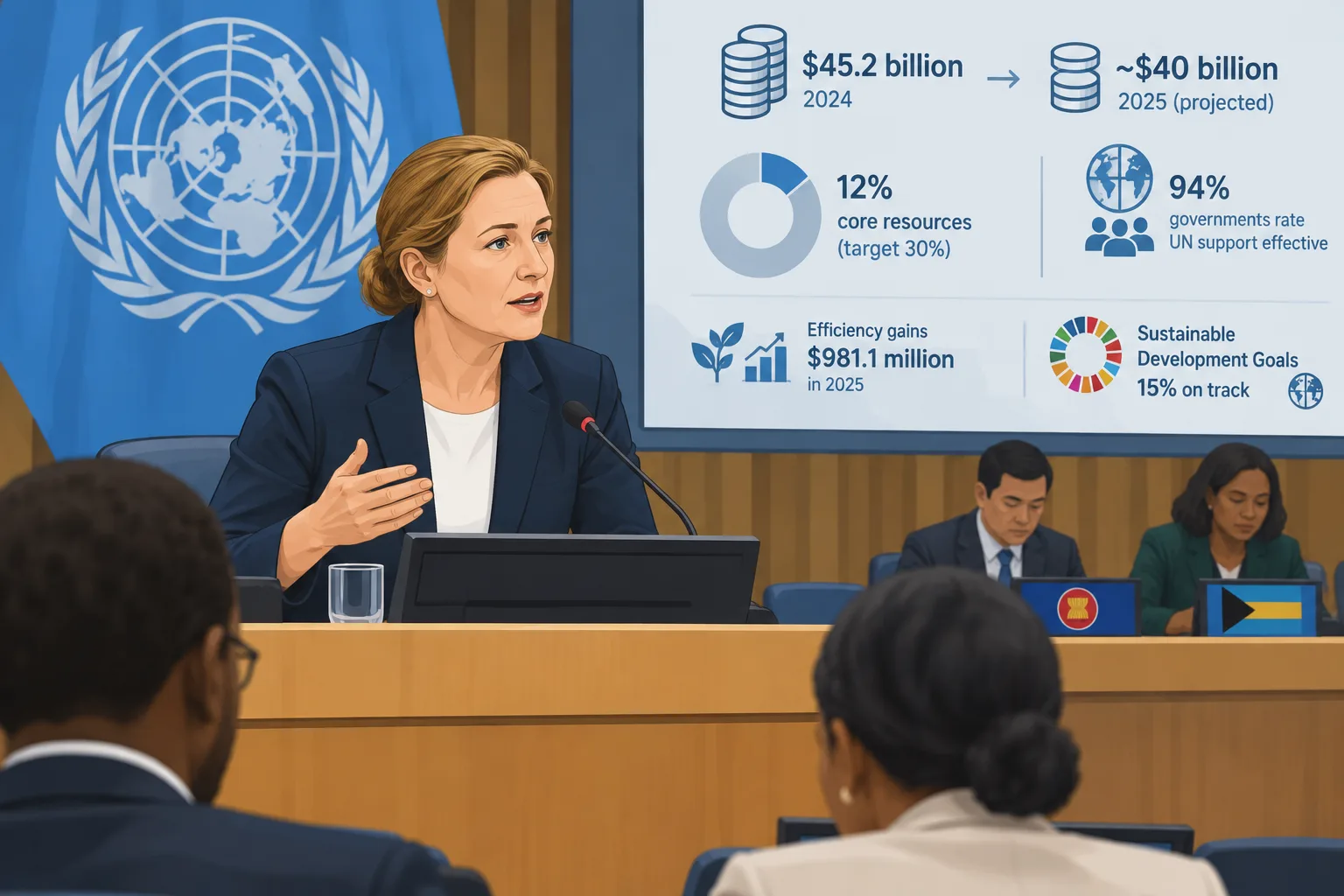
UN officials told the General Assembly’s Second Committee that contributions to the development system were projected to fall from $45.2 billion in 2024 to about $40 billion in 2025, while core funding remained well below its agreed target.
Review information is loading.
The United Nations development system’s funding is falling even as governments report high satisfaction with its work, senior officials told the General Assembly’s Second Committee on 15 October. They warned that a growing reliance on short-term, earmarked contributions could undermine reforms intended to make UN support more coordinated and effective. [1]
Lotta Tähtinen, a director in the UN Department of Economic and Social Affairs, said contributions totalled $45.2 billion in 2024 and were projected to fall to about $40 billion in 2025. Core resources made up 12 per cent of voluntary contributions, against a 30 per cent target set by the Funding Compact.
Tähtinen said the system had become more coherent and responsive, with resident coordinators leading UN country teams in more than 160 countries and territories. She reported that 94 per cent of programme-country governments rated UN development support as effective, and that the system recorded $981.1 million in efficiency gains in 2025.
But she said resources for least developed countries, landlocked developing countries and African countries had declined in real terms. Responding governments in those groups continued to rate UN support highly, she added.
Delegates also pointed to the wider development challenge: Thailand, speaking for the Association of Southeast Asian Nations, said only 15 per cent of Sustainable Development Goal targets were on track. Jamaica, speaking for the Caribbean Community, called for funding arrangements that better account for the needs of small island states.
Uruguay, speaking for the Group of 77 and China, said South-South cooperation should complement, not replace, North-South cooperation, particularly in financing, capacity-building and technology transfer.
Dima Al-Khatib, head of the UN Office for South-South Cooperation, said trade among developing economies had expanded by about 8 per cent, while South-South trade accounted for more than a third of global commerce. She also cited potential economic contributions from artificial intelligence of up to $20 trillion by 2030, while warning that technological disparities could limit developing countries’ ability to benefit.
The discussion took place as member states considered reports on UN development-system reforms and funding. The UN meeting account said delegates called for stronger coordination and more predictable resources, including less reliance on earmarked contributions. [1]
How do we know?
1 listed sources · explore evidence, limitations and provenance.
Sign in to give this article a thumbs up or down.
About this discussion and AI questions
Private test discussion. Comments are readers’ views and are not yet automatically fact-checked. Editing is available for 60 seconds after posting.
Sign in with a confirmed reader account and choose a username to read comments and participate.
Sorting applies to top-level comments; replies remain oldest first. New comments and likes can change the order. Refresh for the current ranking.
Loading comments…