News Made Clear · Loading…
Category
Regions
Continents
DNB president says climate choices can still limit damage as 1.5°C threshold nears
Loading statistics…
DNB president Olaf Sleijpen says global warming is likely to exceed 1.5°C within the next decade, but argues that rapid action can still limit the economic and human costs.
Review information is loading.
De Nederlandsche Bank president Olaf Sleijpen has warned that the world is likely to exceed the 1.5°C global-warming limit within the next decade, but said choices made now can still reduce the damage to economies and people.
Speaking at the Green Swan conference in Manila on 19 October, Sleijpen said the remaining carbon budget consistent with limiting warming to 1.5°C was almost exhausted. A significant overshoot was “very likely” within the next decade, he said, while stressing that this did not make the eventual scale of harm inevitable. [1]
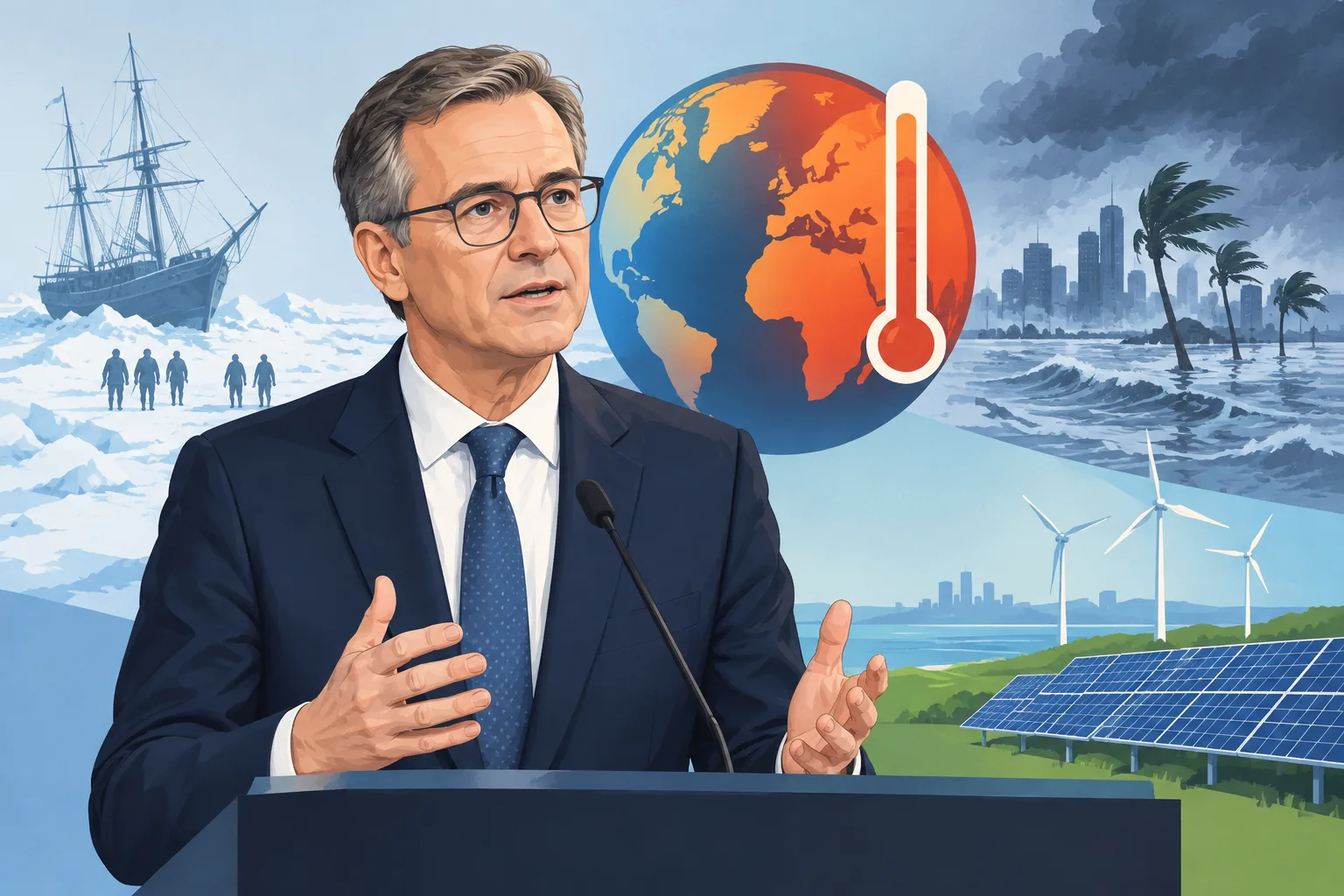
Sleijpen compared the situation with Ernest Shackleton’s 1914 Antarctic expedition. After the ship Endurance was trapped and crushed by ice, Shackleton abandoned his original goal of crossing the continent and focused on bringing his crew to safety. All members of the crew survived.
The speech argued that climate change is already affecting economic and financial stability through extreme weather and damage to nature. Sleijpen cited reinsurers’ estimate that direct global losses from weather-related events averaged $384bn a year over the past five years, more than twice the level in the early 2000s. He also referred to a Network for Greening the Financial System study that found economic losses and inflation effects varied significantly between countries. [1]
He pointed to evidence of progress alongside the risks: global warming projections have fallen from as much as 3.5°C by 2100 in 2015 to about 2.8°C under current policies, while global renewable power capacity has more than doubled since 2015. Sleijpen said faster emissions cuts would limit physical damage and reduce economic exposure to volatile fossil-fuel prices. [1]
Sleijpen said central banks and financial supervisors could analyse climate-related economic risks and advise governments, but did not set climate policy. The decisions, he said, rest with governments. [1]
How do we know?
1 listed sources · explore evidence, limitations and provenance.
Sign in to give this article a thumbs up or down.
About this discussion and AI questions
Private test discussion. Comments are readers’ views and are not yet automatically fact-checked. Editing is available for 60 seconds after posting.
Sign in with a confirmed reader account and choose a username to read comments and participate.
Sorting applies to top-level comments; replies remain oldest first. New comments and likes can change the order. Refresh for the current ranking.
Loading comments…