Dutch central bank warns combined cyber, AI and debt risks could weaken financial stability
De Nederlandsche Bank warns that cyberattacks, an AI-driven market correction and rising interest rates could reinforce one another, leaving the financial system more exposed. It says Dutch banks, insurers and pension funds have solid buffers, but public finances offer governments less room to absorb shocks.
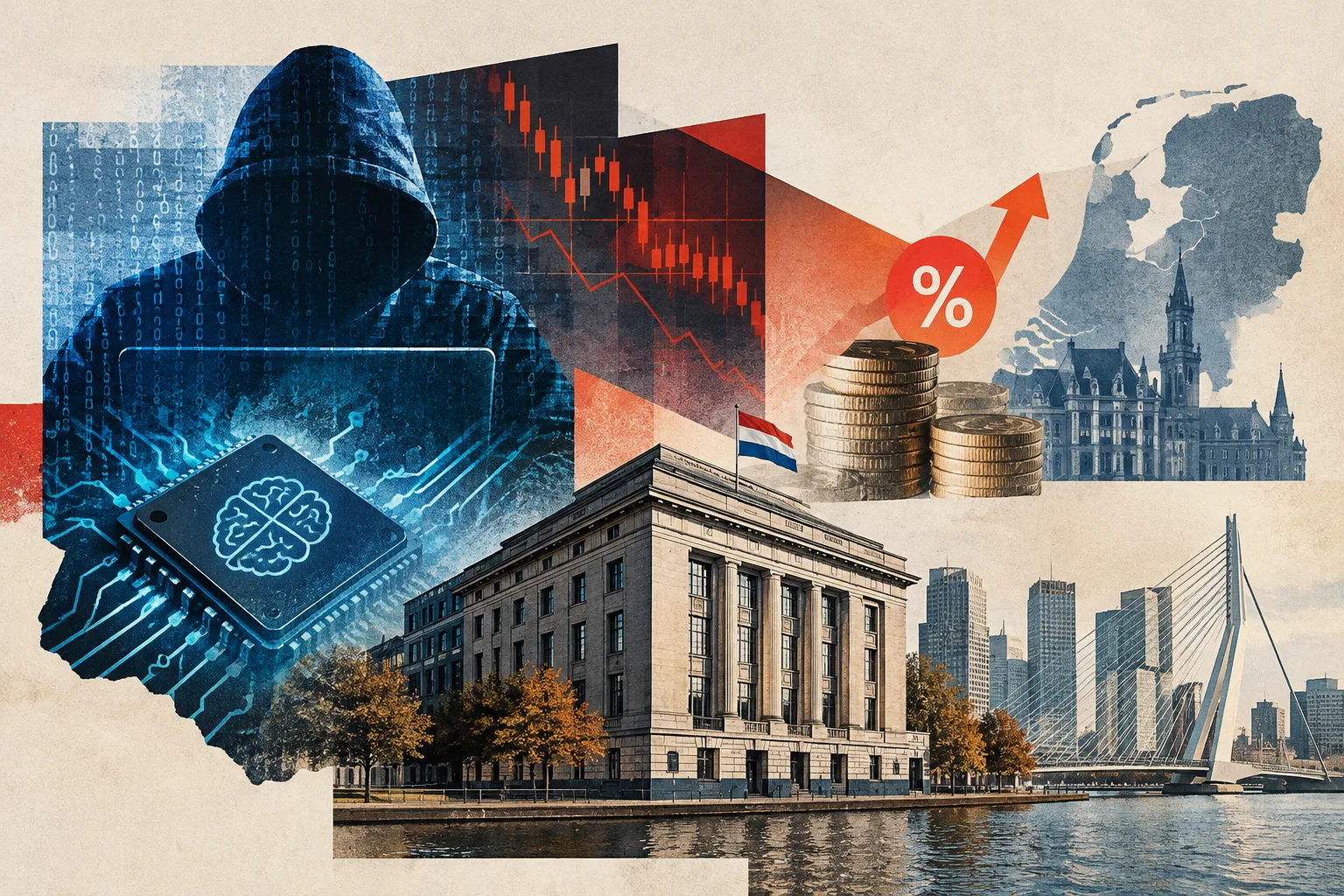
The Dutch financial system could be more vulnerable when cyberattacks, a market correction and higher interest rates hit at the same time, De Nederlandsche Bank (DNB) warned on 24 November. The central bank says such shocks could reinforce one another, while governments have less room than in recent years to absorb their effects.
In its latest half-yearly Financial Stability Overview, DNB says risks are increasing as cyberattacks become more frequent and artificial intelligence makes them faster and more powerful. At the same time, high public debt is harder to sustain as interest rates rise, and markets are exposed to the possibility that returns from AI investments will fall short of investors’ expectations.
“The systemic risk lies mainly in the potentially dangerous combination of shocks, such as cyberattacks, a stock-market correction or the impact of higher interest rates,” DNB president Olaf Sleijpen said. He added that limited government budget capacity could allow shocks to spread more quickly and widely through the financial system.
DNB says many financial institutions rely on a small group of technology companies, raising the risk that disruption could affect the system more broadly. It also warns that some digital weaknesses are exploited before they become publicly known and defenders can fix them.
A fall in AI-related share prices could have wider consequences because investment in the sector is increasingly financed with debt, linking debt and equity markets more closely. Dutch banks’ direct lending exposure to the AI value chain is at least €13.5 billion, which DNB describes as limited for now. But the bank says complex financing structures and leverage in the AI ecosystem make the risks difficult to assess.
Interest rates around the world have risen by about one percentage point in recent months, reaching their highest level since the start of the century, according to DNB. High debt, large budget deficits and weak economic growth make it harder for governments to stabilise their finances; if rates stay high and public finances are not put in order, debt sustainability could come under further pressure.
The warning comes with an important qualification: Dutch financial institutions remain in a relatively strong position. DNB says banks are profitable and have solid capital buffers, while insurers and pension funds also have substantial buffers. But its analysis finds that losses can rise sharply when stress spreads across markets. Losses for insurers and pension funds from a correction in private markets would be considerably greater if it also hit public credit markets.
DNB says financial firms need to keep investing in cyber resilience, including the ability to recover quickly and maintain critical services through backup systems. It also calls for regular exercises between finance, energy and telecoms providers, and stronger crisis preparation at European level. For governments, the bank says, keeping public finances sustainable is essential to retaining room to respond to future shocks.
Sign in to give this article a thumbs up or down.
From the discussion
Private test discussion. Comments are readers’ views and are not yet automatically fact-checked. Editing is available for 60 seconds after posting.
Sign in with a confirmed reader account and choose a username to read comments and participate.
Sorting applies to top-level comments; replies remain oldest first. New comments and likes can change the order. Refresh for the current ranking.
Loading comments…