Dutch government sets 2040 target for large-scale battery capacity
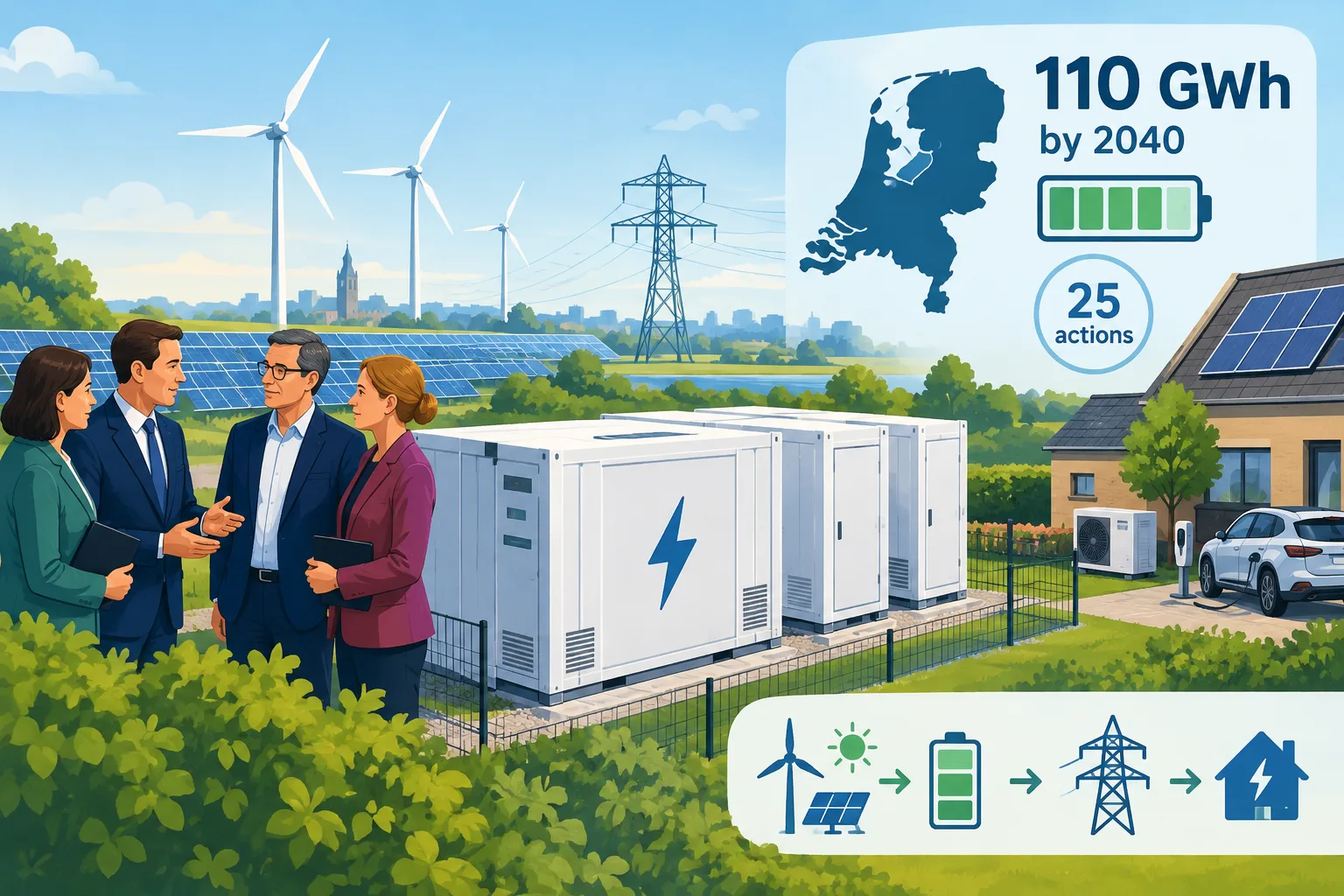
The Dutch government and energy-sector organisations have agreed a target of 110 gigawatt-hours of battery capacity by 2040 and 25 actions to accelerate energy storage, as pressure on the electricity grid grows.
Review information is loading.
The Dutch government and energy-sector organisations have set a target of 110 gigawatt-hours of battery capacity by 2040, alongside 25 actions intended to speed up energy storage projects. The target is a forecast, not a binding requirement, and would represent more than 50 times the battery capacity in the Netherlands at the end of 2025, the government says.
The government developed its energy storage agenda with grid operators, Energy Storage NL, the Authority for Consumers and Markets (ACM) and local authorities. The agreed actions include speeding up permits for large batteries and setting terms and payments that encourage storage to ease pressure on the electricity grid.
The government says batteries and other forms of storage can hold renewable electricity for periods when wind and solar output is lower, and help balance supply and demand. They could also feed electricity into the grid when regional demand is high. The policy agenda says the energy storage sector is growing, but not quickly enough to reach the 2040 target.
The announcement also covers household devices. Since 1 November, households in Gelderland, Utrecht, Flevoland and North Brabant have been able to join schemes offered by some energy suppliers, receiving payment for using batteries, heat pumps or electric-vehicle chargers to help manage peaks in grid demand. The government says the schemes are expected to expand to the rest of the Netherlands next year.
Sign in to give this article a thumbs up or down.
About this discussion and AI questions
Private test discussion. Comments are readers’ views and are not yet automatically fact-checked. Editing is available for 60 seconds after posting.
Sign in with a confirmed reader account and choose a username to read comments and participate.
Sorting applies to top-level comments; replies remain oldest first. New comments and likes can change the order. Refresh for the current ranking.
Loading comments…