ESA antenna sends commands to two Mars orbiters at once
ESA says its new Deep Space Antenna 4 in Western Australia has demonstrated simultaneous X-band commands to Mars Express and the ExoMars Trace Gas Orbiter. The capability could free capacity on the agency’s deep-space network, but depends on two spacecraft being close together in the sky.
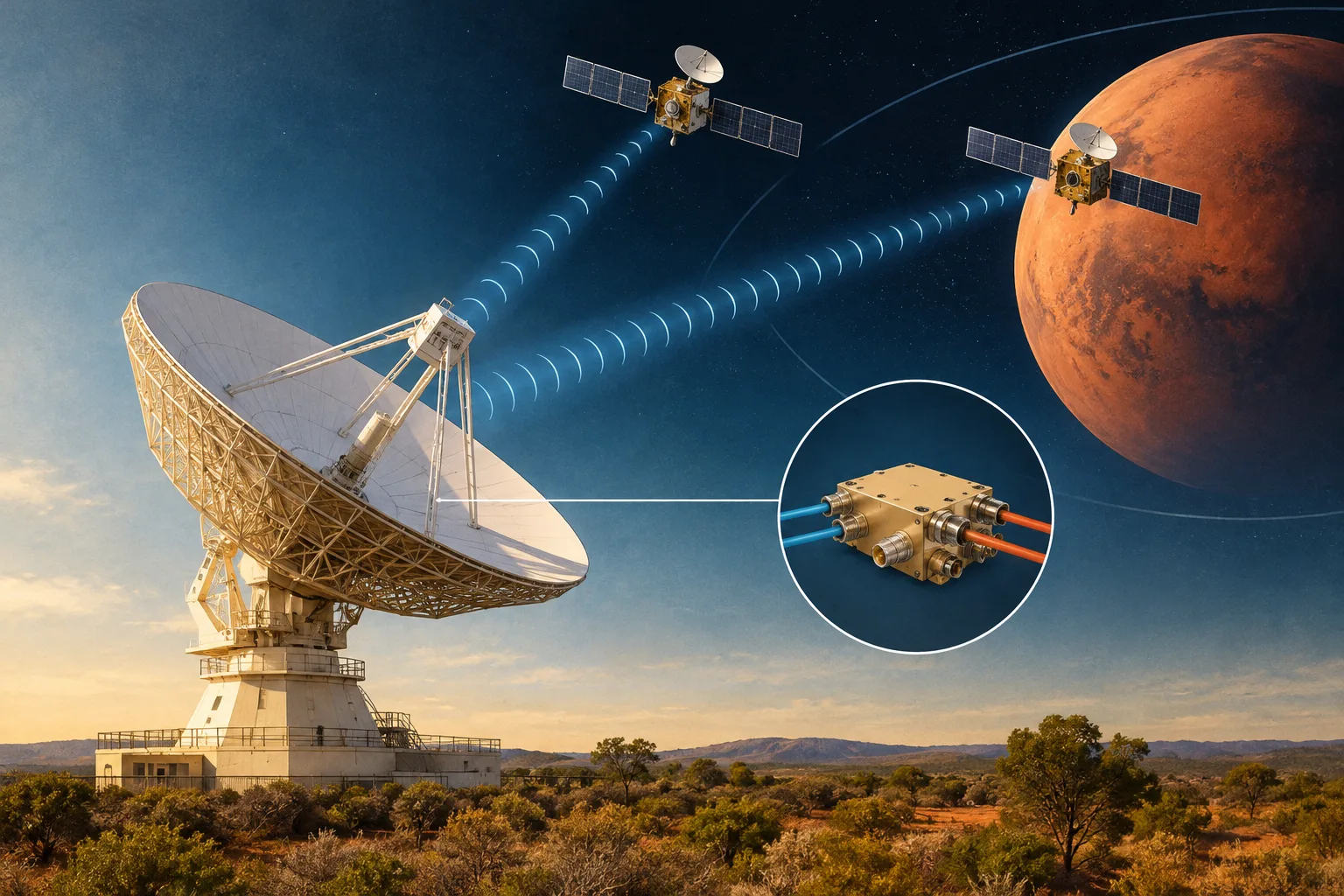
The European Space Agency says its new 35-metre antenna at New Norcia, Western Australia, has sent commands to two Mars orbiters at once using the same radio band, a capability that could ease pressure on its deep-space communications network.
ESA demonstrated the dual X-band uplink with Mars Express and the ExoMars Trace Gas Orbiter (TGO). The antenna, Deep Space Antenna 4 (DSA 4), can now support both spacecraft during the same pass, the agency says.
Receiving signals from multiple spacecraft through one antenna is already routine. Sending two separate command signals at once is more difficult because the signals can interfere. ESA says a hybrid coupler, built by Thales Alenia Space, lets DSA 4 share its antenna feed between the two X-band signals and route them independently.
The new system builds on an earlier workaround at New Norcia. ESA’s Deep Space Antenna 1 could command Mars Express and TGO simultaneously by transmitting to one in S-band and the other in X-band. That approach depended on Mars Express carrying an S-band system and was less suitable during solar conjunction, when the Sun can disrupt the weaker S-band signal. DSA 4 can send both commands in X-band.
The benefit depends on spacecraft being close enough in the sky for the same antenna to point at both. ESA says that geometry is rare in deep space, but suits the two orbiters at Mars. It expects simultaneous uplinking to make their commanding more reliable, simplify operations and reduce competition for ground-station time.
ESA says the added capability will help free capacity across Estrack as more missions book time at its stations. The agency’s next planned 35-metre deep-space antenna, DSA 5, is also due to include a hybrid coupler and dual X-band uplink capability. DSA 4’s design was intended to support future missions, though the technique will only be usable when spacecraft are suitably positioned.
Sign in to give this article a thumbs up or down.
From the discussion
Private test discussion. Comments are readers’ views and are not yet automatically fact-checked. Editing is available for 60 seconds after posting.
Sign in with a confirmed reader account and choose a username to read comments and participate.
Sorting applies to top-level comments; replies remain oldest first. New comments and likes can change the order. Refresh for the current ranking.
Loading comments…