ESA satellite observations point to rain breaking up reflective marine clouds
EarthCARE observations point to rain as a key factor in breaking up reflective marine cloud decks, offering insight into a process that exposes more ocean to sunlight.
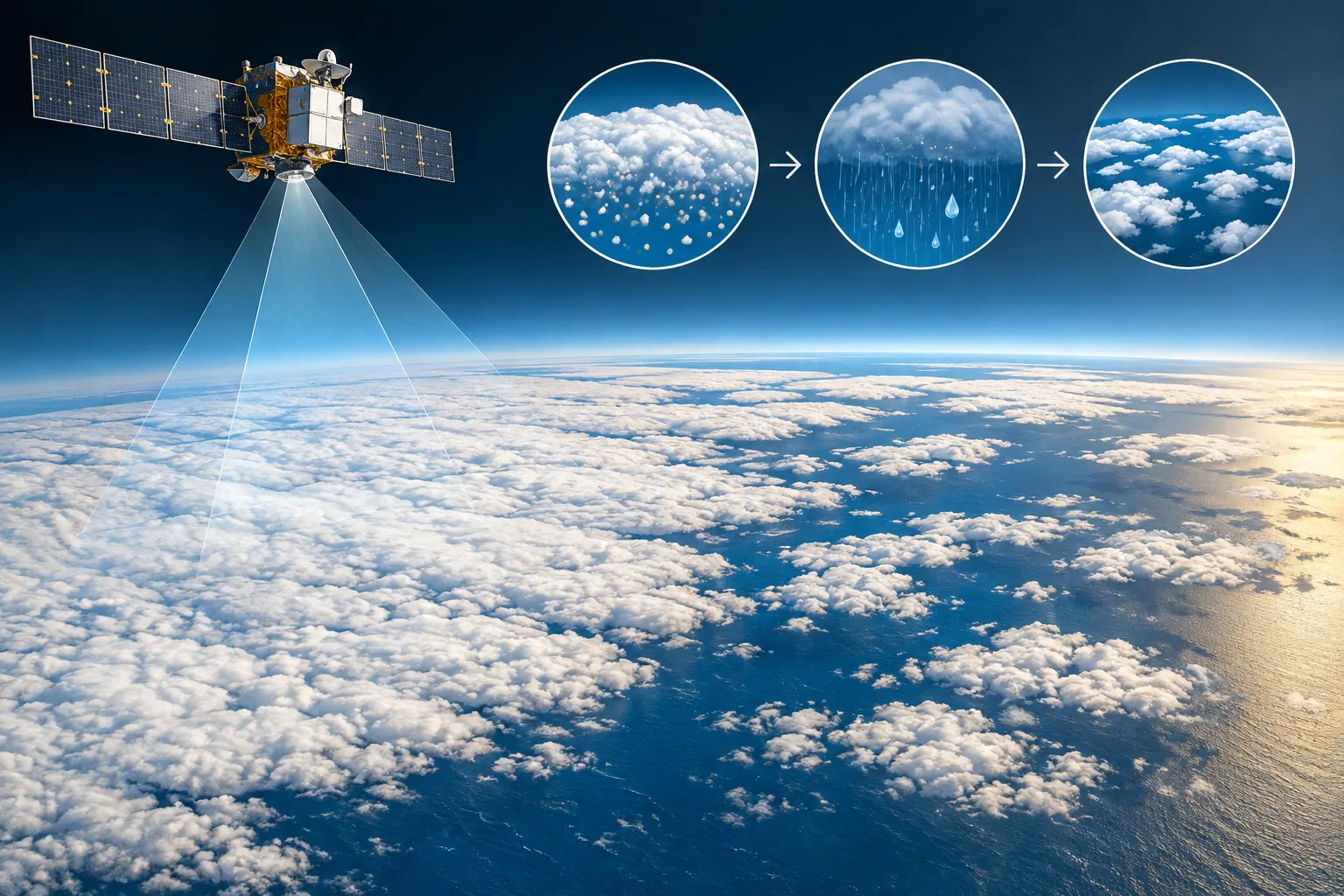
Rain appears to help break up bright marine cloud formations that reflect sunlight back into space, according to observations from the European Space Agency’s EarthCARE satellite. The findings offer a closer look at a process that could help explain why these cloud decks are declining and how that change affects Earth’s energy balance.
Marine stratocumulus clouds form broad, low-lying sheets over the oceans. Their bright surfaces reflect sunlight, while breaks in the cloud cover expose darker ocean that absorbs more solar energy.
In a paper published in *Atmospheric Chemistry and Physics*, researchers combined images from a geostationary satellite, which tracked cloud changes over time, with EarthCARE measurements of cloud structure and precipitation. The observations point to rain as a key driver of the shift from continuous, closed cloud cells to more fragmented, open cells, ESA says.
Johanna Mayer, the paper’s lead author and a research fellow at ESA’s Earth System Science Hub, described a feedback process: falling raindrops remove aerosol particles that help cloud droplets form. With fewer particles available, the remaining droplets grow larger, making rain more likely. The cycle can eventually disrupt the air circulation that sustains the continuous cloud deck, she said.
The change does not mean the clouds disappear altogether. Rather, their structure becomes more fragmented, exposing more ocean surface to sunlight. ESA says recent studies have found marine stratocumulus clouds are declining, but scientists do not yet fully understand why or whether the trend will continue or accelerate as the planet warms.
EarthCARE can measure cloud structure, droplets and precipitation, as well as aerosols involved in droplet formation. ESA says these observations let scientists examine cloud processes that have been difficult to profile from space, particularly close to the ocean surface.
Bjorn Stevens, director of the Max Planck Institute for Meteorology, said researchers hoped to use EarthCARE’s growing body of measurements to improve understanding of processes that govern Earth’s energy budget and influence the rate of global warming.
Sign in to give this article a thumbs up or down.
From the discussion
Private test discussion. Comments are readers’ views and are not yet automatically fact-checked. Editing is available for 60 seconds after posting.
Sign in with a confirmed reader account and choose a username to read comments and participate.
Sorting applies to top-level comments; replies remain oldest first. New comments and likes can change the order. Refresh for the current ranking.
Loading comments…