News Made Clear · Loading…
Category
Regions
Continents
AI-edited property photos risk misleading homebuyers, Trading Standards warns
Loading statistics…
AI-edited property photos can help buyers imagine a home’s potential, but changes that distort its size or hide features risk misleading viewers. Trading Standards says agents should disclose AI use and warns that some alterations could break the law.
Review information is loading.
Estate agents are increasingly using AI to retouch property-listing photos, but alterations that conceal defects or change a home’s features can mislead buyers and may break consumer-protection law, Trading Standards has told the BBC.
The practice, dubbed “housefishing”, is becoming easier as AI tools make it possible to change a room’s appearance with little effort. Agents say enhanced images can help buyers picture how a property might look; the boundary is whether the pictures still represent the home being sold.
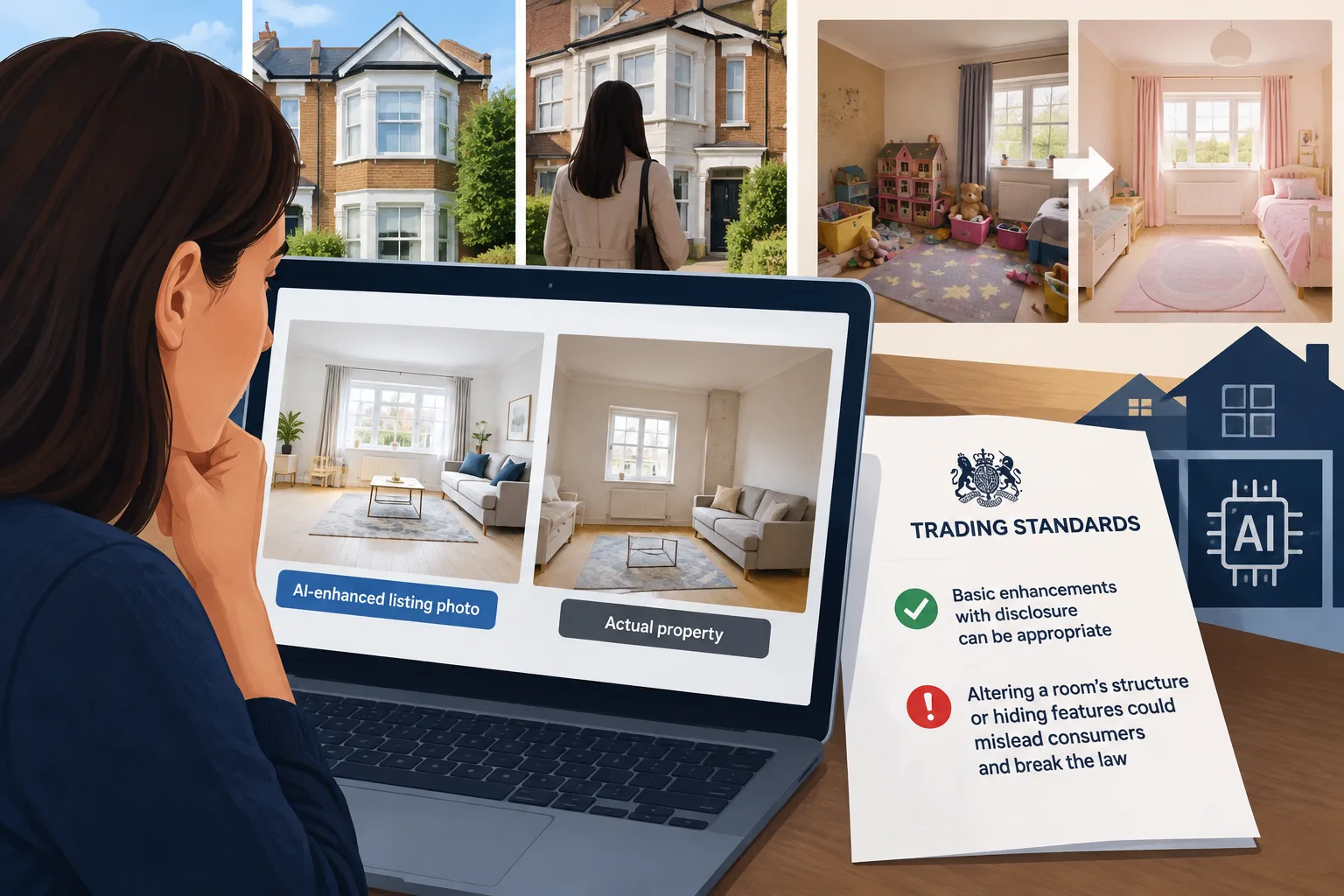
Olivia Nicole, 29, told the BBC she was surprised when a south-west London house she had viewed online looked different in person. She said the rooms were smaller, the windows were smaller and a raised section of wall behind the sofa was missing from the listing photos. The images appeared on Rightmove, Zoopla and Winkworth; the companies said they had strict rules on AI use and had since removed them. Nicole said the listing had not made the AI enhancement clear and that she had taken time off work for the viewing.
A separate seller, identified as Cara, said her agent, Howards, had used AI to clear toys and clutter from her son’s room. She also said an image of her daughter’s room had been altered to remove a doll’s house, brighten the room and change a rug’s shape. Howards said it had introduced a policy of labelling AI-enhanced photos and did not use AI to misrepresent a property’s fundamental features.
The BBC reports that the Guild of Property Professionals, a trade group for independent agents, says it is difficult to measure how widespread the practice is. A survey of 906 UK homebuyers found that one in five respondents who had bought a home in the past year said they had viewed a property whose photos had been digitally enhanced to make it look better than it was.
Property-listing reviewer Jack Bushrod said he had seen a surge in AI-enhanced images over the past six months. He said he considered decluttering or virtually furnishing an empty room acceptable, but objected to changes such as removing a pillar or adding a window. He also said most of the altered images he had seen were not clearly labelled.
Trading Standards told the BBC that agents can make basic enhancements or virtually furnish an empty room or garden if they disclose the use of AI. Altering a room’s structure or hiding features could mislead consumers and break the law, it said.
Sign in to give this article a thumbs up or down.
About this discussion and AI questions
Private test discussion. Comments are readers’ views and are not yet automatically fact-checked. Editing is available for 60 seconds after posting.
Sign in with a confirmed reader account and choose a username to read comments and participate.
Sorting applies to top-level comments; replies remain oldest first. New comments and likes can change the order. Refresh for the current ranking.
Loading comments…