Global CO₂ emissions projected to rise despite possible fossil fuel dip
Researchers expect a small drop in fossil CO₂ emissions in 2026, but project that the broader total, including land-use change, will rise. Both are provisional estimates.
Review information is loading.
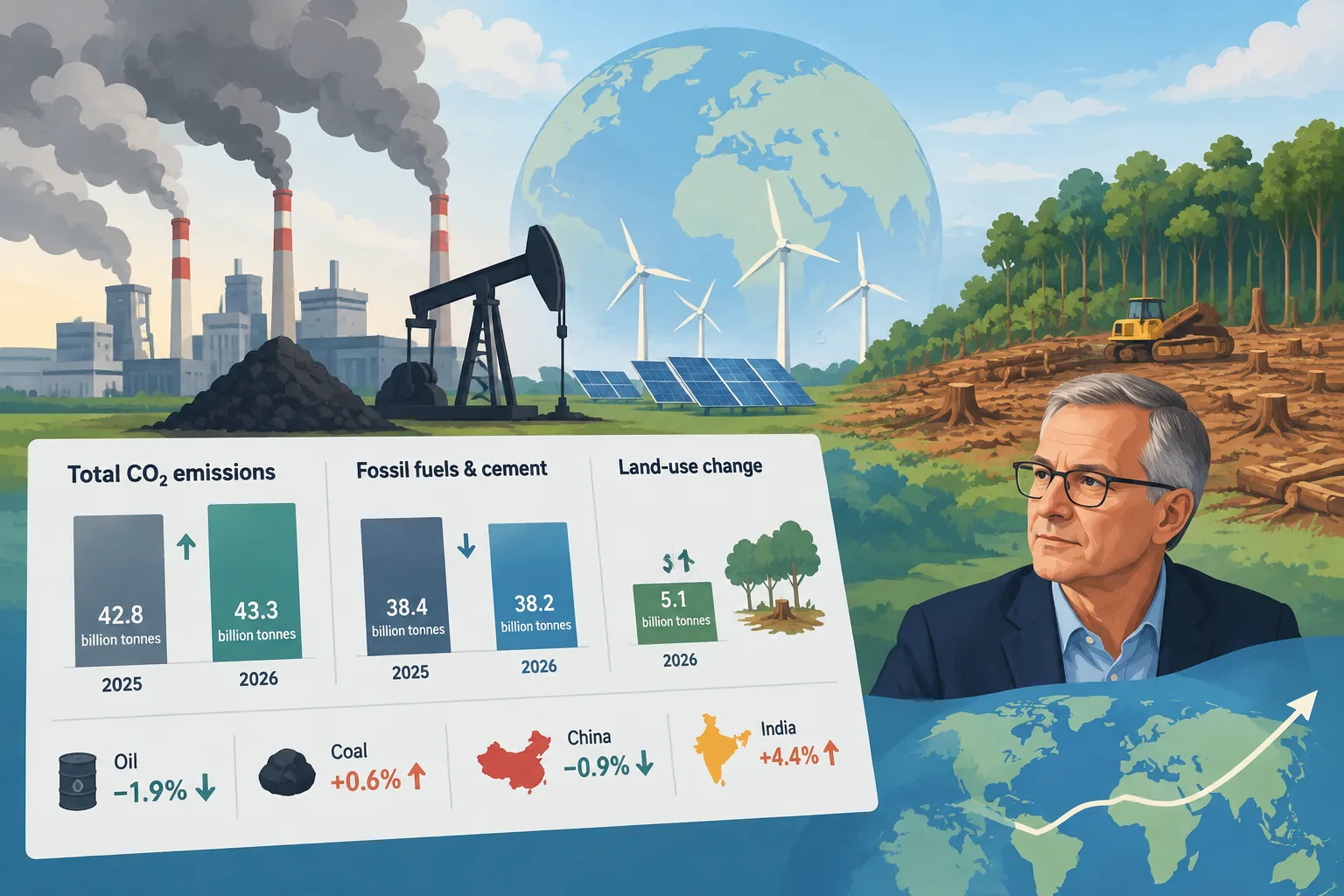
The Global Carbon Budget projects that human activities will emit 43.3 billion tonnes of carbon dioxide in 2026, up from an estimated 42.8 billion tonnes in 2025. The total includes emissions from fossil fuels, cement production and net emissions from land-use changes such as deforestation.
The researchers estimate that land-use changes will account for 5.1 billion tonnes of CO₂ in 2026. They caution that confidence in that projection is low: it uses emissions from deforestation, forest degradation and peat fires as indicators of land-use change.
For fossil fuels and cement, the team projects emissions of 38.2 billion tonnes, down from 38.4 billion tonnes in 2025. Its central estimate is a fall of 0.4%, but the uncertainty range runs from a drop of 1.5% to a rise of 0.6%. That range does not include uncertainty in the 2025 baseline.
If the decline is confirmed, it would be the first fall in fossil CO₂ emissions since 2020, the first year of the Covid-19 pandemic. The 2026 figures are projections based on data available before the end of the year. The research was published as a preprint and is under review at the journal Earth System Science Data.
Emissions from oil are projected to fall by 1.9%, while those from coal are expected to rise by 0.6%. The Global Carbon Project says the oil decline is likely to be a short-term response to the energy shock triggered by the Iran conflict. It also points to the growth of solar and wind power.
The researchers project a 0.9% fall in China’s fossil emissions for the year. That follows a separate estimate of a 3.1% decline in the third quarter, compared with the same period a year earlier. India’s fossil emissions, by contrast, are projected to rise by 4.4%.
Glen Peters, a researcher at Norway’s CICERO Center for International Climate Research and a study co-author, cautioned against treating a single year’s decline as a lasting turning point. “A drop in emissions in one year is not a peak unless it is driven by structural change,” he said.
Sign in to give this article a thumbs up or down.
About this discussion and AI questions
Private test discussion. Comments are readers’ views and are not yet automatically fact-checked. Editing is available for 60 seconds after posting.
Sign in with a confirmed reader account and choose a username to read comments and participate.
Sorting applies to top-level comments; replies remain oldest first. New comments and likes can change the order. Refresh for the current ranking.
Loading comments…