AI ANALYSIS & OPINION
Trump’s tax attack on Gillen omits her support for expanding overtime relief
Donald Trump’s tax attack on New York Democrat Laura Gillen is misleading: she voted against the law containing the breaks he cites, but later backed a proposal to expand overtime relief.
Review information is loading.
In a 31 October 2026 Truth Social post, Trump said Gillen had voted against tax measures for tips, overtime and Social Security, the US retirement and disability benefits programme. He predicted that if she and the Democrats gained power, “all of these things would be terminated”.
Trump was endorsing Jeanine Driscoll, the Republican tax receiver in the town of Hempstead, who is challenging Democratic incumbent Gillen in New York’s 4th congressional district on Long Island. The election is on 3 November. He had endorsed Driscoll and made the same accusation and prediction in August.
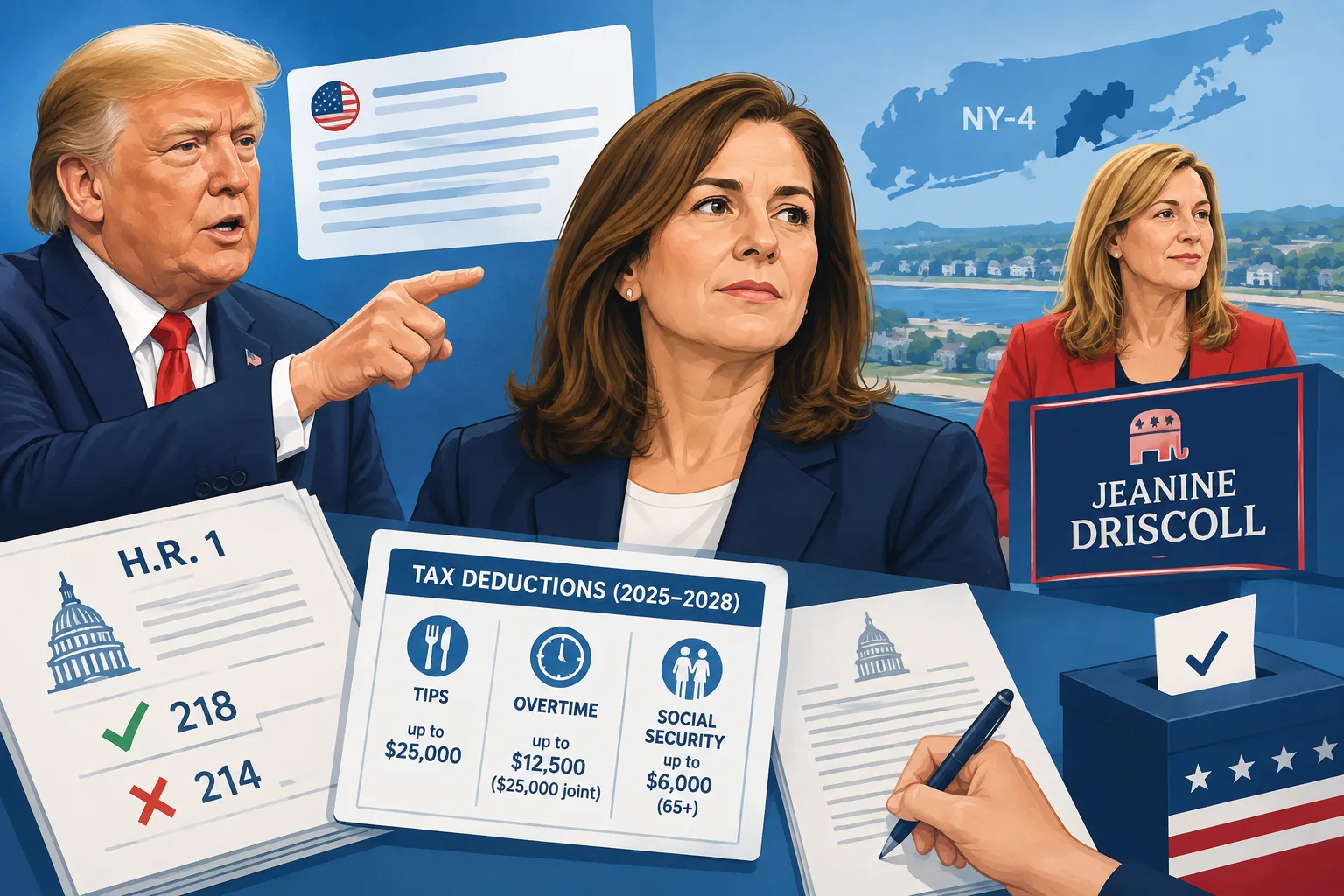
The post did not identify a vote. House records show that Gillen voted on 3 July 2025 against the Senate version of H.R. 1, a broad tax-and-spending package containing the three provisions. The House passed it by 218 votes to 214, and it became law the following day. The vote was on the entire package, not on each deduction separately.
In a statement after the vote, Gillen objected to cuts to Medicaid, a public health-insurance programme, and food assistance, as well as the law’s failure to remove a cap on federal deductions for state and local taxes. The law raised the cap from $10,000 to $40,000 for many taxpayers for the 2025 tax year, subject to income limits.
In March 2026, Gillen became a co-sponsor of a bipartisan bill introduced by Republican Nicole Malliotakis. It would expand the existing overtime deduction to cover certain additional premium pay under employment agreements, including for some railway and airline workers. Her support does not establish her position on the tips or senior deductions, or whether she would extend overtime relief beyond 2028.
The deductions and their future
The federal income-tax deductions for tips, overtime and older people apply to tax years 2025 to 2028 and are due to expire afterwards unless Congress changes the law. They reduce taxable income, rather than cutting tax bills by the same amount, and phase out at higher incomes.
Eligible taxpayers can deduct up to $25,000 a year in qualifying tips. The overtime deduction is capped at $12,500, or $25,000 for joint filers, and covers qualifying premium pay above the regular rate, not the whole overtime wage.
What Trump calls “NO TAX ON SOCIAL SECURITY” is an additional deduction of up to $6,000 per eligible person aged 65 or over. People can claim it without receiving Social Security, and it does not exempt all benefits from tax.
A bill Gillen co-sponsored in October with fellow Democrat Hakeem Jeffries proposed reversing specific health-insurance tax-credit restrictions in the 2025 law; the text as introduced did not repeal the three deductions.
Illinois Democrat Sean Casten, by contrast, called in July for repealing the entire law in 2028. He argued that this would not affect taxes on tips or overtime because the deductions expire. They remain available for the 2028 tax year, however, so a repeal’s effect would depend on its wording and effective date. His call does not establish that Gillen and the Democrats would end all three deductions if they won.
Sign in to give this article a thumbs up or down.
About this discussion and AI questions
Private test discussion. Comments are readers’ views and are not yet automatically fact-checked. Editing is available for 60 seconds after posting.
Sign in with a confirmed reader account and choose a username to read comments and participate.
Sorting applies to top-level comments; replies remain oldest first. New comments and likes can change the order. Refresh for the current ranking.
Loading comments…