AI ANALYSIS & OPINION
Trump’s Venezuela oil deal offers discounts, not guaranteed cheaper fuel
Trump says the first million-barrel cargo will cost taxpayers nothing. But investment rights, discounted oil purchases and reserve estimates do not establish the rapid savings for drivers he promises.
Review information is loading.
Donald Trump’s Venezuela oil agreement offers Washington potentially valuable buying and investment rights, but does not substantiate his promise of an imminent plunge in petrol and diesel prices. Even a free first million-barrel cargo would not establish a lasting increase in supply.
In a Truth Social post on 27 October 2026, the president said the United States would receive one million barrels at “NO cost to the American Taxpayer”, followed by “BILLIONS of Barrels to come”. He credited the military operation that captured Nicolás Maduro in January and the oil agreement announced in August, predicting that fuel prices would “soon come plummeting down”.
The announcement accompanied plans for a Texas campaign trip, with rallies scheduled in Corpus Christi and Lubbock. The Associated Press, citing two US officials and a congressional aide, reported that Trump and Secretary of State Marco Rubio planned to visit a newly arrived tanker at Port Arthur. Speaking to reporters, Trump also described the cargo as a gift, Reuters reported.
Buying rights, not free supplies
The White House’s 31 August description of the agreement says North American Blue Energy Partners, or NABEP, received 100-year concessions for 17 Venezuelan oilfields. Washington would gain an investment interest and preferential access to the company’s production.
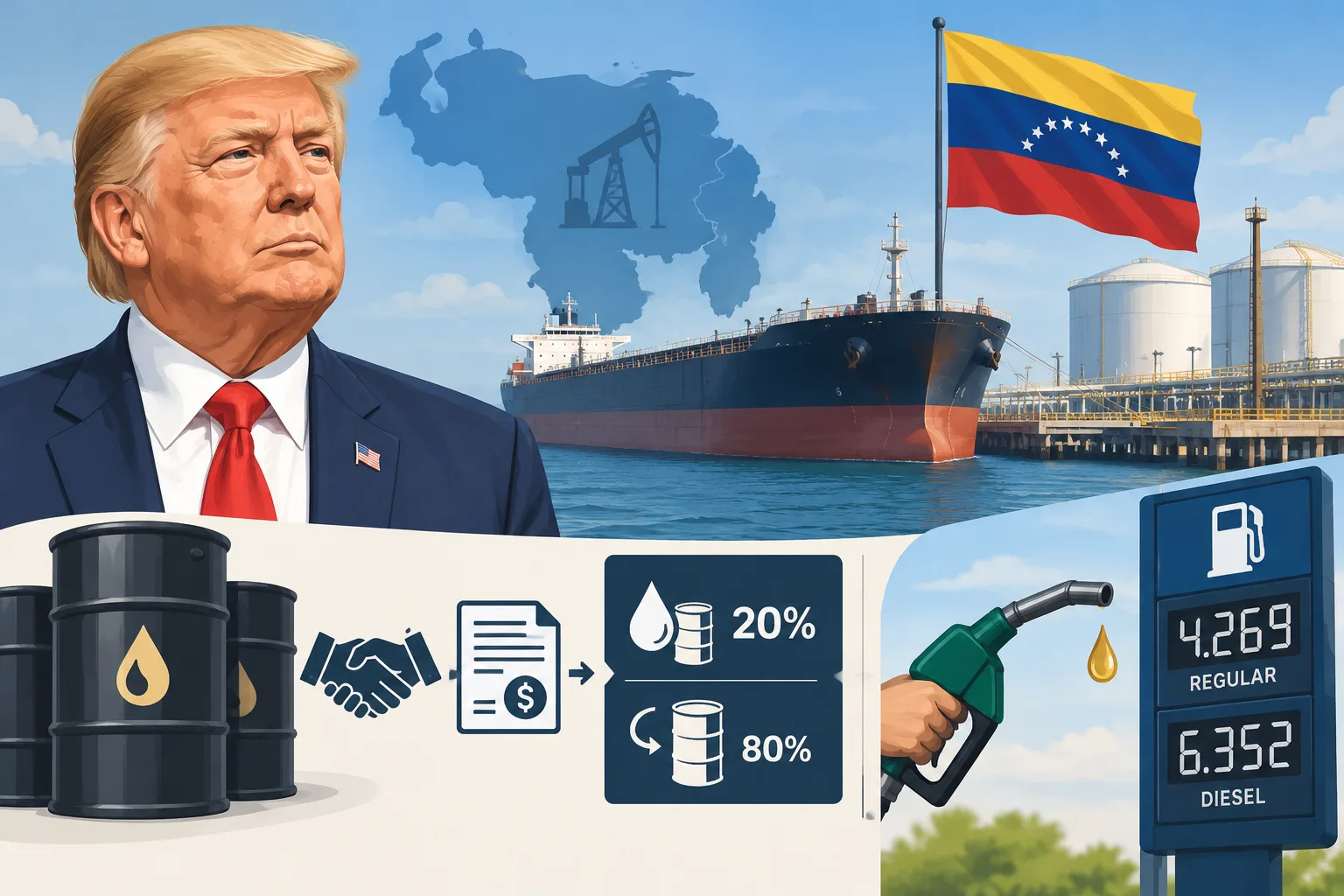
The purchasing terms are explicit: the US has the right to buy 20% of production at production cost and a right of first refusal over the remaining 80%. Those could provide a strategic and commercial advantage, but they are arrangements for buying oil.
The separate 35% interest in NABEP’s corporate parent was described by the White House as costing taxpayers nothing. A US official subsequently explained to Reuters that the position was structured as warrants — rights to acquire shares later at a token price — with dividend entitlements before those rights were exercised. Acquiring those financial rights is distinct from receiving physical oil free of charge.
ProPublica, which examined an 18-page partnership agreement and supporting documents, reported on 20 October that the discounted 20% share could be purchased for $30 a barrel. That price excluded blending materials needed to move much of Venezuela’s thick crude. NABEP told the publication that much of its oil needed little or no blending and that blending costs would not meaningfully affect production costs.
A separate donation could coexist with those commercial purchases. Trump’s claim about this first cargo is therefore not disproved by the wider agreement, but the arrangements for its freight and other charges remain unclear.
The private partner also benefits from the arrangement. Reuters identified Venezuelan businessman Alejandro Betancourt as NABEP’s controlling owner and reported that the concessions were awarded without competition. NABEP told ProPublica it had been chosen for its record of expanding production.
Trump had made a broader financial promise at his 3 January news conference, saying oil companies would fund rebuilding and Washington would be “reimbursed for everything that we spend”. That earlier promise concerns the wider intervention and reconstruction, rather than the cost of this particular shipment.
Existing trade and future supply
Venezuelan oil was already reaching the US in substantial and growing quantities before the August agreement. US Energy Information Administration data record crude imports averaging 200,000 barrels a day in January and 701,000 in July. A first shipment under the new arrangement is not the beginning of that trade.
For scale, the promised million barrels is equivalent in volume to about 70 minutes of projected US consumption of petroleum and other liquid fuels. The EIA puts that consumption at 20.6 million barrels a day for 2026. A single cargo is a quantity of oil, not a daily addition to supply.
The wider venture does envisage expansion. ProPublica’s 20 October report put NABEP’s production at about 200,000 barrels a day and described a target of 500,000 by the end of 2028. It also reported that implementation details remained under negotiation and that the agreement’s full effect depended on closing conditions.
The reserve claims require a separate distinction. The White House described the 17 fields as holding approximately 65 billion barrels of proven reserves. Francisco Monaldi, a Venezuelan oil specialist at Rice University, told AP that 10 billion to 15 billion barrels would qualify as proven reserves in the short term. That is a much lower estimate, but still a substantial potential resource. Neither figure is a schedule for production or US deliveries.
Why the price promise goes further
The day before Trump’s post, EIA national averages stood at $4.269 per US gallon for regular petrol and $6.352 for road diesel, including taxes. Petrol had fallen 1.5 cents over the week; diesel had risen 7.6 cents. Both were considerably more expensive than a year earlier.
Those figures describe the starting point, not a response to the announcement. The agency’s October outlook, based on market inputs finalised on 1 October, identified disrupted Middle Eastern supplies and high shipping costs, alongside exceptionally tight diesel markets, as pressures on prices.
The EIA itself expected petrol prices to fall slowly and diesel prices to ease gradually as crude prices declined and inventories recovered. It forecast lower average retail prices in 2027. A future fall is therefore entirely possible; what is not established is a rapid fall caused by this Venezuelan delivery.
For drivers, the longer-term benefit depends on how much additional oil the venture brings to market, when it arrives and what happens to refining and global supplies. The terms support the possibility of cheaper government purchases. They do not support treating the rapid savings Trump is promising motorists as assured.
Sign in to give this article a thumbs up or down.
About this discussion and AI questions
Private test discussion. Comments are readers’ views and are not yet automatically fact-checked. Editing is available for 60 seconds after posting.
Sign in with a confirmed reader account and choose a username to read comments and participate.
Sorting applies to top-level comments; replies remain oldest first. New comments and likes can change the order. Refresh for the current ranking.
Loading comments…